How to choose the best respondent panel for your research
15 min read

You create a good questionnaire, but when it comes to collecting responses, you run into a problem: finding the right people to answer. That's where a respondent panel comes in as a solution.
But how do you choose the best option for your research? In this content, you will understand what to evaluate and how to find the ideal panel to reach the right respondents.
What is a respondent panel?
A respondent panel is a group of registered individuals available to participate in market, opinion, or behavior research. These individuals share information about their profile, such as age, region, consumption habits, profession, and interests, allowing researchers to find participants with the right characteristics for each study.
In practice, the panel acts as a bridge between companies that need to collect opinions and people willing to answer surveys. Instead of looking for respondents from scratch for each project, companies can access an already qualified and segmented base, making data collection faster, more efficient, and more reliable.
In addition to speeding up recruitment, a respondent panel helps reach specific audiences, ensuring that responses come from the most relevant people for the research objectives. This contributes to more accurate results and higher quality insights for decision-making.
How does a respondent panel work?
For a researcher, a respondent panel functions as a base of previously registered and profiled participants, who can be recruited for different types of research quickly and scalably.
The process usually begins with participants registering on the platform. During this stage, demographic, socioeconomic, geographic, and behavioral information is collected, which helps to compose each respondent's profile.
When a new survey is created, the researcher defines the sample criteria, such as age group, gender, location, income, consumption habits, or any other characteristic relevant to the study. The platform then identifies participants who fit these requirements and sends out invitations to participate.
As respondents access and complete the survey, the system monitors indicators such as the number of responses, incidence rate, completion rate, and sample distribution. This allows for real-time monitoring of collection progress and adjustments if necessary.
After field completion, the researcher receives a response database from previously qualified participants, reducing recruitment time and increasing the operational efficiency of the study.
What are the types of online panels?
Below is a table with the fundamental categories of panels and examples:
| Main Category | Examples and Details |
| General Population / Broad | General internet population, respecting class, gender, age, and region. |
| B2C | Consumers on a global scale, ideal for product testing, consumption habits, and advertising campaigns. |
| B2B | Executives and senior professionals from various sectors and company sizes. |
| Specialized or Niche | Specific groups difficult to reach, such as developers, gamers, SMEs, healthcare professionals, IT, and finance. |
| Specific Institutional Panels | La Clé Network, Kids&Teens, HealthMonitor (with verified CRM). |
| Exclusive Panels for Brands | QPanel aimed at specific audiences, such as mothers of young children or premium consumers. |
This diversity allows for broad or extremely niche research, depending on the project's needs.
How do companies prevent fraud in online panels?
Fraud prevention is an essential step to ensure that insights are truly reliable. Therefore, in addition to rigorously structuring the panel, it is necessary to apply continuous verification mechanisms. This process protects data integrity and ensures that only legitimate profiles contribute to the surveys.
1. Strict identity verification in respondent panels
First and foremost, the panel performs an initial check to confirm if the profile is real, unique, and consistent. This verification prevents duplicate registrations, fake identities, or incompatible information. Thus, only genuine respondents proceed to the next stages.
2. Continuous consistency checking
Next, the response history is constantly compared to the registered profile. If the participant's behavior shows sudden changes or incompatibilities, such as discrepancies between demographic data and declared habits, the system flags it for analysis. This ensures data quality remains stable over time.
3. Frequency and behavior monitoring
Additionally, the panel monitors participation patterns. Abnormal frequencies, very quick responses, or repetitive behaviors may indicate attempted fraud or low quality. Thus, the platform automatically identifies and excludes suspicious profiles, preserving sample integrity.
4. Protection against incentive fraud
Another critical point involves detecting registrations motivated solely by rewards. To prevent this, advanced mechanisms identify repeated registrations, invented data, or typical behaviors of users attempting to circumvent the system just to accumulate incentives. This way, the panel remains healthy and reliable.
5. Filter questions
Finally, surveys include filter questions that prevent people outside the target audience from advancing in the questionnaire. These questions act as methodological barriers that ensure only suitable respondents participate in specific studies — thus increasing the relevance and accuracy of the results.
Is a respondent panel safe?
Yes, a respondent panel can be a safe and reliable way to collect data for research, provided that the platform adopts good security, privacy, and compliance practices with current legislation.
However, not all panels offer the same level of protection. Therefore, before hiring a provider, it is important to evaluate what security mechanisms and certifications the company has to protect both respondent data and researcher information.
LGPD Compliance
One of the main aspects to observe is compliance with the General Data Protection Law (LGPD). Platforms that follow the legislation's requirements adopt processes to collect, store, and process personal data transparently and securely, ensuring that participants' information is used only for authorized purposes.
The presence of an LGPD Certificate demonstrates the company's commitment to good privacy practices and data protection.
Protection against cyber risks
Information security also depends on the technological infrastructure used by the panel. Companies that have a Cyber Certificate adopt measures to protect their systems against unauthorized access, data breaches, and digital threats.
These practices contribute to the integrity of the information collected during the research and reduce risks for researchers, contracting companies, and respondents.
Commitment to transparency and the consumer
Another important indicator is the existence of certifications focused on customer relationship and consumer protection. The Consumer Certificate signals that the company follows standards of transparency, service, and good practices in managing its relationship with users.
This is especially relevant in respondent panels, as participant trust is fundamental to ensure an active and engaged base.
Participant quality control
In addition to data protection, the best panels invest in mechanisms to validate respondent identity, identify suspicious behaviors, and prevent fraud. These measures help ensure that collected responses are authentic and reliable.
How to evaluate the security of a panel
Before choosing a provider, it's worth checking if the platform:
- Has an LGPD Certificate;
- Has a Cyber Certificate;
- Has a Consumer Certificate;
- Adopts clear privacy and data usage policies;
- Uses validation and quality control mechanisms for respondents;
- Maintains processes for monitoring and protecting collected information.
What are the advantages of a respondent panel?
A respondent panel offers benefits that go beyond simple response collection. For researchers, institutes, and companies, it represents a more efficient way to recruit participants, reduce operational costs, and increase the quality of the data obtained.
Faster recruitment
Finding participants for a survey can be one of the most time-consuming stages of a project. With a respondent panel, participants are already registered and profiled, allowing data collection to begin quickly. This significantly reduces the time between questionnaire creation and receiving the first responses.
Access to specific audiences
One of the biggest advantages of panels is the ability to segment the sample with precision. It is possible to find respondents with specific characteristics, such as age group, region, profession, income, consumption habits, or experience with a particular brand or product. This facilitates more targeted and relevant studies.
Higher sample quality
The best panels use participant validation, profiling, and monitoring processes. This helps reduce fraud, duplicate responses, and low-quality participation, increasing the reliability of the collected data.
Scalability for different projects
Whether it's a survey with a few dozen participants or a study with thousands of responses, a panel allows you to expand or reduce the sample according to the project's needs. This flexibility is especially important for recurring or large-scale research.
Reduction of operational costs
Traditional recruitment requires time, staff, and investment in dissemination. Since the panel already has an active base of participants, the cost of acquiring respondents tends to be lower, making the research more efficient from a financial point of view.
Real-time monitoring
Most platforms with respondent panels allow you to monitor data collection as it happens. The researcher can view metrics such as the number of completed responses, incidence rate, sample profile, and quota progress, enabling quick adjustments when necessary.
Better quota control
When a survey requires a specific distribution of participants, for example, 50% men and 50% women or a division by age group, the panel facilitates the management of these quotas. This helps maintain sample representativeness and avoids imbalances during collection.
Greater predictability in results
Since recruitment happens within a structured base, it is easier to estimate deadlines, response rates, and sample viability even before the field begins. This predictability contributes to better planning of research projects.
Possibility of recurring surveys
Panels allow continuous access to groups of respondents, which is useful for follow-up studies, brand tracking, satisfaction surveys, and behavior monitoring over time. This way, the researcher can track changes and trends with more consistency.
How much does a respondent panel cost?
There is no single price for using a respondent panel. The cost can vary greatly depending on the provider, the desired audience profile, the sample size, and the level of segmentation required by the research.
Generally, panels usually charge per complete response (CPI – Cost Per Interview), but some providers also work with collection packages or recurring contract models.
Number of responses
One of the main factors influencing the price is the sample size. The greater the number of respondents needed, the greater the total investment in data collection. However, in some cases, the cost per response may decrease as the volume increases.
Level of segmentation
Broad audiences usually have a lower cost, as they are easier to find within the panel. On the other hand, surveys that require specific criteria, such as professionals from certain areas, decision-makers, users of a specific product, or consumers with very particular behaviors, tend to have a higher cost due to the difficulty of recruitment.
Incidence rate
The incidence rate represents the percentage of people who qualify to participate in the survey after answering screening questions. The lower this rate, the higher the collection cost tends to be, as more participants will need to be invited to reach the desired sample.
Questionnaire length and complexity
Longer surveys demand more time from participants and generally require greater incentives. Additionally, questionnaires with complex logic, validations, or specific tasks can impact the final collection value.
Geographic profile of the sample
Cost can also vary according to the location of respondents. National surveys usually have different prices than studies conducted in specific regions, smaller cities, or international markets.
Panel quality and size
More robust panels, with rigorous participant validation processes and quality control, typically have higher costs. In contrast, they offer greater data reliability and lower risk of fraud or inconsistent responses.
Additional services
Some providers offer extra features that can influence the investment, such as quota management, real-time monitoring, advanced respondent validation, customized reports, and specialized support during data collection.
What types of research can be done with a respondent panel?
Because they are extremely versatile, they can be used in different types of research, such as:
Market research
One of the most common applications of panels is market research. Companies use this resource to understand consumption habits, identify trends, analyze purchasing behaviors, and evaluate opportunities in different segments. The collected data helps support strategic decisions and reduce uncertainties before launches or investments.
Product and service testing
Before launching a new product or service, a panel can be used to collect opinions from target audience consumers. Participants can evaluate concepts, functionalities, packaging, user experiences, and perceptions of the value proposition, providing important insights for adjustments and improvements.
Satisfaction survey
Panels can also be used to measure consumer satisfaction with brands, products, services, or customer service experiences. This type of study helps identify strengths, areas for improvement, and factors that influence customer loyalty.
Consumer behavior studies
With a respondent panel, researchers can understand how people make purchasing decisions, what factors influence their choices, and how their habits evolve over time. This information is fundamental for developing marketing and positioning strategies.
Communication and advertising tests
Advertising campaigns, creative pieces, slogans, brand concepts, and communication materials can be evaluated before being launched to the market. The panel allows measuring comprehension, relevance, impact, purchase intent, and perception of the message among different audience segments.
Brand research
Companies use panels to monitor indicators such as brand recognition, spontaneous recall, attribute association, preference, and positioning perception. These studies help understand brand strength and its evolution relative to competitors.
Public opinion research
Institutions, organizations, and media outlets can use panels to measure opinions, perceptions, and attitudes of the population on social, economic, cultural, or political topics. Sample segmentation allows analyzing differences between profiles and regions.
User experience (UX) studies
Panels are frequently used to recruit participants for user experience research. Respondents can evaluate websites, applications, digital platforms, and navigation flows, contributing to the identification of barriers, difficulties, and optimization opportunities.
B2B research
In addition to the consumer public, many panels offer access to professionals and decision-makers from different sectors. This enables conducting research with managers, specialists, entrepreneurs, and other corporate profiles to understand trends, challenges, and needs of the business market.
Longitudinal and tracking studies
When the objective is to monitor changes over time, panels allow conducting recurring research with similar audiences or even with the same participants. This approach is widely used to monitor brand indicators, satisfaction, behavior, and market trends.
Academic and scientific research
Universities, research centers, and students also use respondent panels to collect data in a structured way and reach specific audiences for scientific studies, academic papers, and applied research projects.

How to choose the best respondent panel?
Before making a decision, it's worth analyzing some criteria that help identify which solution best meets your project's needs.
First, evaluate the quality of the respondent base
The size of the panel is important, but the quality of the base is even more relevant. A good panel should have active, profiled, and frequently updated participants. Furthermore, it is essential to have mechanisms to identify inconsistent, duplicate, or fraudulent responses.
Thus, a qualified base increases the chances of obtaining more reliable and representative data.
Also, check the segmentation options
Each survey has specific audience needs. Therefore, it is important to choose a panel that allows segmenting respondents according to demographic, geographic, socioeconomic, and behavioral criteria.
Consequently, the greater the segmentation capacity, the easier it will be to find exactly the profile needed for the study.
Another important point is to analyze the collection speed
In many projects, time is a critical factor. For this reason, a good panel should be able to recruit participants quickly, without compromising sample quality.
Before hiring, it is worth checking the supplier's history, average delivery times, and ability to handle surveys with different levels of complexity.
Similarly, consider the quality control mechanisms
The reliability of the results directly depends on the quality of the respondents. Therefore, it is important to understand what processes the platform uses to validate participants, detect fraud, and monitor behavior during surveys.
In this sense, features such as identity verification, duplication control, and response consistency analysis are important differentials.
It is also worth evaluating security and compliance
Data protection must be a priority. Therefore, look for suppliers who demonstrate a commitment to privacy, information security, and regulatory compliance.
In addition, certifications such as LGPD Certificate, Cyber Certificate, and Consumer Certificate are important indicators that the company adopts good security and governance practices.
Next, compare the cost-benefit
The lowest price does not always represent the best choice. After all, in addition to the investment required for collection, it is important to consider factors such as sample quality, segmentation capacity, offered support, and delivery speed.
Thus, a panel that delivers more reliable data can generate more value for the project, even if the initial cost is slightly higher.
Equally important is to check the support offered
During collection, questions, quota adjustments, or specific needs related to the sample may arise. For this reason, having a specialized support team can make all the difference in the progress of the research.
More than a supplier, a good partner assists the researcher in defining the sample and executing the project.
Finally, seek transparency in processes
The best panels make their recruitment, profiling, validation, and remuneration criteria for respondents clear. This way, the researcher can better understand the origin of the data and increase confidence in the results obtained.
What is the best respondent panel?
If you are looking for a solution that combines technology, agility, and quality in data collection, PainelTAP stands out as an excellent alternative.
With a broad base of respondents and advanced segmentation features, the platform helps researchers, institutes, and companies find the right audience for each study, reducing recruitment time and increasing collection efficiency.
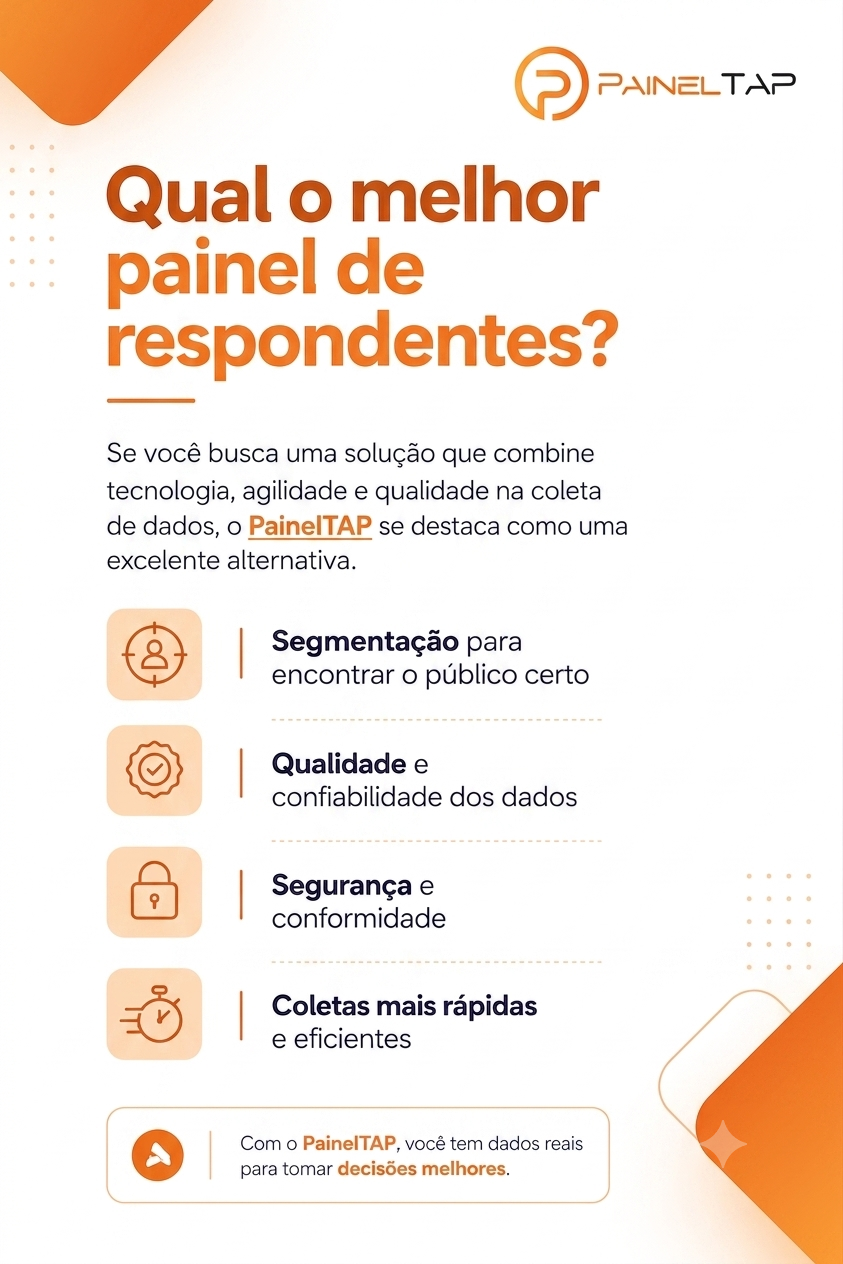
Segmentation to find the right audience
Not every survey seeks the same participant profile. Therefore, PainelTAP offers different segmentation criteria, allowing specific audiences to be reached according to demographic, geographic, socioeconomic, and behavioral characteristics.
This makes the sample more aligned with the research objectives and contributes to more relevant results.
Data quality and reliability
PainelTAP adopts validation and quality control mechanisms to ensure that the collected responses are consistent and reliable. This process helps reduce fraud, duplications, and inappropriate participations, increasing the methodological security of the studies.
Security and compliance
Data protection is a fundamental aspect of any research. PainelTAP holds Cyber Certificate, Consumer Certificate, and LGPD Certificate, demonstrating its commitment to information security, privacy, and good governance practices.
Faster and more efficient collections
By using an active respondent base, our panel allows projects to start quickly and accelerates the recruitment process, helping researchers meet deadlines without sacrificing sample quality.
Find the right respondents for your research
The quality of a survey begins with the quality of the sample. With PainelTAP, you find qualified respondents, segment the audience according to your study's objectives, and monitor data collection with greater agility and security.
Whether for market research, concept testing, satisfaction studies, or opinion polls, our panel helps connect your research to the right people.
Request a quote and discover how PainelTAP can make your next data collection faster, more reliable, and more efficient.