Respondent Panel: A Complete Guide for Businesses and Researchers
26 min read

In an increasingly data-driven market, making decisions based on real consumer opinions has ceased to be a differentiator and has become a necessity. It is in this context that the respondent panel stands out as one of the main tools for companies and researchers seeking to collect information quickly, scalably, and reliably.
But after all, what is a respondent panel? How does it work in practice? What are its advantages, challenges, and quality criteria? Understanding these points is fundamental to ensuring consistent results and research that truly supports decision-making.
In this complete guide, you will discover everything about respondent panels: from basic concepts to best practices for selecting participants, increasing data quality, and choosing the most suitable solution for each type of research.
What is a respondent panel?
A respondent panel is a structured database of people who have agreed to participate in surveys and provide opinions on different topics, products, services, or consumer behaviors. These participants are pre-registered and can be segmented according to specific characteristics, such as age, gender, location, income, profession, purchasing habits, and various other criteria.
In practice, the panel functions as a community of people available to answer questionnaires, allowing companies and researchers to quickly find the target audience needed for their studies. Instead of starting a new recruitment process for each survey, it is possible to access an already qualified audience, reducing time, costs, and operational effort.
How does a respondent panel work?
The operation of a respondent panel involves combining technology, recruitment, and participant management to connect companies and researchers with the ideal audience for each study. The goal is to make data collection faster, more efficient, and more reliable, eliminating the need to recruit respondents from scratch for each new survey.
It all starts with participant recruitment. Interested individuals register with the panel and provide information about their demographic, socioeconomic, professional, and behavioral profiles. This data is stored and updated periodically, allowing respondents to be classified into different segments.
When a company or researcher wants to conduct a study, specific criteria are defined for the sample, such as age group, gender, geographic region, income level, or consumption habits. Based on these filters, the system identifies participants who fit the desired profile and sends invitations to participate in the survey.
After receiving the invitation, the respondent accesses the questionnaire and answers the questions according to their experience, opinion, or behavior. In many cases, before starting the main survey, the participant goes through a qualification stage to confirm that they truly meet the requirements defined for the study.
Throughout the process, respondent panel platforms use quality control mechanisms to ensure the reliability of the collected data. These controls may include verifying response consistency, identifying very fast completions, detecting duplicate responses, and monitoring for potential fraud.
After the necessary number of responses is reached, the data is consolidated and made available for analysis. From this information, companies and researchers can identify trends, validate hypotheses, understand behaviors, and make evidence-based decisions.
Who uses respondent panels?
Thanks to the ease of access to different participant profiles, respondent panels have gained increasing prominence among different audiences, especially those who need to make data-driven decisions, such as:
Companies and brands
Currently, companies of all sizes use respondent panels to better understand their consumers and monitor market changes. In this context, through surveys conducted with these participants, it is possible to assess customer satisfaction, test new products, measure brand perception, identify growth opportunities, and, consequently, support more assertive strategic decisions.
Furthermore, panels allow for quick feedback on advertising campaigns, shopping experiences, and innovation initiatives. This way, companies can reduce risks before making large investments and increase the chances of success of their strategies.
Research institutes
Similarly, research institutes are among the largest users of respondent panels. This is because these organizations use these databases to conduct large-scale quantitative studies, opinion polls, consumer behavior analyses, and market surveys for clients in different sectors.
Moreover, the possibility of segmenting participants by specific criteria, such as age, location, consumption habits, and socioeconomic profile, makes panels an essential tool. Thus, it is possible to ensure samples that are more appropriate to the objectives of each study and obtain more reliable results.
Universities and academic researchers
In academia, researchers and educational institutions also use respondent panels to collect data for scientific papers, dissertations, theses, and academic projects.
In this sense, facilitated access to participants helps accelerate information collection and, at the same time, expands the possibilities of conducting studies in various areas of knowledge. With this, researchers can develop more complete analyses based on real data.
Customer Experience (CX) teams
Another audience that widely uses respondent panels are Customer Experience (CX) teams. These professionals resort to these tools to understand customers' perception of products, services, and service journeys.
From this information, the collected data helps identify areas for improvement, increase consumer satisfaction, and strengthen relationships with the public. Consequently, companies can create experiences more aligned with customer expectations.
Marketing teams
In addition to CX areas, marketing teams also use surveys with respondent panels to evaluate campaigns, analyze consumption trends, understand target audience preferences, and test concepts before launching new products or services.
In this way, these insights allow for the creation of strategies more aligned with consumer needs and increase the effectiveness of communication actions. Thus, marketing can reduce uncertainties and make decisions with greater security.
Technology and product development companies
Similarly, organizations that develop digital products, applications, and platforms use respondent panels to validate functionalities, test user experiences, and collect feedback during different stages of development.
With this, these companies can identify possible improvements during the creation process. Furthermore, this practice contributes to developing solutions that are more aligned with user needs and reducing failures before launch.
Public bodies and non-profit organizations
Finally, governments, public entities, and third-sector organizations also use respondent panels to understand public opinion, evaluate programs, measure social impacts, and support the formulation of data-driven public policies.
In this scenario, panels enable a broader view of society's needs and help these organizations develop more efficient initiatives. Thus, important decisions can be made considering the real perceptions of the different groups involved.
What is the difference between a respondent panel and traditional recruitment?
When planning a survey, one of the first decisions involves how participants will be found. In this context, many companies and researchers are faced with two alternatives: using a respondent panel or conducting traditional recruitment. Although both aim to gather people to participate in studies, there are important differences between these approaches.
Respondent panel: participants already available
In a respondent panel, participants are already registered in a database and have expressed interest in participating in surveys. Furthermore, their profiles usually contain demographic, behavioral, and socioeconomic information that allows for more precise segmentation.
When a new survey is created, it is enough to define the desired criteria for the platform to identify and invite the most suitable participants. This makes the process faster and more efficient, especially in studies that require a large volume of responses or specific audiences.
Traditional recruitment: active search for participants
In traditional recruitment, participants are found specifically for each survey. Recruitment can occur through social media, email, phone, referrals, events, in-person approaches, or other dissemination strategies.
As there is no previously structured database, each new study requires additional effort to locate, qualify, and select participants. Depending on the profile sought, this stage can consume a significant portion of the survey's time and budget.
Main differences
The main difference between the two models lies in the availability of participants. While the respondent panel offers immediate access to an already registered database, traditional recruitment requires building the sample from scratch.
Another important difference is speed. Panels allow data collection to start quickly, while traditional recruitment can take days or even weeks to gather the necessary number of participants.
Segmentation is also usually simpler in respondent panels. As profiles are already registered, it is possible to select participants with specific characteristics automatically. In traditional recruitment, this identification usually happens during the screening process.
How do participants join a panel?
The quality of a respondent panel begins with the recruitment process. For the collected data to be reliable and representative, it is essential that participants are selected and registered through structured methods that ensure diversity of profiles and updated information.
In general, participants join a respondent panel voluntarily. They register on a platform, fill in information about their profile, and express interest in participating in future surveys. From that moment on, they become part of the respondent database available to companies and researchers.
Initial registration
The first step is filling out a registration form. At this stage, participants provide information such as age, gender, location, education, profession, income, and other data relevant for survey segmentation.
Depending on the panel, information related to consumption habits, digital behavior, purchasing preferences, product use, and specific interests may also be collected.
Qualification process
After registration, many panels perform a validation step to verify the quality of the information provided. The objective is to reduce fraud, avoid duplicate profiles, and ensure that participants are real people.
Some platforms use email, phone, document confirmations, or automated verification systems to increase the reliability of the database.
Profile update
Participant profiles do not remain static. As habits, income, profession, and other aspects can change over time, the most robust panels periodically update registration information.
This process helps keep the database updated and increases the accuracy of the segmentation used in surveys.
Survey invitations
Once registered and qualified, participants begin to receive invitations for surveys compatible with their profile. Not all respondents are invited to all studies. The selection depends on the criteria defined by each survey, such as age group, geographic location, professional occupation, or consumption behavior.
When the participant meets the study requirements, they can answer the questionnaire and contribute their opinions and experiences.
Participation incentives
Many panels offer incentives to encourage respondent engagement. These benefits may include points, rewards, credits, gift cards, or participation in benefit programs.
In addition to increasing the response rate, incentives help keep participants active and contribute to the constant renewal of the database.
Continuous quality control
Joining a panel does not guarantee permanent participation. Professional platforms continuously monitor respondent behavior to identify inconsistent responses, inadequate completions, or suspicious activities.
Participants who do not follow the quality criteria may be suspended or removed from the database, contributing to the maintenance of a more reliable panel with higher data quality.
How does participant recruitment work?
A well-structured recruitment process helps ensure diversity of profiles, greater representativeness, and more reliable data for companies and researchers. Therefore, a good panel works in stages, such as:
Recruitment channels
Participants can be recruited through various channels, depending on the strategy adopted by the platform. Among the most common are:
- Social media campaigns.
- Ads on websites and search engines.
- Email invitations.
- Referral programs.
- Partnerships with companies and communities.
- Applications and digital platforms.
- Proprietary user bases.
The use of multiple channels contributes to the formation of a more diverse base and reduces the risk of excessive concentration in certain profiles.
Registration and information collection
After expressing interest in participating, the potential respondent goes through a registration stage. At this point, information is collected that will help define their profile within the panel.
Data may include:
- Age.
- Gender.
- Location.
- Education.
- Profession.
- Income bracket.
- Consumption habits.
- Use of products and services.
- Interests and behaviors.
This information is fundamental for participants to be selected for surveys compatible with their characteristics.
Screening and Qualification
Not every registration is automatically approved. Many panels conduct screening processes to verify the consistency of the information provided and identify possible irregularities.
This step may include email validation, phone confirmation, analysis of duplicate registrations, and automated checks to detect fraudulent profiles or inconsistent responses.
The goal is to ensure that the database is composed of real and qualified participants.
Respondent Segmentation
Once approved, participants are organized into different segments. This segmentation allows companies and researchers to quickly find specific audiences for their studies.
For example, a survey might require women between 25 and 40 years old who have made online purchases in the last six months. With a well-structured panel, these participants can be identified and invited quickly and accurately.
Engagement and Retention
Recruitment does not end after registration. To maintain panel quality, continuous participation from respondents must be encouraged.
Therefore, many platforms invest in relationship strategies, frequent communication, reward programs, and periodic profile updates. These actions help keep the base active and reduce participant loss over time.
Quality Monitoring
An efficient recruitment process also includes continuous monitoring. Panel managers track indicators such as response rate, information consistency, participation frequency, and the quality of responses provided.
This monitoring helps identify inappropriate behaviors and maintain a more reliable base for future research.
How are respondents validated?
Participant validation is a fundamental step to ensure the quality of a respondent panel. Without verification mechanisms, there is a risk of including fake profiles, duplicate registrations, or participants who provide incorrect information, compromising the reliability of research results.
Therefore, professional platforms adopt different validation processes to confirm the identity of respondents and maintain a more secure and qualified participant base.
CPF Validation
One of the most effective forms of validation is the use of CPF (Brazilian individual taxpayer registry identification). During registration, the participant provides their document number, which can be verified to confirm its authenticity and prevent duplicate registrations.
This process helps ensure that each person has only one account on the panel, reducing fraud attempts and increasing sample quality. Furthermore, CPF validation contributes to the identification of real participants, making the collected data more reliable.
Email and Phone Confirmation
Another common procedure is the validation of contact details. After registration, the participant receives a confirmation code or link via email or SMS.
This step verifies if the provided information is valid and if there is a real person behind the registration.
Duplicity Verification
Research platforms also use systems to identify duplicate registrations. In addition to CPF, data such as email address, phone number, device used, and other identifiers can be analyzed.
The objective is to prevent the same person from participating multiple times in the same survey or maintaining multiple accounts to obtain undue benefits.
Information Consistency
During the registration process and throughout participation in surveys, the information provided by respondents can be compared to identify inconsistencies.
For example, if a participant provides one age during registration and a completely different one in subsequent surveys, the system can flag the profile for review.
Behavior Monitoring
Validation does not only happen at the time of registration. The most robust panels continuously monitor respondent behavior to identify suspicious patterns.
Among the analyzed signs are:
- Excessively fast responses.
- Repetitive or random responses.
- Excessive participation in a short period.
- Inconsistencies between surveys.
- Attempts to circumvent qualification criteria.
What are the types of respondent panels?
Not all studies seek to hear the same audience. While some research needs to understand the behavior of end consumers, others depend on the opinion of professionals, executives, doctors, or highly specialized audiences. Therefore, there are different types of respondent panels, each developed to meet specific research objectives. Let's see what the most common ones are?
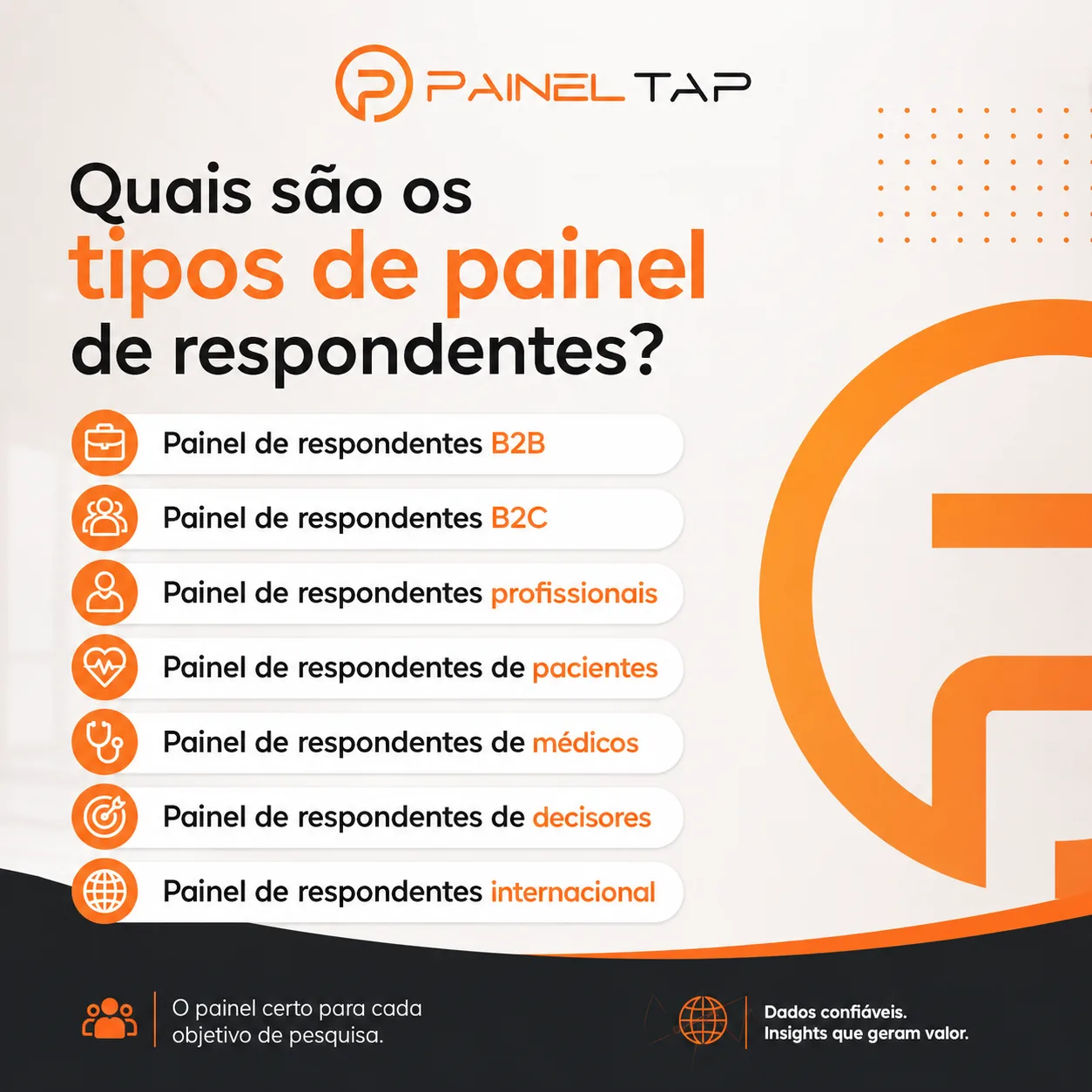
B2B Respondent Panel
The B2B respondent panel (Business to Business) is composed of professionals who work in companies and organizations. This type of panel is used in research aimed at the corporate market, allowing the collection of information about processes, technologies, suppliers, trends, and challenges faced by companies.
Depending on the study's objective, participants may hold different positions and hierarchical levels, from analysts and coordinators to managers, directors, and executives.
B2C Respondent Panel
The B2C respondent panel (Business to Consumer) gathers end consumers who use products and services daily. It is one of the most common types of panels and is widely used in market research, customer satisfaction, concept testing, and brand evaluation.
Through this panel, companies can understand preferences, consumption habits, purchase intentions, and public perceptions regarding products and services.
Professional Respondent Panel
The professional respondent panel is formed by people who perform a specific activity or profession. Participants may belong to specific sectors, such as technology, human resources, finance, engineering, education, or marketing.
This model is especially useful when the research requires technical knowledge or practical experience on a particular topic.
Patient Respondent Panel
The patient respondent panel gathers people who live with certain health conditions or who have undergone specific treatments. This type of panel is frequently used in pharmaceutical industry research, clinical studies, patient experience evaluations, and health-related projects.
The recruitment and validation of participants usually follow strict criteria to ensure the quality of the information collected.
Doctor Respondent Panel
The doctor respondent panel is composed of healthcare professionals, including general practitioners, specialists, surgeons, and other medical professionals.
This type of panel is widely used by pharmaceutical companies, research institutions, hospitals, and healthcare organizations that need to understand clinical trends, medical practices, drug use, and perceptions about treatments and technologies.
Decision-Maker Respondent Panel
The decision-maker respondent panel gathers professionals who have direct influence or responsibility for decision-making within organizations. These may include CEOs, directors, partners, presidents, managers, and leaders of strategic areas.
As this audience is often more difficult to access, specialized decision-maker panels have more rigorous recruitment and validation processes. They are frequently used in B2B research, market studies, and corporate trend evaluations.
International Respondent Panel
The international respondent panel allows access to participants from different countries and regions around the world. This type of panel is ideal for global companies, multinational research institutes, and organizations that want to compare behaviors, opinions, and trends across different markets.
In addition to expanding the geographical reach of research, international panels enable multicultural studies and comparative analyses between different profiles of consumers, professionals, and decision-makers.
When is it worth using a respondent panel?
Generally, it is worth using a respondent panel when there is a need to access specific audiences quickly, without relying on lengthy recruitment processes. Since participants are already registered and qualified, data collection usually happens in a much shorter time frame compared to traditional methods.
When speed is a priority
In many projects, the time available for data collection is limited. Product launches, campaign tests, concept validations, and strategic decisions frequently require quick responses.
In these cases, a respondent panel allows research to start immediately and obtain results in a few days or even hours, depending on the sample size and the requested profile.
When it is necessary to reach specific audiences
Some research requires participants with very particular characteristics, such as professionals from certain areas, consumers of a specific category, doctors, patients, or decision-makers.
Finding these profiles through traditional recruitment can be complex and time-consuming. With a respondent panel, segmentation is already available, facilitating the identification and invitation of suitable participants.
When research needs scale
Projects that require hundreds or thousands of responses also benefit from panels. Since there is an active base of participants, it is possible to achieve high volumes of collection without the need to mobilize large recruitment teams.
This scalability makes panels especially useful for market research, satisfaction studies, brand monitoring, and quantitative surveys.
When there is a need to reduce operational costs
Participant recruitment often represents a significant portion of a research budget. Since panels already have a structured base of respondents, many of the costs related to finding and qualifying participants are reduced.
This allows research to be conducted with greater operational efficiency and better use of available resources.
When recurring research is needed
Companies that continuously track indicators, such as customer satisfaction, brand perception, or consumer behavior, can greatly benefit from using respondent panels.
The constant availability of participants facilitates the execution of recurring studies and contributes to the construction of more consistent historical series.
When the focus is on online research
Respondent panels are especially effective in digital research. Online questionnaires, concept tests, product evaluations, opinion surveys, and behavior studies can be conducted quickly and efficiently using this methodology.
When other approaches may be more suitable
Although panels offer several advantages, there are situations where other methodologies may be more appropriate. Studies requiring specific probabilistic sampling, complex in-person interviews, or extremely difficult-to-identify audiences may demand complementary recruitment strategies.
What research can be done from the respondent panel
Versatility is one of the main advantages of a respondent panel. As it allows quick and segmented access to different participant profiles, this methodology can be used in various types of studies, from market research to academic projects and user experience analyses.
Below, learn about some of the main research that can be carried out with the support of a respondent panel.
Market Research
Market research is among the most common applications of respondent panels. They help companies understand trends, identify opportunities, monitor changes in consumer behavior, and assess market competitiveness.
The collected data serves as a basis for strategic decisions related to products, services, positioning, and business expansion.
Concept Testing
Before investing in the development of a new product, service, or campaign, many companies conduct concept tests to evaluate the idea's receptiveness among the target audience.
Through a respondent panel, it is possible to obtain quick feedback on proposals, messages, functionalities, and differentiators, reducing risks and increasing the chances of a successful launch.
Product Testing
Product tests allow evaluating consumers' perception of characteristics such as quality, usability, design, functionalities, and overall satisfaction.
This type of research helps identify improvement opportunities before launch or during the product's lifecycle.
Pricing Research
Defining the ideal price for a product or service is a challenge for many companies. Pricing research helps understand consumers' willingness to buy, identify acceptable value ranges, and assess market sensitivity to price changes.
With a respondent panel, it is possible to conduct these studies with different audience segments and obtain valuable information for pricing strategies.

Branding Studies
Branding studies aim to evaluate the market's perception of a brand. These studies can measure recognition, recall, reputation, attributes associated with the brand, and competitive positioning.
The results help companies strengthen their identity and direct investments in communication and marketing.
Electoral Surveys
Respondent panels can also be used in electoral surveys, provided that the methodology adopted is appropriate for the study's objectives and applicable regulatory requirements.
These surveys allow for the analysis of voting intentions, perceptions of candidates, government evaluations, and topics of public interest, contributing to an understanding of the political landscape.
Academic research
Universities, research centers, and independent researchers use respondent panels to collect data for scientific papers, dissertations, theses, and investigation projects.
Facilitated access to participants speeds up information collection and expands the reach of studies.
UX Research
UX Research (User Experience Research) seeks to understand how people interact with digital products, applications, websites, and systems.
Through a respondent panel, researchers can recruit users with specific profiles to evaluate journeys, test functionalities, identify navigation difficulties, and understand expectations regarding the offered experience.
Customer Experience (CX)
Customer Experience (CX) surveys help companies understand how customers perceive their experience throughout their relationship journey with the brand.
With a respondent panel, it is possible to measure satisfaction, identify friction points, evaluate service, analyze loyalty, and understand factors that influence the consumer experience.
What segmentations does a respondent panel offer?
One of the main advantages of a respondent panel is the possibility of segmenting participants according to different characteristics. This segmentation allows companies and researchers to find people with specific profiles, increasing the relevance of the data collected and ensuring that the research is directed to the most appropriate audience. Many attributes can be segmented, such as:
Age
Age segmentation allows directing research to different generations and life stages. This criterion is essential for studies that seek to understand differences in behavior, preferences, and needs among age groups.
For example, a survey on digital habits may require young participants, while a study on financial planning may need to analyze different age groups to compare behaviors.
Region
Geographic segmentation allows selecting respondents according to location, such as country, state, city, or region.
This type of filter is important for research that analyzes cultural differences, regional consumption habits, brand perception, or specific behaviors of certain markets. In international studies, regional segmentation also makes it possible to compare opinions and trends between different countries.
Profession
Profession segmentation allows access to audiences with specific experiences and knowledge. This criterion is especially relevant in B2B research, professional studies, and analyses that depend on technical knowledge.
Through this segmentation, it is possible to find professionals from specific areas as well as strategic positions, such as managers, directors, and decision-makers.
Habits
Habit segmentation considers participants' behaviors and routines, such as purchase frequency, use of certain products, media consumption, preferences for shopping channels, and daily activities.
This type of filter helps companies find consumers who are truly related to the research topic, making the responses more relevant.
Behavior
Behavioral segmentation analyzes how participants act, make decisions, and relate to brands, products, and services. Aspects such as purchase intention, brand loyalty, consumption journey, preferences, needs, and motivations can be evaluated.
This segmentation is widely used in market research, concept testing, and customer experience studies.
Income
Income segmentation allows analyzing different economic groups and understanding how purchasing power influences opinions, choices, and behaviors.
This criterion is important in research related to price, consumption, premium products, financial services, and purchasing decisions.
Other segmentation possibilities
In addition to these criteria, many respondent panels offer additional segmentations, such as:
- Education level.
- Marital status.
- Family size.
- Personal interests.
- Use of products and services.
- Consumer profile.
- Devices used.
- Brand preferences.
- Lifestyle.
The combination of different criteria allows creating highly targeted samples and finding exactly the profile needed for each survey.
Frequently asked questions about respondent panels: clear your doubts

How long does it take to recruit participants?
Generally, the time to recruit participants depends on different factors, such as the required sample size, the desired participant profile, and the complexity level of the research.
In already structured respondent panels, for example, data collection can begin quickly, as participants are already registered, classified, and segmented according to different characteristics. This way, companies can access specific audiences without having to start a recruitment process from scratch.
Furthermore, research aimed at broader audiences can be completed in a few days, as there is greater availability of participants compatible with the study's criteria. On the other hand, research requiring very specific profiles, such as professionals from certain sectors, consumers with well-defined characteristics, or niche audiences, may demand a longer recruitment period.
In this context, the availability of qualified participants becomes one of the main benefits of respondent panels compared to traditional recruitment methods. Thus, it is possible to reduce collection time, increase process efficiency, and obtain responses from people more aligned with the research objectives.
How much does it cost to use a panel?
The cost of using a respondent panel varies according to different factors, such as the number of participants, questionnaire size, sample profile, filter complexity, and market analyzed.
Research with more specific audiences usually has a higher cost, as it requires greater recruitment and segmentation effort. Studies with broader audiences generally have more accessible values.
Therefore, the investment should be evaluated considering not only the price but also the quality of the respondents, the reliability of the data, and the support offered by the platform.
Do respondents get paid?
Yes. Generally, many respondent panels offer incentives to participants as a form of recognition for their contribution to the research. These incentives are mainly used to value the time dedicated by respondents and encourage participation in new studies.
However, the reward formats may vary according to the platform, the participating audience, and the type of research conducted. Thus, each panel can define different incentive models according to its objectives and characteristics.
Among the most common options are cash payments, points that can be exchanged for benefits, credits, gift cards, or other reward formats. In addition, some platforms use scoring systems to encourage frequent participation and maintain an engaged respondent base.
Thus, incentives serve as a way to recognize the collaboration of participants and, at the same time, contribute to increasing commitment and the quality of responses collected during the research.
Are participant data protected?
Yes. Professional panels have data protection processes to ensure the security of participant information.
Measures such as access control, secure storage, data anonymization, and privacy policies help protect personal information and ensure that data is used exclusively for research-related purposes.
Furthermore, results are usually analyzed in an aggregated manner, without exposing the individual identity of respondents.
Do the panels follow LGPD?
In Brazil, respondent panels must follow the guidelines established by the General Data Protection Law (LGPD), which defines rules for the collection, storage, processing, and use of personal data. Thus, companies and platforms responsible for the panels need to adopt practices that ensure greater transparency and security in the use of participant information.
In this sense, it is essential to clearly inform respondents how their data will be used, what information will be collected, and for what purposes. In addition, when applicable, it is necessary to request participants' consent, allow privacy preference management, and implement security measures to prevent unauthorized access or any inappropriate use of data.
Similarly, companies that use respondent panels should carefully evaluate whether the chosen provider has well-defined privacy policies, compliance processes, and practices aligned with current legislation.
Thus, in addition to ensuring participant protection, compliance with the LGPD contributes to increasing trust in research, strengthening the credibility of companies, and ensuring that data collection is carried out ethically and responsibly.
How to choose a good panel provider?
The choice of a respondent panel provider should consider several factors beyond the size of the database. Some important criteria include:
- Participant quality: verify how respondents are recruited, validated, and monitored.
- Available segmentation: evaluate whether the platform offers the necessary filters to find the research's target audience.
- Quality control: understand what mechanisms are used to prevent fraud and inconsistent responses.
- Transparency: analyze how data collection and processing procedures are presented.
- Experience and support: consider the provider's ability to assist during research planning and execution.
- LGPD compliance: verify if adequate data protection policies exist.
What is the best respondent panel?
Currently, PainelTAP has been standing out as a solution for companies and researchers seeking to conduct research with more agility, efficiency, and quality. Through the platform, studies can be connected to a broad base of respondents, allowing different participant profiles to be found according to the objectives of each research.
Furthermore, with advanced segmentation features, PainelTAP makes it possible to direct research considering characteristics such as age, region, habits, behavior, and other relevant criteria for each study. This way, companies can collect opinions from people truly aligned with the audience they wish to understand, increasing the relevance and quality of the insights obtained.
Another important point is the ease of access to respondents, which makes the collection process simpler, faster, and more efficient. With this, market research, concept testing, customer experience studies, satisfaction surveys, and various other formats can be carried out in less time, supporting decisions with greater agility.
However, in addition to the number of available participants, the quality of the respondent base also plays a fundamental role. For this reason, validation and monitoring processes are essential to ensure more reliable responses and generate results that truly contribute to strategic decisions.
In this context, when choosing a respondent panel, it is important to look for a platform that combines technology, segmentation, security, and data quality. Thus, PainelTAP presents itself as an alternative for companies and researchers who want to transform real opinions into relevant insights and use this information to make more assertive decisions.
Want to understand how PainelTAP can help your research? Schedule a demonstration!