B2C Demographic Segmentation: When and How to Apply It
6 min read

B2C demographic segmentation is, without a doubt, one of the pillars for understanding consumer behavior and making more strategic decisions in any business that deals directly with the end consumer. More than just grouping by age or gender, this segmentation allows for analyzing how different profiles react to products, campaigns, and experiences, and this directly impacts a brand's success.
Throughout this article, you will understand what B2C demographic segmentation is, and discover why it is essential for market research. Finally, we will show you how to apply it in practice to generate truly valuable insights.
What is B2C demographic segmentation?
Simply put, B2C demographic segmentation consists of dividing the consumer public based on objective and measurable characteristics. This data is usually obtained through forms, databases, or research panels, and covers attributes such as:
-
Age group
-
Gender
-
Education level
-
Marital status
-
Occupation
-
Monthly income
-
Geographic location
By identifying these profiles, companies can better direct their marketing strategies, as well as adjust products more precisely and develop campaigns that truly connect with the needs and expectations of each group. Consequently, this approach makes actions much more assertive and significantly increases the chances of engagement and conversion.
Learn more: B2C sample – What characterizes a well-segmented sample?
Why apply it in market research?
In market research, B2C demographic segmentation allows going beyond the general average of the data. Through this approach, it is possible to identify distinct behaviors among groups, detect relevant patterns, anticipate consumption trends, and reduce risks before launching new products or making strategic decisions.
To illustrate, imagine your company conducts a customer satisfaction survey. If you only consider the total result, the analysis will be superficial and may hide important nuances. On the other hand, by cross-referencing the data with demographic variables such as age group and income, you may notice, for example, that younger customers with lower purchasing power show lower satisfaction levels.
This type of insight, which guides specific and assertive improvements, only becomes visible when there is a well-structured segmentation. In other words, correct segmentation is what transforms a generic reading into a strategic and actionable analysis.
Furthermore, this approach allows for:
-
Selecting more representative samples;
-
Customizing questionnaires according to the respondent's profile;
-
Comparing responses by groups with greater precision;
-
Delivering reports richer in insights.
Read more: Difference between population and sample in market research
How to apply B2C demographic segmentation in market research?
Now that you understand its importance, let's go through the step-by-step process of how to efficiently apply B2C demographic segmentation in a research project.
1. Clearly define the objectives
Every research begins with a central question. Do you want to understand interest in a new product? Evaluate the impact of a campaign? Measure brand loyalty? By being clear about the objectives, you will know which demographic variables are truly relevant to collect.
2. Select the most strategic demographic criteria
It is not always necessary to collect all information. Choose those that will make a difference in the analysis. For example:
-
Products aimed at young audiences: prioritize age and lifestyle.
-
Premium services: highlight income and geographic location.
-
Family products: marital status and number of children can be essential.
3. Assemble or hire a representative sample
It is fundamental to ensure that the sample represents the actual target audience of your business. For this, having a segmented B2C panel is the most practical and secure way. Panels allow you to select respondents according to the desired criteria and ensure the quality of the data.
4. Customize questionnaires by profile
B2C demographic segmentation can also be used to adapt the language or response options in a questionnaire. This improves the response rate and increases the quality of the data collected.
5. Analyze data separately by group
After collecting the data, the great value lies in the analysis. Separate the results by age group, region, or other relevant criteria and look for patterns, similarities, and contrasts. This step will reveal actionable insights for your business strategies.
Another article worth reading: Market research with an online respondent panel
Practical examples of using B2C demographic segmentation
To make everything clearer, here are two examples of applying B2C demographic segmentation in real research projects:
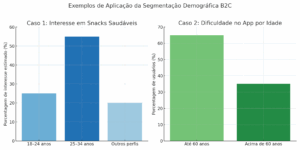
Here is the graph with two examples of applying B2C demographic segmentation:
-
Case 1 shows that women between 25 and 34 years old have the highest interest in healthy snacks.
-
Case 2 reveals that users over 60 years old face more difficulties with the service company's app, justifying a change in the service channel.
Extra tip: combine demographic segmentation with other types
Although B2C demographic segmentation is a powerful tool on its own, its analytical potential grows exponentially when combined with other forms of segmentation. By cross-referencing different criteria, you gain a much richer and more precise view of your audience, essential for truly effective strategies.
See how different approaches can complement B2C demographic segmentation:
● Behavioral segmentation
In addition to knowing who your consumer is, it's important to understand how they behave. Behavioral segmentation takes into account purchasing habits, frequency of use, loyalty level, and even price sensitivity. By cross-referencing this data with demographic profiles (e.g., age + purchase frequency), it is possible to identify patterns that help predict future behaviors.
● Psychographic segmentation
While demographics reveal objective data, psychographic segmentation delves into subjective aspects: values, lifestyle, motivations, interests, and attitudes. For example, two 35-year-old women, with the same income and education, can have completely different behaviors if one prioritizes sustainability and the other values practicality above all else. When we combine B2C demographic segmentation with psychographic segmentation, we can create more authentic and relevant messages.
● Geographic segmentation
In addition to personal factors, location also strongly influences purchasing decisions. This is because different cities present very distinct economic, cultural, and logistical contexts. For this reason, by considering variables such as state, city, climate, or urban/rural area, and integrating them into B2C demographic segmentation, it is possible to adapt regional campaigns and adjust products in a way that is more aligned with the local reality.
Therefore, instead of analyzing these approaches in isolation, think of segmentation as an integrated system. The cross-referencing of demographic, behavioral, psychographic, and geographic data allows for identifying specific high-value niches, understanding variations within the audience, and refining your decision-making based on reliable and contextualized data.
B2C demographic segmentation as a strategic tool
Correctly applying B2C demographic segmentation in market research allows companies to make smarter decisions, reduce risks, and develop more personalized and effective strategies. Furthermore, it is a simple, direct approach with high potential for return.
Therefore, if the goal is to conduct research with a focus on segmentation, the first step is to rely on segmented panels and qualified samples. In this regard, Painel TAP offers exactly what you need: agility in execution, data precision, and valuable insights that guide safer decisions aligned with your audience.
Read also: Demographic segments. How to calculate the ideal target audience?