How to segment your audience in consumer panels
5 min read
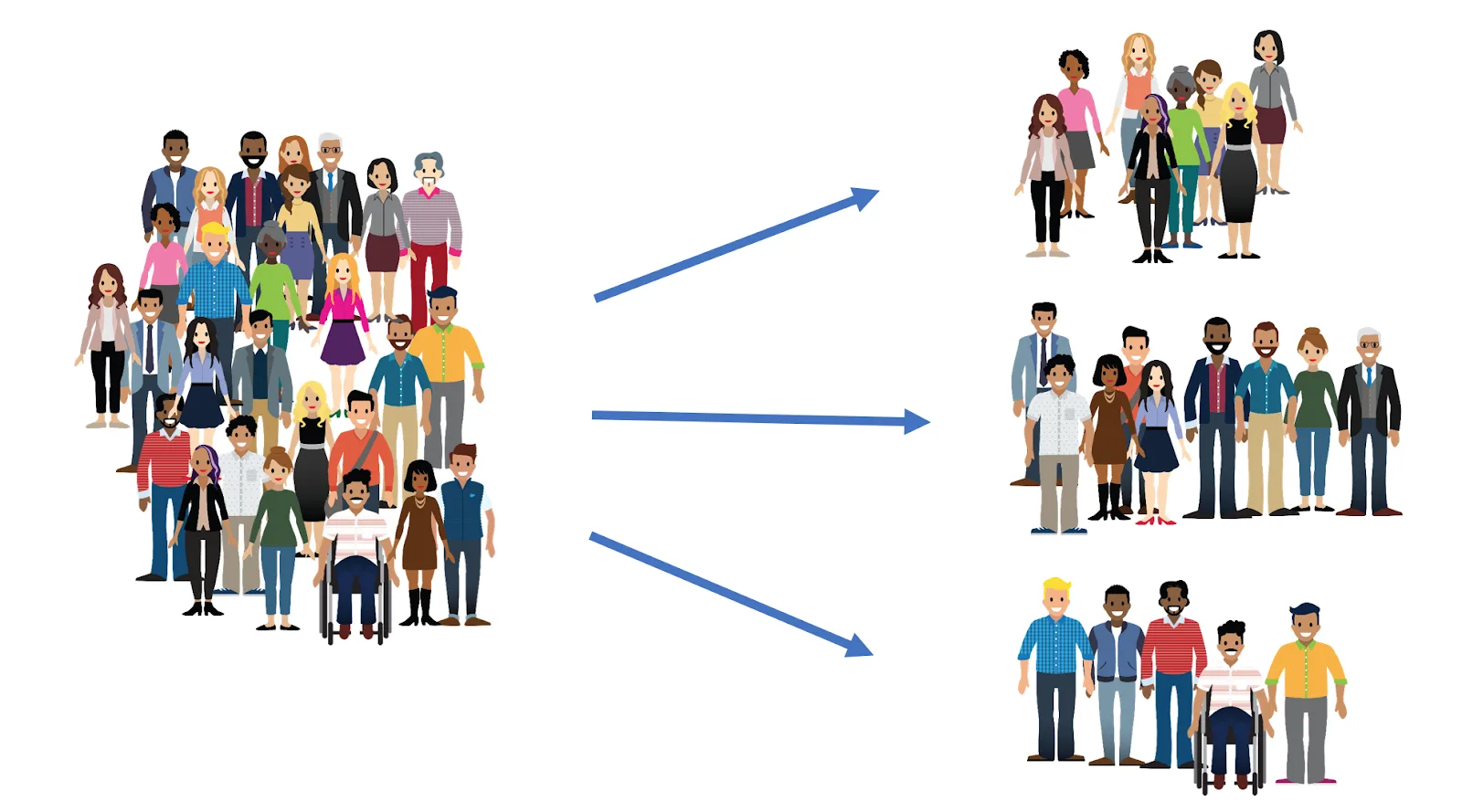
Learn how to apply smart segmentation in consumer panels to ensure qualified samples, increase the efficiency of your data collection, and consequently, make decisions based on real insights.
Currently, in a data-driven market, it's not enough to simply collect information. It is essential to ensure that this data comes from the right people, that is, from profiles aligned with your research objective. In this context, segmentation in consumer panels emerges as an indispensable step to increase the accuracy, relevance, and, above all, the efficiency of your investigations.
Therefore, in this article, you will understand how to correctly segment your audience in online panels. Throughout the content, we will explore best practices, highlight the most common mistakes, and present practical tips that can, in fact, significantly elevate the quality of your samples.
What is segmentation in consumer panels?
Segmentation is, first and foremost, dividing. In the context of consumer panels, this means carefully filtering research participants based on specific characteristics that are directly related to the data collection objectives.
Among these characteristics, we can highlight, for example:
-
Demographic data, such as age, gender, region, and education;
-
Consumption habits, including purchase frequency, preferred channels, and types of products consumed;
-
Professional profile, considering position, industry, and years of experience;
-
Digital behaviors, such as app usage, social media, and online preferences;
-
Lifestyle, values, and opinions, which reveal more subjective but equally important motivations.
Thus, well-executed segmentation allows for the construction of truly representative samples. As a result, it is possible to obtain deeper insights and make significantly more assertive decisions. Ultimately, it is segmentation that transforms raw data into strategic information, capable of guiding concrete and effective business actions.
Read more at: How to Define Target Audience: Essential step in the success of your market research
Why is segmentation fundamental?
Segmentation ensures that your sample accurately represents the audience you want to analyze. Without it, you run the risk of making decisions based on generic or biased data.
Furthermore, with well-defined segmentation, you:
- Reduce wasted time and resources
- Increase survey response rate
- Obtain more actionable insights
- Ensure greater assertiveness for campaigns, launches, and brand positioning
- Avoid data noise and improve analysis quality
In other words, segmentation is what ensures you are listening to the right people to answer the right questions.
How to correctly segment your audience
1. Start with a clear and well-defined brief
The first step is to deeply understand what the research aims to achieve. What business problem do you want to solve? What decision needs to be made? From these answers, you define who are the people who truly need to be heard.
A well-prepared brief is the foundation of good segmentation. It guides the choice of filters and ensures that all subsequent stages of the research are aligned with your ultimate goal.
2. Use smart filters
The best consumer panels have advanced segmentation tools, with cross-filters that help identify profiles highly aligned with your target audience. The more precise the filters, the more reliable your sample will be.
Panels like those from Painel TAP allow, for example, to apply complex segmentations combining demographic, behavioral, and lifestyle data. This expands the potential for personalization of data collection and increases the relevance of the results obtained.
3. Invest in data validation
It's not enough to apply filters. It is essential to validate the information provided by respondents. Serious panels have continuous verification mechanisms, such as trap questions, response consistency, and data quality algorithms.
This process reduces fraud, increases sample reliability, and ensures that insights are extracted from legitimate and representative responses.
4. Avoid over-segmenting
A common mistake is wanting to be so precise that you create a practically unattainable audience. Balance is key: segment enough to obtain relevant data, but maintain a viable sample in terms of size and collection time.
Overly restrictive segmentations make the operation more expensive, delay data delivery, and do not always bring proportional gains in quality. The ideal is to find the optimal point between precision and breadth.
5. Count on a specialized partner
Working with experienced suppliers in consumer panels makes all the difference. They can help build the segmentation strategy, suggest filters, and ensure execution aligned with your objectives.
Painel TAP, for example, offers consulting support from research planning to data analysis. With access to B2C, B2B, and decision-maker panels, the company operates with cutting-edge technology, information security, and highly qualifiable data.
Continue reading at: Examples of target audience for research with online respondent panels
The differential lies in applied intelligence
Precise segmentation is not just a technical matter – it's strategic. The more you understand your audience, the more power of anticipation and personalization you gain.
Modern consumer panels, like those from Painel TAP, combine technology, behavioral data, and artificial intelligence to deliver exactly that: highly segmentable profiles, ready to generate fast and reliable insights.
Furthermore, Painel TAP maintains a robust quality ecosystem, with checking algorithms and continuous updating of the participant base, ensuring that the collected data is always in compliance with each client's research objectives.
Practical cases: how the right segmentation changes the game
- A cosmetics company wanted to understand the consumption habits of women between 25 and 35 years old, with an income above R$ 5 thousand and who consume vegan products. With Painel TAP's filters, they obtained the ideal sample in 48 hours.
- A digital bank needed to test the perception of a new product among self-employed professionals in the Southeast. Using cross-criteria of occupation, location, and digital behavior, they obtained insights that led to crucial adjustments before launch.
These are just two examples of how correct segmentation avoids waste, saves time, and generates much more assertive results.
Need research with a sample from an online panel? Count on Painel TAP.
Behind Painel TAP is a team passionate about data and insight generation, who finds in each project a challenge to seek the best and fastest solution for the most diverse types of needs and demands in online research and market investigation.