Difference between population and sample in market research
5 min read

Understanding the difference between population and sample is essential for obtaining reliable results in market research. These two concepts guide everything from defining the audience to data collection. In this article, you will learn what each term means, how to apply them in practice, and why the correct choice directly influences the quality of your research.
What is a population in research?
In market research, you need to know who you want to study. The population represents this complete group: people, companies, or elements that share a common characteristic and are relevant to your analysis.
For example, if your company sells sportswear and wants to understand consumer behavior, your population might include all physical activity practitioners in Brazil. In a B2B study, the population might consist of all gyms in the city.
You can work with finite populations, when you know the total number of elements, or infinite populations, when the group is very large or constantly changing. Additionally, the numerical characteristic that describes the population is called a parameter.
What is a sample?
It is not always feasible to survey the entire population. Therefore, you can select a sample, which is a smaller part that represents the total group. The sample allows you to collect data more quickly, at a lower cost and with reduced effort, without compromising the reliability of the results, provided it is well chosen.
Think of the sample as a “mini portrait” of the population. It carries the same essential characteristics and provides a solid basis for making decisions quickly and accurately. The information you extract from the sample is called a statistic.
Learn more here: How to Define a Research Sample: A Complete Guide
When to use population or sample?
You should choose between studying the entire population or using a sample based on criteria such as budget, available time, and desired degree of precision. See below in which situations each approach makes more sense:
Use the complete population when:
-
You are working with a small and accessible group;
-
Your study requires complete data, with no margin of error;
-
The research needs to follow legal requirements, such as official censuses.
Use a sample when:
-
The population is too large to be analyzed completely;
-
Resources (time, team, budget) are limited;
-
You need to get answers quickly and efficiently;
-
Market research requires agility without sacrificing reliability.
In summary, when you want breadth and total precision, consider working with the entire population. However, if you are looking for agility, practicality, and good cost-benefit, the sample is the best choice.
Check out more content like this: Response Sample – Maximize the Quality of Your Surveys
Difference between population and sample: how to ensure representativeness?
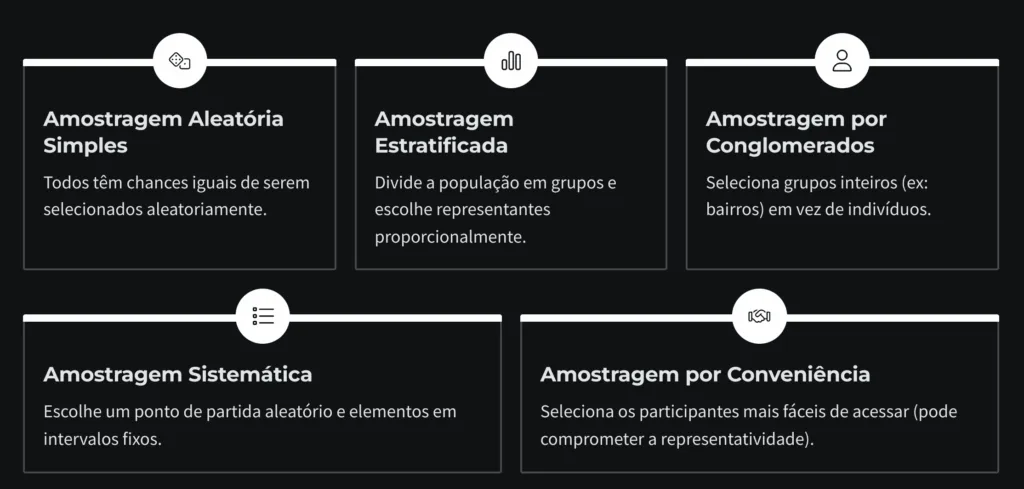
For research results to make sense, you need to ensure that your sample accurately represents the population. Therefore, the choice of sampling method is crucial. Below, see the main types:
Types of sampling:
-
Simple random sampling: you select participants completely randomly, giving equal chances to everyone.
-
Stratified sampling: you divide the population into groups with similar characteristics (such as age, location, gender) and choose representatives from each group proportionally.
-
Cluster sampling: you select entire groups (such as schools, neighborhoods, or companies) instead of isolated individuals.
-
Systematic sampling: you choose a random starting point and then select elements at fixed intervals.
-
Convenience sampling: you select the easiest participants to access — this option is fast, but can compromise representativeness.
By applying the correct method, you increase the quality of the sample and reduce the margin of error of the research.
Research with a sample of respondents. How to Conduct Effective Research
How to collect data from the sample?
Currently, you can collect data more efficiently through online questionnaires. This strategy allows you to reach people of different profiles, locations, and behaviors with ease. Furthermore, it is a scalable, accessible, and fast way to obtain answers.
You can use research platforms with artificial intelligence features, which automate both the creation of questionnaires and the analysis of results. This reduces errors, saves time, and improves decision-making. In addition, these tools usually offer ready-made panels with respondent profiles segmented by relevant criteria — which ensures greater precision.
Why is the difference between population and sample so important?
Understanding the difference between population and sample avoids serious errors in any type of research, especially when the goal is to obtain reliable insights to guide business decisions. This definition directly affects four fundamental pillars of good research:
-
The quality of the data: by correctly selecting who will be heard, you reduce noise, avoid irrelevant answers, and increase the representativeness of the sample. Quality data comes from well-defined segments.
-
The speed of collection: when you work with a well-sized sample, data arrives faster. This allows for agile analyses and timely responses for strategic decisions.
-
Operational costs: surveying the entire population is expensive. Sampling, when well executed, saves resources without compromising results. You reduce expenses with logistics, tools, and staff.
-
Accuracy in analyses: a representative sample, combined with correct statistical techniques, generates reliable results with a controlled margin of error. Thus, you can project sample data to the entire population with confidence.
Furthermore, clearly defining who you want to hear (population) and who you will actually survey (sample) avoids targeting errors. You move away from guesswork and start basing your decisions on concrete data.
Therefore, a good definition between population and sample not only facilitates research planning but also enhances the assertiveness of the results. This means that your company can make decisions with more security, agility, and focus — transforming data into competitive advantage.
Read more: Online Survey: how to plan and select the ideal sample
The difference between population and sample transforms the quality of your research
The difference between population and sample is one of the most important fundamentals of market research. When you correctly choose which group to analyze, whether it's the complete universe or a representative part of it, you strengthen the entire research structure.
Therefore, before starting any data collection, ask yourself: what audience do I want to study? And, from that, which group can represent this audience accurately, without requiring excessive time and investment?
By answering these questions clearly, you will be ready to create more effective, economical, and relevant research for your business.
Continue reading here: What defines a good sample: size, profile, or engagement?