Blog

Online Panel

Sample Size Calculator

10 min read

Determining the appropriate respondent sample size plays a crucial role in conducting surveys and studies, as it directly influences the reliability and validity of the results obtained. In this regard, a sample size calculator proves to be an essential tool, as it allows researchers to size their samples accurately and efficiently. Furthermore, by optimizing the number of participants, this tool contributes to maximizing statistical precision and minimizing sampling errors, ensuring that the conclusions obtained are representative of the target population. Thus, this systematic approach not only saves resources but also strengthens the credibility and relevance of the findings, consequently driving informed decision-making based on robust and reliable data.

  • Go to Calculator

Sample size, what is it?

Sample size refers to the number of elements or participants selected from a population to be included in a research study or experiment. This dimension is a fundamental aspect of statistical methodology, as it directly impacts the precision and generalization of the results obtained. Determining the appropriate sample size is crucial to ensure that the results are representative of the population of interest, avoiding bias and providing a solid basis for valid conclusions. A sample that is too small can lead to imprecise inferences, while an excessively large sample can represent a waste of resources. Therefore, calculating the sample size using the sample size calculator is an essential practice to guide research efficiently and reliably.

Also understand about sampling error in online surveys


How to interpret sample results?

Interpreting the results of a sample after using the sample size calculator involves carefully analyzing the collected data to extract meaningful and relevant conclusions. Here are some general guidelines for interpreting your sample results:

  1. Contextualization: Understand the research context and how the results relate to the research question. Consider whether the data is consistent with existing literature and initial expectations.
  2. Descriptive Statistics: Use descriptive statistics, such as means, medians, standard deviations, to summarize and describe the main aspects of your data. This provides an overview of the sample's behavior.
  3. Statistical Inferences: If appropriate, apply statistical tests to infer conclusions about the population based on the sample. Be sure to understand the assumptions underlying the chosen statistical test and interpret the results with caution.
  4. Confidence Intervals: Use confidence intervals to assess the precision of estimates. A confidence interval indicates the range within which a population parameter is expected to lie with a certain probability.
  5. Statistical Significance: Evaluate whether the results are statistically significant. This usually involves comparing p-values with a predefined significance level.
  6. Practical Relevance: In addition to statistical significance, evaluate the practical relevance of the results. Sometimes, even if an effect is statistically significant, it may not have significant practical importance.
  7. Sampling Considerations: Remember the inherent limitations of sample size and potential biases. Consider whether the sample is truly representative of the target population.
  8. Subgroup Analysis: If applicable, analyze results by subgroups to identify patterns or significant differences between different segments of the sample.

By following these guidelines, researchers can gain a deeper and more informed understanding of sample results, contributing to a robust and reliable interpretation of the collected data.

How to conduct Quantitative Research through an online panel?


The importance of having the correct sample size

Having the appropriate sample size is fundamental to ensuring the validity and reliability of research results. The importance of this issue can be highlighted in several aspects:

Firstly, a sufficiently large sample size increases population representativeness, which is fundamental for generalizing results with confidence. Furthermore, it directly influences statistical precision, as small samples yield less reliable results, while larger ones offer narrower confidence intervals and smaller error.

Moreover, in experimental studies, an adequate sample is essential to detect significant effects, avoiding erroneous conclusions due to lack of power. On the other hand, correctly calculating the sample size helps save resources, optimizing research time, cost, and effort.

Equally important, well-sized samples make research more credible and valued, reflecting methodological rigor. Another crucial point is statistical power, which represents the ability to identify real effects; small samples reduce this power, making detection difficult.

Finally, an appropriate size reinforces external validity, allowing the generalization of results to other contexts. In summary, using a calculator to estimate sample size contributes to research quality, strengthening its credibility and supporting decisions based on solid evidence.

Learn more about Ad Hoc Research in online respondent panels


Considerations when calculating sample size

When using the Sample Size calculator, it is crucial to consider several factors to ensure that the results are reliable, representative, and statistically significant. Here are some important considerations:

Research Objectives:
The type of study (descriptive, experimental, observational) defines the requirements for sample size. Furthermore, specific hypotheses guide this estimation.

Type of Statistical Analysis:
The chosen statistical test influences the sample size, considering variability and expected effect.

Confidence Level and Margin of Error:
The confidence level (usually 95%) and the acceptable margin of error define the desired precision.

Variability in the Population:
The greater the variability, the larger the necessary sample size tends to be.

Expected Effect Size:
The magnitude of the expected effect between groups or variables is fundamental for the calculation.

Statistical Power:
In experimental studies, greater power requires larger samples to detect real effects.

Population Type:
If the population is finite, its size must be considered in the calculations.

Sample Characteristics:
Sample heterogeneity may require a larger size to adequately represent the population.

Limitations and Restrictions:
Resources such as time, budget, and team can limit the sample size.

Ethical Context:
The ethics of sample size must be evaluated, especially in sensitive studies.

Practical Considerations:
The logistics of data collection must be feasible for the calculated size.

Continuous Evaluation:
Whenever possible, review the sample size during the study, especially in long-term research.

Online Panel – what it is and types of panels


Relevance for each type of research

The impact of sample size varies considerably according to the type of research conducted. Here are some specific considerations for different types of research to better understand how to use the Respondent Sample Size Calculator:

Data needed for calculation

Calculating sample size requires specific information about the study being conducted. The necessary data may vary slightly depending on the type of research, the chosen statistical method, and the study objectives. Here are some of the common data needed for sample size calculation in different contexts:

  • Effect Size:
    Firstly, it represents the magnitude of the expected difference or effect. This data is fundamental for experimental studies or mean comparisons.

  • Standard Deviation (or Variability):
    Furthermore, it quantifies the dispersion of data around the mean and is important for calculating sample size in studies with means or proportions.

  • Estimated Mean or Proportion:
    Another relevant aspect is the prior estimate of the mean or proportion in the population, especially useful for observational or descriptive studies.

  • Confidence Level:
    In parallel, it indicates the probability that the confidence interval contains the parameter of interest. The common level is 95%, but it can vary.

  • Margin of Error:
    Similarly, it represents the desired precision in the estimate and is usually expressed as a percentage.

  • Statistical Probability (or Power):
    In the case of experimental studies, it is essential to consider the probability of detecting a true effect, if it exists.

  • Number of Groups or Conditions:
    Furthermore, when there are comparisons between groups, it is important to define how many groups or conditions will be evaluated.

  • Variability or Covariance (for complex studies):
    For multivariate or covariance analyses, the variability between variables is also necessary data.

  • Population Size (for finite populations):
    Finally, in studies with a limited population, the total population size must be considered to adjust the calculations.

These are some of the common necessary data, but the exact choice of parameters depends on the specific study design and the statistical methods applied. The use of specific tools, such as sample size calculators or consultations with statisticians, can be beneficial to ensure the accuracy of the calculations.

Respondent sample error for online surveys


How to calculate sample size?

Calculating sample size using the sample size calculator is a crucial step in research planning, and the approach can vary based on the type of study, the chosen statistical methodology, and the research objectives. Here is a basic method for calculating sample size:

1. Determine the Effect Size:
First and foremost, it is important to define the effect size, which represents the magnitude of the difference or impact you expect to observe in the population. For example, if you are conducting a means test, the effect size can be the mean difference between groups, expressed in terms of standard deviation.

2. Choose the Confidence Level:
Next, define the desired confidence level for the estimate. The most common value is 95%, although this number can be adjusted according to the precision needed for your study.

3. Determine the Margin of Error:
Subsequently, establish what the acceptable margin of error will be — that is, the tolerable variation around your estimate. Typically, this margin is expressed as a percentage of the expected mean or proportion.

4. Estimate Population Variability:
Furthermore, it is essential to consider population variability. This factor directly influences the sample size calculation. If this variability is not yet known, it is recommended to use a conservative estimate or conduct a pilot study.

5. Choose the Type of Statistical Test:
Afterward, evaluate which type of statistical test will be used (such as t-test, ANOVA, proportion test, among others). Additionally, take into account whether the test will be one-tailed or two-tailed, as this directly impacts the formula adopted.

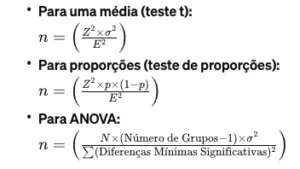
6. Use a Sample Size Formula:
Finally, with all the previous elements defined, apply the most appropriate calculation formula for your objective. Below, we present some of the most used formulas.

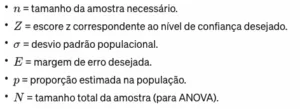
where

Sample size

Respondents for market research. List of some profiles and how to use them.

Remember that when using these formulas, it is crucial to consider the complexity of your experimental design, as well as the assumptions underlying the chosen statistical test. Furthermore, it is fundamental to ensure that these assumptions are met to avoid distortions in the results. In many cases, relying on the guidance of a statistician or using specialized software tools can significantly simplify the process and increase the reliability of the analysis. Therefore, we recommend using our Sample Size Calculator, which helps you find the ideal number of respondents for your research project, in a practical, precise way, and aligned with your objectives.

Calculator

Sample Size Calculator

Sample Size Calculator

Need a survey with a respondent sample? Count on Painel TAP.

Behind Painel TAP is a team passionate about data and generating insights, who finds in each project a challenge to seek the best and fastest solution for the most diverse types of needs and demands in online research and market investigation.