What is probabilistic sampling? Concept, use, and examples
14 min read

If you are thinking of conducting a survey and have started looking for information about the process, you have probably asked yourself: what is probabilistic sampling?
Don't worry! In this article, we will simply explain everything you need to know about this type of sampling and why it is so important for obtaining reliable results.
What is probabilistic sampling?
Probabilistic sampling is a technique for selecting participants where all individuals in a population have a known, non-zero probability of being chosen to be part of the research. This process is carried out randomly, reducing bias and increasing the reliability of the results.
This method is widely used in market research, academic studies, electoral surveys, and opinion polls, as it allows the sample to represent the population with greater accuracy. Since the selection occurs through statistical criteria, the results can be generalized to the surveyed universe, provided the sample is adequately sized.
What are the types of probabilistic sampling?
There are different types of probabilistic sampling, and each is indicated for specific research situations. The choice of method depends on factors such as population size, availability of information about participants, available resources, and the desired level of precision.
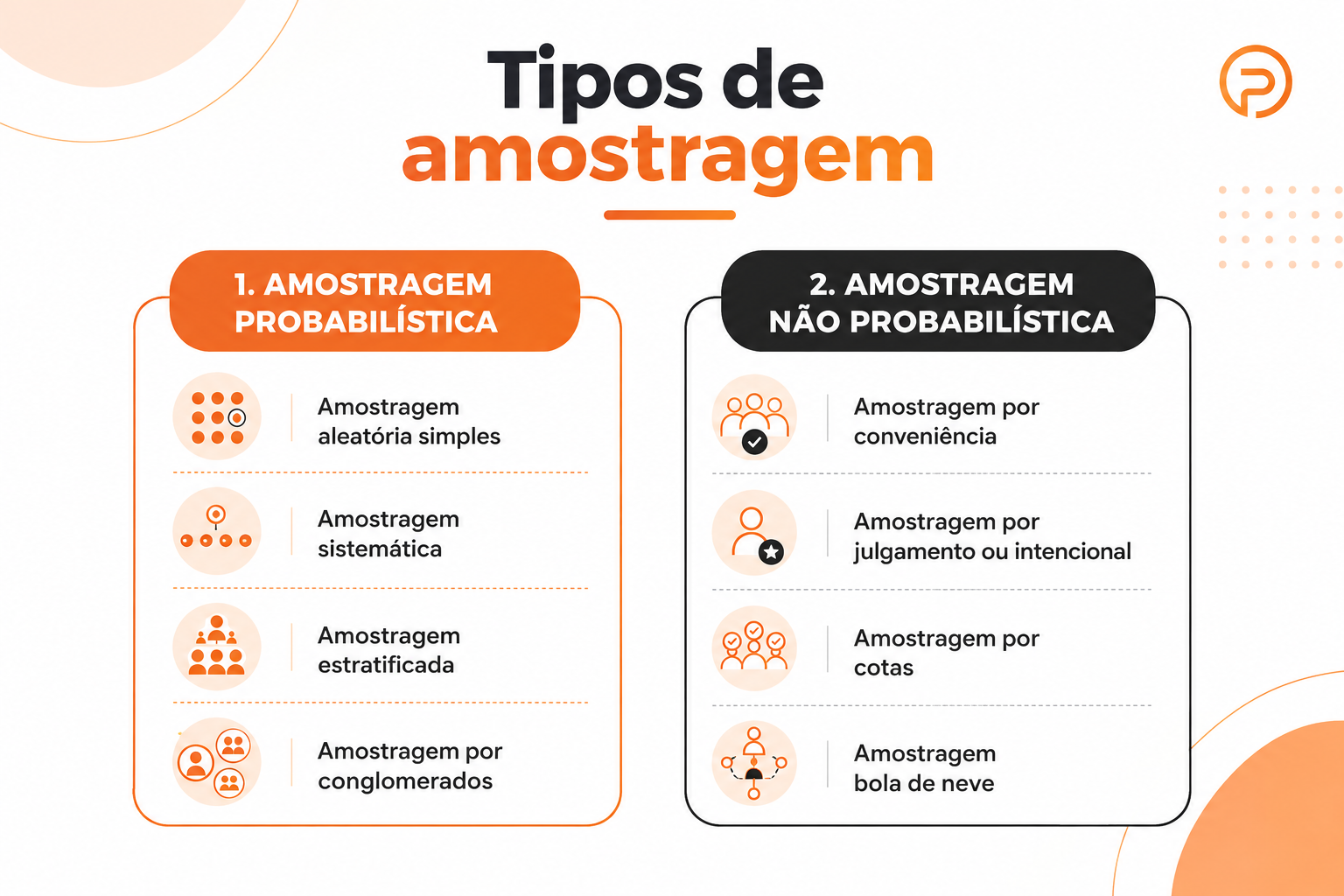
The main types of probabilistic sampling are:
Simple random sampling
Simple random sampling is the most well-known method and also the easiest to understand. In this model, all individuals in the population have exactly the same probability of being selected. The choice is made completely randomly, through draws or computational tools that guarantee impartiality of selection.
This type of sampling is recommended when there is a complete list of the population and all elements can be easily identified. By providing equal chances, it is a method that reduces bias and increases the reliability of the results.
Example: a company has a database of 5.000 registered customers and wants to interview 300 of them. Software performs a random draw to determine which customers will participate in the survey.
Systematic sampling
In systematic sampling, selection occurs by following a fixed interval between participants. First, the starting point is randomly chosen, and then an individual is selected every certain number of elements.
This method is widely used when the population is organized in a list and does not present patterns that could influence the results.
Example: in a list of 10.000 consumers, the survey needs to interview 1.000 people. The researcher draws the first participant and, from them, selects one person every 10 names on the list.
Stratified sampling
Stratified sampling consists of dividing the population into homogeneous groups, called strata, that share some common characteristic, such as age, gender, geographical region, income bracket, or education level.
After this division, a random draw is performed within each stratum. In this way, all relevant groups are represented in the sample, making the results more precise.
This method is especially indicated when the population has very different characteristics.
Example: a national survey can divide respondents by region of the country and select participants proportionally in each, ensuring that North, Northeast, South, Southeast, and Central-West are represented.
Cluster sampling
In cluster sampling, the population is divided into natural groups, called clusters. Instead of selecting individuals directly, the researcher draws some of these groups to compose the research.
Depending on the study, all individuals in the selected clusters may be interviewed, or a new sampling may be performed within them.
This technique is widely used when the population is geographically dispersed, reducing collection costs and time.
Example: an educational survey wants to evaluate high school students throughout Brazil. Instead of selecting students individually, it draws schools and conducts the survey only with students from those institutions.
Multi-stage sampling
Multi-stage sampling combines two or more probabilistic methods at different stages of selection. It is an approach widely used in large-scale research, especially when the population is extensive and distributed across various regions.
The process occurs hierarchically. First, large units are drawn, such as states or municipalities. Then, neighborhoods, schools, companies, or households. Finally, individuals are randomly selected.
Although more complex, this technique makes national surveys more operationally viable and helps reduce costs without compromising sample representativeness.
Example: a research institute can select states, then municipalities, then neighborhoods, and finally, the residents who will participate in the interviews.
When to use probabilistic sampling?
This type of sampling is especially indicated when the research needs to represent a larger group of people, allowing the results obtained in the sample to be applied to the surveyed universe. Therefore, it is widely used in market research, scientific studies, opinion polls, and government surveys.
Some situations where probabilistic sampling is recommended:
When it is necessary to guarantee population representativeness
Probabilistic sampling is ideal when the research needs to reflect the real characteristics of a population. Since participants are selected by random criteria, different profiles have a greater chance of being included in the study.
Example: a company wants to understand the satisfaction of all its customers. By selecting participants randomly, it avoids interviewing only more engaged customers or those who have had recent positive or negative experiences.
When it is important to calculate margin of error and confidence level
In research that needs to present statistically reliable results, probabilistic sampling is the most appropriate choice. It allows calculating indicators such as margin of error and confidence interval, making data interpretation more precise.
Example: an electoral survey needs to estimate the voting intention of the population with a defined margin of error. For this, it uses probabilistic methods for selecting respondents.
When there is a well-defined population
This method works best when the researcher has information about the universe to be studied, such as a list of customers, employees, residents, or consumers.
With an identified population, it is possible to apply techniques such as simple random, stratified, or systematic sampling to select participants.
Example: a university has the registration of all its students and wants to conduct a survey about the academic experience. The institution can select a random sample from the registered students.
When it is necessary to compare different groups
Probabilistic sampling is also indicated when the research needs to analyze differences between population segments. In this case, techniques such as stratified sampling help ensure that all important groups are represented.
Example: a consumer survey can separate participants by age group, region, or income to compare habits among different audiences.
When results will be used for strategic decisions
Companies and organizations that use data to make important decisions need reliable information. Probabilistic sampling helps reduce uncertainties and offers a closer view of the reality of the analyzed population.
Example: a brand that intends to launch a new product can conduct a survey with a probabilistic sample to understand public acceptance before investing in the launch.
In which surveys to use probabilistic sampling?
It can be applied in different areas, especially when the results will be used to make important decisions or represent a larger group of people. Check out some examples:
Market research
Probabilistic sampling is widely used in market research to understand consumer behaviors, preferences, and needs. It allows a company to know the opinion of a specific audience without having to interview all its customers or potential consumers.
Example: a food brand wants to evaluate the acceptance of a new product before launch. By selecting consumers randomly, it can obtain a closer view of market opinion.
Customer satisfaction surveys
Companies that want to measure their customers' satisfaction can use probabilistic sampling to ensure that different consumer profiles are considered in the analysis.
This method helps identify positive points, recurring problems, and improvement opportunities based on a representative sample.
Example: a company with thousands of customers randomly selects part of its base to evaluate the service experience and perception of its services.
Public opinion polls
Opinion polls, such as surveys on social behavior, population habits, or voting intention, frequently use probabilistic methods to represent the opinion of a larger group.
Since it is not possible to interview all citizens, random selection allows estimating population trends with greater reliability.
Example: a national survey on Brazilians' opinion regarding a certain topic selects participants considering different regions, ages, and social profiles.
Electoral surveys
Electoral surveys are one of the best-known examples of probabilistic sampling application. To estimate the voting intention of the population, institutes select a sample that represents different segments of the electorate.
The appropriate choice of participants is fundamental to avoid distortions in the results and present estimates close to reality.
Academic and scientific research
In the academic field, probabilistic sampling is used in studies that need to produce generalizable results for a larger population.
It appears in research in the areas of health, education, psychology, economics, and social sciences, especially when the researcher needs to test hypotheses or identify patterns.
Example: a study on reading habits among students can select students from different educational institutions to represent the studied population.
Product and service evaluation surveys
Companies that want to understand consumers' perception of products, brands, or services can also use probabilistic sampling.
This method allows collecting opinions from different consumer profiles, preventing only a specific group from influencing the results.
Example: a technology company conducts a survey to evaluate users' experience with an application and randomly selects participants from its customer base.
Government surveys and sample censuses
Public agencies use probabilistic sampling to collect information about the population, especially when a complete survey would be unfeasible in terms of cost and time.
It is applied in studies on income, employment, health, education, and living conditions of the population.
What are the advantages of probabilistic sampling?
Since participant selection happens randomly, this method reduces the interference of the researcher's personal choices and increases the quality of the collected information.
Check out the main benefits:
Greater population representativeness
One of the main advantages of probabilistic sampling is the ability to better represent the characteristics of a population. Since all individuals have a known chance of being selected, different profiles have the opportunity to participate in the research.
This prevents only certain groups from being considered and allows for a closer view of the reality of the analyzed public.
Example: a survey on consumption habits can include participants of different ages, regions, and socioeconomic profiles, ensuring a more complete analysis.
Reduction of research biases
Random selection of participants helps reduce possible influences or preferences of the researcher in choosing the sample. Thus, the results tend to be more impartial and reliable.
In non-probabilistic methods, there is a greater risk of selecting people with specific characteristics that can distort the study's conclusions.
Possibility of generalizing results
One of the greatest advantages of probabilistic sampling is allowing the results obtained in the sample to be used to make estimates about the entire studied population.
Provided the research planning is adequate, the collected data can represent trends and behaviors of a larger group.
Example: a survey conducted with a representative sample of consumers can indicate the general market perception of a brand or product.
Allows calculating margin of error and confidence level
Probabilistic sampling enables the use of statistical analyses to calculate the precision of results, including margin of error and confidence level.
This information helps interpret data more securely and shows how much the results can vary in relation to the total population.
Greater data reliability
Since the selection process follows statistical criteria, the results obtained tend to present higher quality and credibility.
This is especially important in research that will be used to guide strategic decisions, investments, or public policies.
More precise comparison between groups
Probabilistic sampling allows for the creation of balanced samples and the analysis of different population segments with greater precision.
Through techniques such as stratified sampling, it is possible to ensure the participation of specific groups and compare their behaviors or opinions.
Example: a company can compare customer satisfaction across different regions or age groups, obtaining more detailed insights.
Greater security for decision-making
Data obtained through a probabilistic sample offers greater support for important decisions, as it presents a lower risk of distortion.
Companies, researchers, and organizations can use this information to develop more efficient strategies aligned with the reality of the studied public.
Example of research with probabilistic sampling
To better understand how probabilistic sampling works in practice, imagine a company that wants to evaluate customer satisfaction after a purchase.
The company has a database with 100 thousand registered customers and wants to conduct a survey to find out how consumers rate the quality of service, the shopping experience, and the products offered. Since interviewing all customers would be unfeasible, it decides to select a representative sample.
Using a simple random sampling method, the company draws 1.000 customers from its database. Each consumer has the same probability of being chosen, ensuring that the selection does not depend on the researcher's preference.
After collecting the responses, the data is analyzed to identify the average level of customer satisfaction and the main areas for improvement. Since the sample was selected probabilistically, the results can be used to estimate the perception of the entire customer base, considering a defined margin of error and confidence level.
Other examples of probabilistic sampling application:
Purchase intention survey:
A cosmetics company wants to understand consumer interest in a new product line. To do this, it randomly selects people within its target audience, ensuring that different consumer profiles are represented.
Electoral survey:
A research institute needs to estimate the voting intention of voters in a city. Since it is not possible to interview all voters, it selects a sample considering characteristics such as age, region, and gender to represent the population.
Market research:
A food brand wants to evaluate the acceptance of a new product before launch. To do this, it randomly chooses consumers from different regions and profiles, preventing only a specific group from influencing the results.
Academic research:
A researcher wants to analyze the study habits of university students at an institution. Instead of interviewing all students, they select a random sample among enrolled students to obtain representative data.
In all these cases, the main characteristic of probabilistic sampling is that participants are chosen following random criteria, allowing the results to have greater reliability and better represent the studied population.
What is the difference between probabilistic sampling and non-probabilistic sampling?
The main difference between probabilistic sampling and non-probabilistic sampling lies in how participants are selected for a survey.
In probabilistic sampling, all individuals in the population have a known probability of being chosen. The selection occurs randomly, following statistical criteria that help reduce bias and increase the representativeness of the results.
In non-probabilistic sampling, participants are selected based on criteria defined by the researcher, such as ease of access, availability, or specific characteristics of the public. In this case, not all individuals in the population have a known chance of participating in the survey.
Check out the main differences:
| Characteristic | Probabilistic sampling | Non-probabilistic sampling |
| Selection method | Random selection | Selection by criteria defined by the researcher |
| Probability of participation | Known and greater than zero | Not known |
| Representativeness | Greater potential to represent the population | May present a higher risk of bias |
| Statistical analysis | Allows calculation of margin of error and confidence level | Generally does not allow precise statistical estimates |
| Cost and execution | May require more time and resources | Normally faster and more economical |
| Indication | Research that needs generalizable results | Exploratory research or when there is no access to the complete population |
When to use probabilistic sampling?
Probabilistic sampling is indicated when the research needs to represent a larger population and generate reliable results. It is common in electoral surveys, scientific studies, market surveys, and public opinion polls.
Example: a company wants to know the satisfaction of all its customers. To do this, it randomly selects a part of its database, ensuring that different profiles have a chance to participate.
When to use non-probabilistic sampling?
Non-probabilistic sampling is used when the researcher needs to collect information more quickly, has access limitations, or wants to explore opinions and behaviors of a specific group.
It is widely applied in qualitative research, initial product tests, and exploratory studies.
Example: a company launches an online survey and invites volunteers who are interested in responding. In this case, participants are not chosen randomly and represent only the group that decided to participate.
How to find respondents for probabilistic sampling?
One of the most efficient ways to find respondents is to use research panels composed of people previously registered and segmented according to different characteristics, such as age, region, gender, consumption habits, and socioeconomic profile. These panels facilitate access to the target audience and allow the selection of participants who meet the defined criteria for the research.
The PainelTAP is a solution that helps companies and researchers find respondents for their surveys more quickly and efficiently. With a database of registered participants and segmentations by different attributes, it is possible to direct questionnaires to specific audiences and obtain responses more aligned with the study's objectives.
In addition to facilitating recruitment, a respondent panel contributes to more organized data collection, reducing the time needed to find participants and increasing the quality of the information obtained.
If you need to conduct research with a sample suitable for your audience, get to know PainelTAP and find the ideal respondents for your study. Schedule a demonstration.