Non-probabilistic sampling in research: a complete guide!
15 min read

Non-probabilistic sampling is one of the most used techniques in market research, academic studies, and opinion polls when the goal is to recruit participants quickly, practically, and at a lower cost.
Although widely used, many people still have doubts about what it is, when it should be applied, and what its advantages and limitations are.
In this complete guide, you will understand how it works, learn about its main types, discover in which situations it is most suitable, see practical examples, and learn how respondent recruitment platforms can make this process much more efficient.
What is non-probabilistic sampling?
Non-probabilistic sampling is a method of participant selection where individuals are not chosen randomly. Instead, the sample definition is based on criteria established by the researcher, such as demographic profile, experience, availability, or convenience.
In practice, this means that not all people in the population have the same chance of being selected to participate in the research. The goal is not to statistically represent the entire population, but to gather respondents who meet the necessary characteristics to answer the study's questions.
What are the types of non-probabilistic sampling?
The main types of non-probabilistic sampling are:
Convenience sampling
Convenience sampling is one of the most used methods due to its ease of application. In this method, participants are selected because they are available or easy for the researcher to access.
This type of sampling is common in research conducted with current customers, users of digital platforms, or people close to the data collection location.
Example: a company conducts a satisfaction survey with customers who have just made a purchase in its store.
The main advantage of this method is its speed and low cost, but the results may have limitations, as the surveyed group may not represent the entire population.
Judgmental or purposive sampling
In judgmental sampling, also called purposive sampling, the researcher selects participants deemed most suitable to answer the survey.
The choice is based on the researcher's knowledge of the target audience and the criteria defined for the study.
Example: a survey on business software might only select technology managers who use this type of solution daily.
This method is widely used when it is necessary to find people with specific experiences or knowledge about a particular subject.
Quota sampling
Quota sampling aims to create a sample with characteristics similar to those of the studied population. To do this, the researcher defines groups or categories that need to be represented in the research.
Quotas can consider criteria such as age, gender, region, income, or consumption habits.
Example: an opinion survey on a new product defines that it needs to interview 50% men and 50% women, following the composition of the target audience.
Although it allows for greater balance between groups, selection within quotas does not happen randomly.
Snowball sampling
Snowball sampling occurs when participants themselves refer other people who can also participate in the research.
This method is widely used to reach hard-to-find audiences or very specific groups.
Example: a survey with professionals from a highly specialized field might start with a few participants, who then refer other professionals with the same profile.
The main advantage is facilitating access to restricted groups, but there is a risk that the referred participants may have very similar characteristics to each other.
Volunteer or self-selection sampling
In voluntary sampling, individuals themselves decide to participate in the research on their own initiative. They can respond to a questionnaire disseminated on websites, social media, apps, or online communities.
Example: a company publishes a survey on its website inviting consumers to evaluate a new feature.
This method allows for collecting many responses quickly, but it can generate bias, as people more interested in the topic tend to participate more frequently.
How to choose the type of non-probabilistic sampling?
The choice of the most appropriate technique depends mainly on the research objective, the audience that needs to be reached, the available timeframe, and the resources involved.
- For quick and low-cost research, convenience sampling can be a good alternative.
- For specific audiences, purposive or snowball sampling can offer better results.
- For research that needs to balance audience characteristics, quota sampling is usually more indicated.
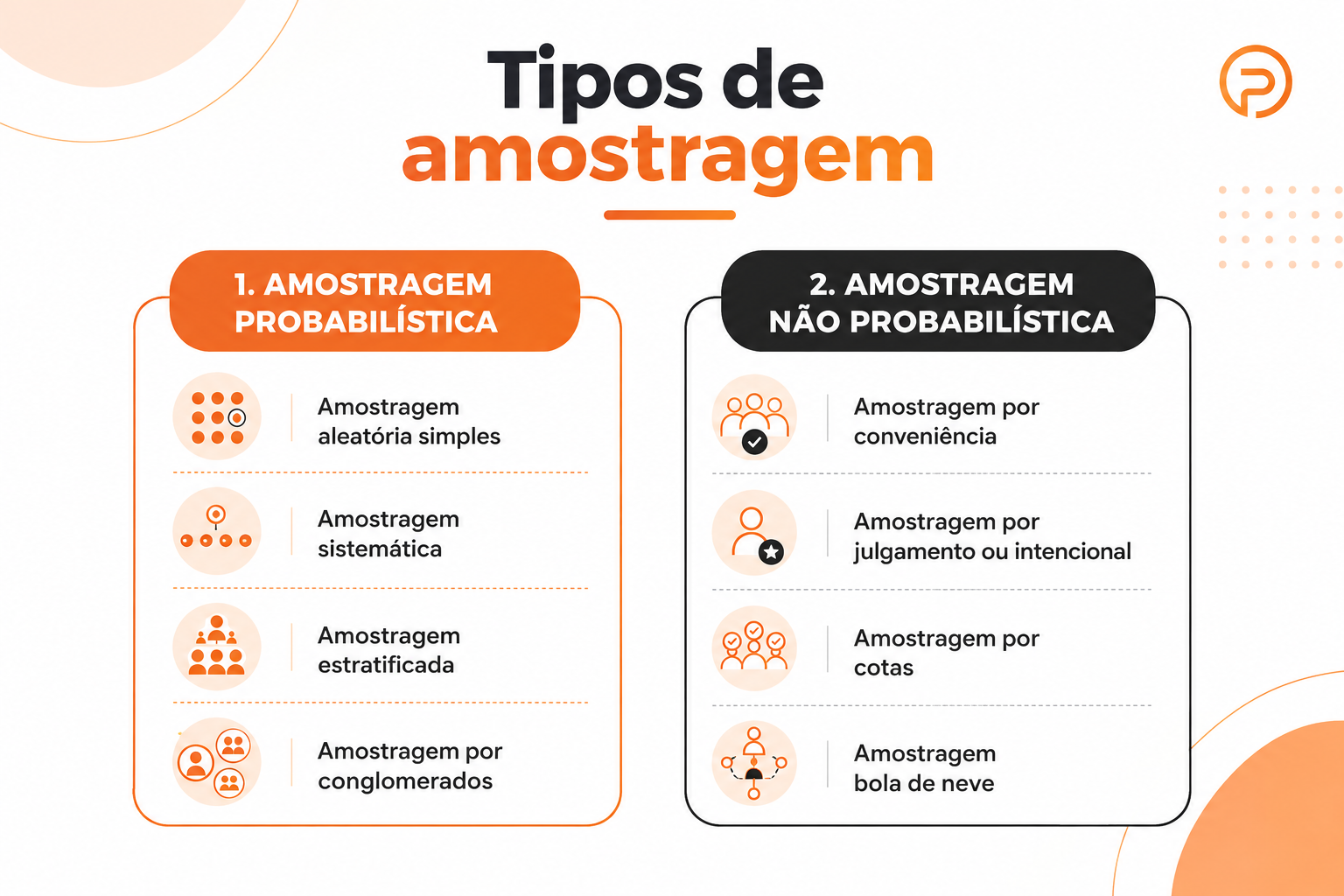
Example of non-probabilistic sampling
An example of non-probabilistic sampling occurs when a company wants to understand consumers' opinions about a new product and selects participants who are available or who have specific characteristics related to the target audience.
Imagine a food brand wants to test the acceptance of a new product flavor. Instead of randomly choosing consumers from the entire population, it selects 500 people who already buy similar products, are within a certain age range, and live in regions of interest to the brand.
In this case, the selection of participants does not happen by chance. They were selected because they meet the criteria defined by the research, characterizing non-probabilistic sampling.
What are the advantages of using non-probabilistic sampling?
Despite not guaranteeing the same statistical representativeness as a probabilistic sample, it can be an excellent choice when the goal is to explore behaviors, test hypotheses, or obtain targeted insights.
Check out the main advantages of this method:
Faster data collection
One of the main advantages of non-probabilistic sampling is the speed in finding and selecting participants. Since respondents do not need to be chosen through a random process, recruitment can happen more simply and directly.
This characteristic is especially useful in market research with tight deadlines, concept testing, and studies that need to generate information quickly to support decisions.
Lower cost for conducting research
Non-probabilistic sampling generally requires less financial investment compared to probabilistic methods. Since the participant selection process is simpler, there is a reduction in costs related to recruitment, data collection structure, and research operation.
Therefore, this method is widely used by companies that want to obtain consumer insights without needing to invest large resources.
Ease of finding specific audiences
Another great advantage is the possibility of selecting people with very specific characteristics. The researcher can define criteria such as age, profession, consumption habits, location, or experience with a particular product or service.
For example, a company that wants to understand the opinion of app users can only look for people who have already used that solution. This allows for obtaining more relevant answers for the research objective.
Greater flexibility during research
Non-probabilistic sampling offers more freedom to adapt recruitment according to the study's needs. If it is necessary to adjust the profile of participants or expand a certain group, the researcher can make changes more easily.
This flexibility is important in exploratory research, where objectives can be refined as new data is found.
Ideal for exploratory research
When a company or researcher is still trying to understand a particular topic, non-probabilistic sampling can be a great alternative.
It allows for collecting initial perceptions, opinions, and behaviors that help identify trends, raise hypotheses, and guide future, more in-depth studies.
Allows access to hard-to-find groups
Some audiences are naturally more difficult to locate by traditional sampling methods. Non-probabilistic sampling facilitates access to these groups through strategies such as participant referral or targeted selection.
This resource is widely used in research with specific niches, such as professionals in certain areas, consumers of specialized products, or people with very particular experiences.
Good option for initial product and idea testing
Before launching a product or campaign to the market, many companies conduct research with small groups of consumers to validate concepts and identify possible improvements.
Non-probabilistic sampling allows for quickly gathering participants and evaluating initial perceptions, aiding in decision-making before large investments.
When to use non-probabilistic sampling?
This method is very common in market research, exploratory studies, product testing, satisfaction surveys, and academic research, especially when there are limitations of time, budget, or difficulty in accessing all individuals in the population.
Here are some scenarios where non-probabilistic sampling is a good choice:
When it is necessary to research a specific audience
Non-probabilistic sampling is indicated when the research needs to reach people with certain characteristics or experiences.
For example, a company that wants to evaluate customer satisfaction with a specific vehicle model can select only consumers who have had contact with that product. In this case, the focus is not to represent all consumers, but to hear from a group that has relevant knowledge on the topic.
When the research needs to be conducted quickly
In situations where time is a decisive factor, non-probabilistic sampling allows for finding participants more quickly.
Market research, campaign evaluations, and concept testing often require answers within a few days to support strategic decisions. Since recruitment is simpler, this method helps accelerate data collection.
When the research budget is limited
Non-probabilistic sampling is also an interesting alternative when there is an investment constraint.
Since it does not require complex random selection processes, it tends to reduce the costs involved in participant recruitment, making research accessible for companies of different sizes and academic projects.
When the goal is to explore a little-known topic
In exploratory research, where the initial objective is to understand a problem or identify new opportunities, non-probabilistic sampling can be very useful.
It allows for collecting opinions and perceptions from people related to the topic, helping the researcher identify patterns, raise hypotheses, and define the next steps of the study.
When it is necessary to test products, services, or concepts
Before launching a new product or service on the market, many companies conduct research to understand consumer acceptance.
Non-probabilistic sampling allows for selecting participants who have a profile compatible with the target audience and evaluating aspects such as interest, perceived value, purchase intention, and areas for improvement.
When the surveyed population is difficult to access
Some groups have specific characteristics that make random selection difficult. In these cases, non-probabilistic sampling facilitates access to participants.
This happens, for example, in research with professionals from very specific areas, users of certain services, or consumers of niche products.
When the research aims to generate insights and not statistical estimates
The choice of sampling depends mainly on the study's objective. When the intention is to understand opinions, behaviors, and motivations, non-probabilistic sampling can provide valuable information.
On the other hand, when the research needs to project results for an entire population with a known margin of error, probabilistic sampling is usually more appropriate.

What type of research uses non-probabilistic sampling?
This method is very common when the researcher needs agility, lower cost, or access to a specific audience. Instead of randomly selecting participants, the research uses defined criteria to find people who have relevant characteristics for the study.
Check out the main types of research that use non-probabilistic sampling:
Market research
Market research is one of the main examples of non-probabilistic sampling application. Companies use this method to understand consumer habits, preferences, needs, and perceptions.
For example, a brand that wants to test the acceptance of a new product can select consumers with its target audience profile to answer a questionnaire.
In this case, the objective is to obtain insights into consumer behavior, and not necessarily to represent all consumers in the market.
Customer satisfaction surveys
Customer satisfaction surveys frequently use non-probability sampling to collect opinions from people who have recently interacted with a company, product, or service.
An example is sending a survey to customers who made a purchase in the last few days or used a specific service.
The advantage is getting responses from people with real and recent experience, making the results more useful for identifying areas for improvement.
Exploratory research
Non-probability sampling is widely used in exploratory research, whose objective is to better understand a problem, identify opportunities, and raise hypotheses.
As this type of study seeks to deepen knowledge on a topic, the researcher can select participants who have a greater relationship with the analyzed subject.
Example: interviewing frequent users of transportation apps to understand their main needs and difficulties.
Product and concept testing
Companies that want to launch new products, services, or campaigns use non-probability sampling to assess public perception before launch.
In this case, participants with characteristics similar to the ideal consumer are selected.
Example: a cosmetics company gathers consumers who use personal care products to test a new formula and evaluate aspects such as packaging, price, and purchase intention.
Opinion and behavior research
Studies that seek to understand opinions, preferences, and behaviors can also use non-probability sampling.
This method allows reaching people with certain profiles and analyzing how they think about a specific topic.
Example: a survey to understand streaming consumption habits among young adults can select participants within this age group.
Academic research and qualitative studies
In the academic field, non-probability sampling is widely used in qualitative research, case studies, and in-depth interviews.
The researcher usually chooses participants who have knowledge or experience related to the studied topic.
Example: interviewing university professors to analyze teaching methods in a specific area.
Research with hard-to-find audiences
Some studies need to reach very specific groups that are not easily found through random selection. In these cases, non-probability sampling becomes an efficient alternative.
It can be applied in research with specialized professionals, users of specific products, or people with certain experiences.
Example: a survey with users of specific medical equipment or professionals in a technical area.
What is the difference between Non-probability sampling and probability sampling?
In probability sampling, all individuals in the population have a known and non-zero chance of being selected. The choice happens through random methods, such as draws or statistical selection systems, allowing greater control over the representativeness of the sample and the possibility of calculating the margin of error of the results.
In non-probability sampling, participants are chosen based on criteria defined by the researcher, such as availability, specific profile, or ease of access. In this case, not all people in the population have the same opportunity to participate, and the results cannot be generalized with the same level of statistical precision.
The choice between the two methods depends on the research objective. Studies that need to represent an entire population and generate statistical estimates usually use probability sampling. Exploratory research, product testing, and studies with specific audiences frequently use non-probability sampling due to its agility and flexibility.
Comparative table: non-probability sampling vs. probability sampling
| Characteristic | Non-probability sampling | Probability sampling |
| Selection method | Participants are chosen by criteria defined by the researcher | Participants are selected randomly |
| Probability of participation | Not all individuals have a known chance of being selected | All individuals have a known probability of selection |
| Sample representativeness | May present a higher risk of bias and lower statistical representativeness | Generally offers greater population representativeness |
| Margin of error | Normally does not allow calculating statistical margin of error | Allows calculating margin of error and confidence level |
| Collection speed | Faster and simpler to execute | May require more time for planning and selection |
| Cost | Generally has lower cost | Usually requires greater financial and operational investment |
| Flexibility | Greater flexibility to find specific audiences | Less flexibility due to statistical selection criteria |
| Indication of use | Exploratory research, concept testing, market research, and studies with specific audiences | Electoral surveys, sample censuses, academic studies, and research that needs to represent a population |
| Example | Interviewing available consumers in a store or selecting users of a specific product | Drawing people from a customer list to answer a survey |
Which to choose: probability or non-probability sampling?
There is no single best method for all situations. The choice depends mainly on the research objective.
If the intention is to understand opinions, test ideas, explore behaviors, or reach a specific audience, non-probability sampling can be an efficient option.
On the other hand, if the research needs to represent an entire population, compare results with statistical precision, or calculate reliable indicators, probability sampling is more appropriate.
In market research, many companies combine different strategies to balance data quality, speed, and cost, choosing the method that best meets the study's objectives.
Is it possible to use Non-probability sampling in a respondent panel?
Yes, it is possible to use non-probability sampling in respondent panels, especially in market research, behavioral studies, and opinion surveys that need to find participants with specific characteristics.
In a respondent panel, participants are pre-registered and have profile information, such as age, location, gender, consumption habits, and interests. From this data, the researcher can select people who meet the research criteria, using techniques such as convenience sampling, quota sampling, or purposive sampling.
For example, a company that wants to understand consumers' perception of a new application can use a panel to quickly find people who already use this type of service. In this case, participants are not necessarily chosen by lot, but rather by meeting the desired profile for the study.
The use of non-probability sampling in panels offers advantages such as greater agility in collecting responses, cost reduction, and ease of reaching segmented audiences. This model is widely used in exploratory research, concept testing, product evaluation, and customer experience studies.
Find the respondents for your research
After defining the methodology and type of sampling for your research, the next step is to find the right people to answer the questionnaire. After all, the quality of the results depends directly on having respondents who truly have the appropriate profile for the study.
With PainelTAP, you can find participants for your research quickly, segmentedly, and efficiently. The service allows access to a panel of respondents with different demographic and behavioral characteristics, facilitating the recruitment of people aligned with your research objectives.
In a few steps, you define the profile of the participants, send your research, and receive responses from real people, ensuring greater agility in data collection and higher quality in the insights generated.
Want to know more? Schedule a demonstration!