Difference between sample and sampling: understand both concepts
9 min read

Anyone starting to develop research always ends up in doubt about the difference between sample and sampling. But rest assured that here you will understand everything you need about both concepts to create your research with quality.
What is a sample?
A sample is the group of people, companies, or elements selected to participate in a survey. Instead of interviewing the entire population, the researcher collects data from a representative part, capable of reflecting the characteristics of the universe they wish to study.
For example, if a company wants to know the opinion of Brazilian consumers about a new product, it is not necessary to interview all inhabitants of the country. It is enough to select a well-planned sample that represents different profiles, such as age, gender, region, and income bracket.
When the sample is correctly defined, the research results are more reliable and can be used to support strategic decisions, reducing costs and data collection time without compromising the quality of the information.
When to use a sample in research?
A sample should be used when it is not feasible or necessary to interview the entire population that is part of the study. In most market research, satisfaction, public opinion, and consumer behavior studies, working with a sample is the most efficient solution to obtain reliable results in less time and at a lower cost.
This method is indicated when the population is very large, is distributed in different regions, or when the objective is to make decisions quickly. As long as the sample is representative and follows appropriate statistical criteria, it is possible to extrapolate the results to the researched universe with a high level of confidence.
What are the attributes of a sample?
The attributes of a sample are the characteristics used to ensure that it adequately represents the researched population. These attributes vary according to the objective of the study but must reflect the most relevant profiles of the analyzed public.
The most common attributes include:
- Age: different age groups may present distinct behaviors and opinions.
- Gender: ensures the proportional participation of men, women, and, when applicable, other groups.
- Geographic region: considers the distribution of participants by states, regions, or municipalities.
- Income bracket: allows analysis of differences related to purchasing power.
- Education level: represents the different levels of education of the population.
- Social class: mainly used in market research and consumer behavior studies.
- Occupation or profession: important in studies focused on the labor market or specific segments.
- Marital status and family composition: relevant for research on consumption, housing, and lifestyle.
In addition to demographic attributes, a sample can also include behavioral criteria, such as purchasing habits, product use, consumption frequency, brand preference, or use of certain services. The choice of these attributes depends on the research objectives and the profile to be represented.
What is sampling?
Sampling is the process of selecting participants who will be part of a survey. In other words, it is the methodology used to define which portion of the population will be interviewed, so that the results represent the studied universe.
This process follows statistical or methodological criteria to ensure that the sample is adequate for the research objectives. Well-planned sampling reduces bias, increases data reliability, and allows relevant information to be obtained without the need to interview the entire population.
In practice, sampling is one of the most important stages of a study, as the quality of the results directly depends on how participants are selected. The more rigorous this process, the greater the precision of the conclusions and the security for making decisions based on the research.
When to use sampling?
Sampling should be used when it is not feasible to interview the entire population of interest or when doing so would generate high costs and deadlines. Instead of conducting a census, the researcher selects a representative portion of the public to collect the necessary data.
This method is widely used in market research, customer satisfaction, consumer behavior, public opinion, and academic studies. As long as the sampling is planned correctly, it is possible to obtain reliable results that reflect the characteristics of the researched population.
In addition to reducing data collection time and costs, sampling makes research more agile and efficient. Therefore, it is recommended whenever the objective is to generate quality information to support decisions, without the need to interview all individuals in the research universe.
What are the types of sampling?
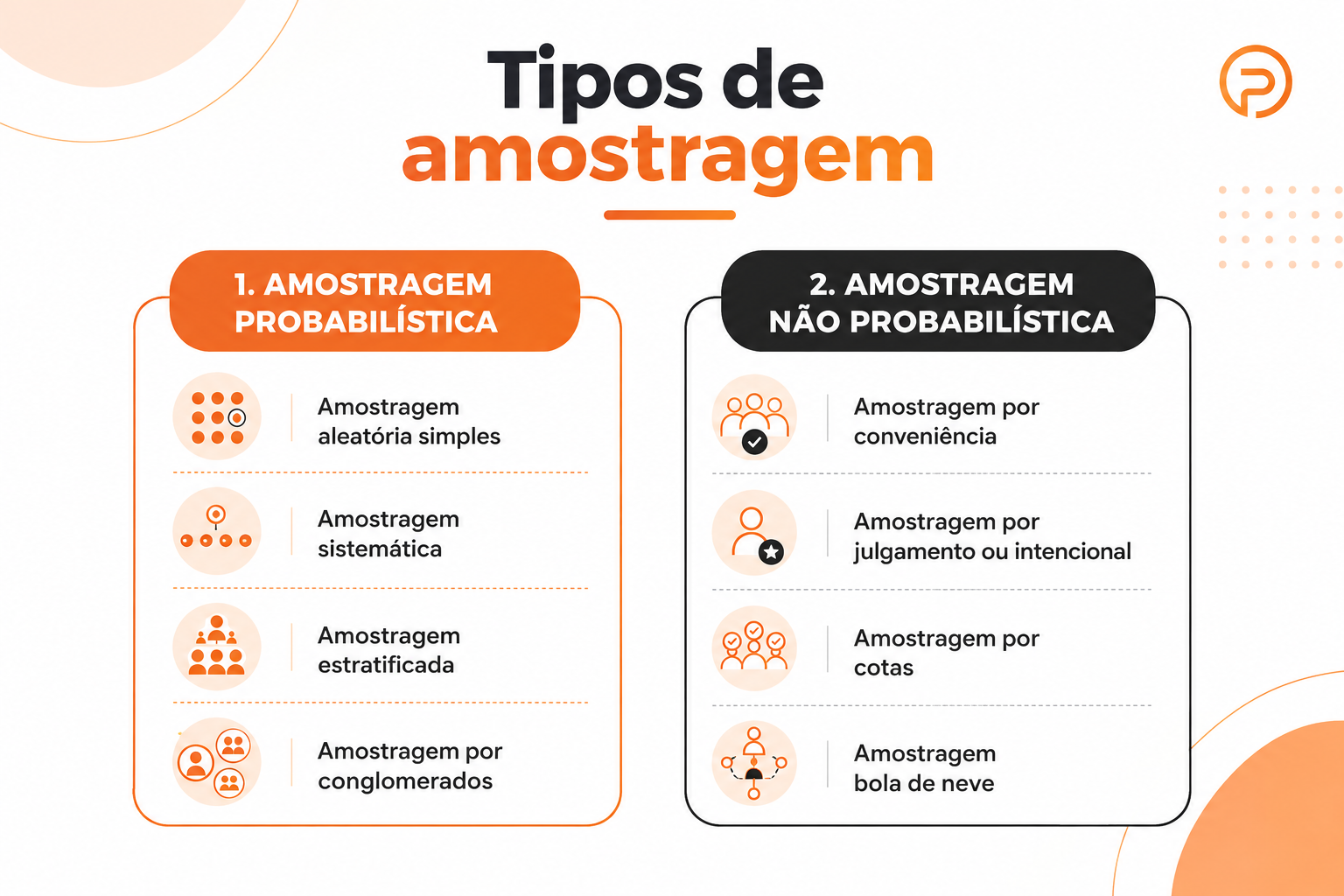
The types of sampling are divided into two main categories: probabilistic sampling and non-probabilistic sampling. The choice between them depends on the research objectives, the desired level of precision, and the available resources.
Probabilistic sampling
In probabilistic sampling, all elements of the population have a known probability of being selected. This method reduces bias and increases sample representativeness, being widely used in quantitative research.
The main types are:
- Simple random sampling: participants are chosen completely randomly.
- Systematic sampling: selection is performed at regular intervals, such as one participant for every certain number of records.
- Stratified sampling: the population is divided into groups with similar characteristics (such as age, gender, or region), and a sample is selected from each stratum.
- Cluster sampling: entire groups are selected, such as schools, neighborhoods, or companies, instead of individuals.
Non-probabilistic sampling
In non-probabilistic sampling, participants are selected based on criteria defined by the researcher, without all individuals in the population having the same chance of participation. It is a method widely used in exploratory, qualitative research, or when there are time and budget limitations.
The main types include:
- Convenience sampling: selects easily accessible participants.
- Judgment sampling (or purposive): the researcher chooses people who have specific characteristics of interest.
- Quota sampling: defines a quantity of participants for each population profile, such as sex, age group, or region.
- Snowball sampling: participants indicate other people with similar characteristics, being suitable for research with hard-to-reach audiences.
What is the difference between sample and sampling?
Although the terms are often used interchangeably, sample and sampling have different meanings within a research. Take a look:
Sample
A sample is a group of individuals, companies, or elements selected from a population to participate in a survey. It represents a part of the universe to be studied and provides the necessary data for analysis.
For example, a company wants to understand the opinion of Brazilian consumers about a new product. Since it would be unfeasible to interview all consumers in the country, it selects a sample of people with different profiles, considering characteristics such as age, gender, region, and income bracket.
When a sample is well-defined, it allows obtaining reliable information about the researched population, reducing costs and data collection time.
Sampling
Sampling is the process used to define how the sample will be selected. It involves choosing the criteria, methods, and techniques that will be applied to find the research participants.
For example, when conducting a survey on consumption habits, the researcher may define that 1.000 people distributed among different regions of the country and age groups will be interviewed. The way these participants are chosen represents the sampling process.
Well-planned sampling increases the representativeness of the sample and helps reduce possible distortions in the research results.

Difference between sample and sampling
| Sample | Sampling |
| It is the group of participants who will be part of the research. | It is the process used to select the research participants. |
| Represents a part of the studied population. | Defines the criteria and methods for sample selection. |
| It is the final result of the participant selection. | It is the strategy used before and during the selection. |
| Example: 500 consumers chosen to answer a survey about a product. | Example: method used to choose these 500 consumers considering age, region, and consumption profile. |
Examples of sample and sampling
To better understand the difference between the two concepts, it is important to remember: the sample is the group chosen to participate in the research, while sampling is the method used to reach that group.
Example 1: Customer satisfaction survey
Sample:
A company has 50 thousand customers and selects 2 thousand consumers to answer a satisfaction survey.
Sampling:
The company defines that these 2 thousand customers will be chosen considering different regions, age groups, and purchase frequency, so that the group better represents its customer base.
Example 2: Survey on consumption habits
Sample:
A study interviews 1.500 Brazilians to understand the purchasing habits of electronic products.
Sampling:
The researcher determines that participants will be selected to include people from different regions of the country, ages, genders, and income levels.
Example 3: Academic research
Sample:
A researcher analyzes the responses of 300 university students about the use of artificial intelligence tools in their studies.
Sampling:
The researcher defines the criteria for selecting these students, considering different courses, undergraduate periods, and educational institutions.
In summary:
| Sample | Sampling | |
| What is it? | The group participating in the research. | The process used to select this group. |
| Question it answers | “Who will be surveyed?” | “How will these people be chosen?” |
| Example | 1.000 consumers interviewed. | Selection of consumers by age, region, and purchase profile. |
How to find survey respondents?
Finding the right respondents is one of the most important stages of a survey. After all, the quality of the results directly depends on interviewing people who have the appropriate profile to answer the study's questions.
There are different ways to find participants, such as dissemination on social media, proprietary customer lists, online communities, and referrals. However, these alternatives can present challenges, such as difficulty in reaching specific audiences, low response rates, and lack of control over participant profiles.
A solution increasingly used by companies and researchers are respondent panels.
What are respondent panels?
Research panels are databases formed by people who have previously registered and agreed to participate in studies. These participants have profile information, such as age, gender, location, consumption habits, and other attributes, allowing for quick identification of people who match the research's target audience.
With a panel, the researcher can select respondents with greater precision, reduce collection time, and ensure a sample that is more aligned with the study's objectives.
Find the right respondents with PainelTAP
The PainelTAP connects researchers and companies to a broad base of participants, allowing them to segment audiences by various criteria and find people with the ideal profiles for each survey.
With PainelTAP, it's possible to create studies more quickly, reaching qualified respondents for market research, satisfaction, consumer behavior, and various other types of analysis.
By using a respondent panel, your research gains efficiency, data quality, and more security to make decisions based on real information. Want to know more? Schedule a demonstration!