Sampling types: see which ones exist and how to apply them in your research
16 min read

Understanding the types of sampling is the pillar of any reliable research. After all, it is rarely possible to hear from the entire population one wishes to study. That is why researchers, companies, and institutes select a representative portion of this public to collect data and generate insights.
The choice of sampling method directly influences the quality of the results, the accuracy of the analyses, and the ability to make decisions based on the information obtained.
In this article, you will learn about the main types of sampling, understand their differences, and discover when each method is most suitable for your research.
What is sampling in research?
Sampling is the process of selecting a part of a population to participate in a survey. Instead of collecting information from all individuals who are part of the interest group, researchers choose a sample that represents this universe and use the data obtained to perform analyses and draw conclusions.
This process is widely used because, in most cases, interviewing the entire population would be unfeasible in terms of time, cost, and resources. Imagine a company that wants to understand the consumption habits of Brazilians.
Interviewing millions of people would be extremely complex. With a well-planned sample, it is possible to obtain reliable results without having to consult the entire population.
For the results to be representative, the selection of participants must follow criteria appropriate to the research objective. It is precisely at this point that the different types of sampling come into play, each with specific characteristics, advantages, and applications.
Why is sampling important for the quality of results?
When the sampling process is well-planned, the results become more precise and useful for decision-making. In addition, there are other important points for using the correct sampling, such as:
Population representativeness
Good sampling allows the sample to reflect the main characteristics of the population to be analyzed. This means including profiles, behaviors, and opinions that are present in the researched universe. The more representative the sample, the greater the confidence that the results obtained correspond to the reality of the population.
Bias reduction
The appropriate choice of participants helps minimize biases that can distort research results. When certain groups are over-represented or excluded from the sample, conclusions can become inaccurate. Well-defined sampling methods reduce this risk and increase data reliability.
Greater precision in analyses
A correctly structured sample enables more consistent analyses and statistically more robust results. This allows identifying trends, behaviors, and patterns with greater certainty, reducing the probability of mistaken interpretations.
Time and resource savings
Conducting research with the entire population is not always feasible. Sampling allows obtaining relevant information with less operational effort, reducing costs and accelerating data collection. In this way, organizations can make decisions more quickly without compromising the quality of the results.
Basis for more assertive decisions
Companies, institutions, and researchers use research results to define strategies, develop products, evaluate services, and understand behaviors. When the sample is well-constructed, decisions made from the data are more likely to reflect the needs and expectations of the target audience.
Greater research credibility
The quality of sampling directly impacts the credibility of the results. Research conducted with appropriate methodologies is more reliable and generates greater confidence among managers, clients, investors, and other publics who use this information to guide their decisions.
What is the difference between sample and sampling?
Although the terms sample and sampling are often used together, they have different meanings within a research. Understanding this distinction is essential to comprehend how data is collected and analyzed.
Sample
The sample is the group of people, elements, or units selected to participate in the research. It represents a portion of the population to be studied and serves as the basis for data collection and analysis.
For example, if a company wants to know the opinion of Brazilian consumers about electric cars, interviewing the entire population would be unfeasible. In this case, it can select 2.000 people to answer the survey. These 2.000 people constitute the research sample.
The quality of the results depends directly on the sample's ability to represent the characteristics of the population. Therefore, the selection of participants must follow criteria appropriate to the study's objective. See some examples of samples in this article.
Sampling
Sampling is the process used to select the sample. In other words, it is the set of methods, techniques, and criteria employed to define who will be part of the research.
It is sampling that determines how participants will be chosen, how many people will be interviewed, and which characteristics need to be represented in the sample. There are different sampling methods, such as simple random, stratified, systematic, convenience, and quota, among others.
While the sample corresponds to the selected group, sampling is the strategy used to reach that group. A well-planned sampling methodology helps reduce biases, increase participant representativeness, and ensure more reliable results.
The difference
Simply put, the sample is the final result of the selection, that is, the set of research participants. Sampling, on the other hand, is the method used to perform this selection. Both concepts are fundamental for data quality and the reliability of the conclusions obtained.
What are the main types of sampling?
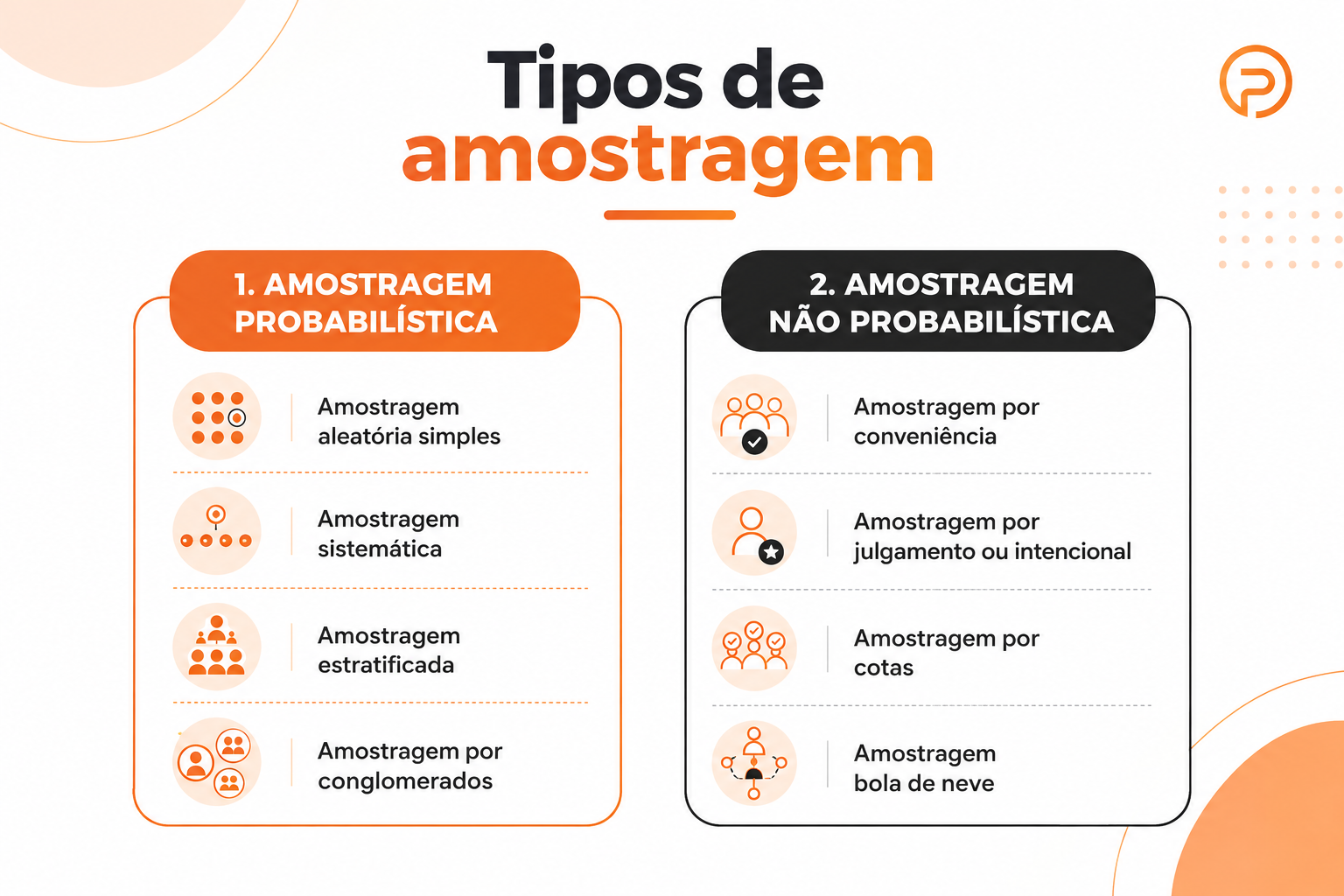
Sampling methods can be divided into two broad categories: probabilistic sampling and non-probabilistic sampling. The main difference between them lies in how participants are selected.
In probabilistic sampling, all individuals in the population have a known probability of being chosen.
In non-probabilistic sampling, selection occurs based on criteria defined by the researcher, without all members of the population having the same chance of participation. See some types of sampling from each category!
Probabilistic sampling
Probabilistic sampling is considered one of the most robust approaches for quantitative research. In this model, each individual in the population has a known and calculable chance of being selected to compose the sample.
As selection occurs randomly, this method reduces the influence of biases and increases the representativeness of the results. Therefore, it is widely used in market research, academic studies, population surveys, and electoral polls.
Among the main types of probabilistic sampling are:
Simple random sampling
Simple random sampling is the most basic and well-known method. In it, all individuals in the population have exactly the same probability of being selected.
The process works similarly to a lottery. After listing all elements of the population, participants are chosen randomly, ensuring equal chances for everyone.
This method is indicated when there is a complete list of the population and when its members have relatively homogeneous characteristics in relation to the researched topic.
Systematic sampling
In systematic sampling, participants are selected following a previously defined fixed interval.
For example, if a company has a list of 10.000 clients and wants to interview 1.000 of them, it can select one person every 10 records after defining a random starting point.
This method simplifies the selection process and can be quite efficient in large populations. However, it is important to ensure that the list used does not have patterns that could influence the results.
Stratified sampling
Stratified sampling consists of dividing the population into smaller groups, called strata, that share similar characteristics.
These strata can be defined by criteria such as age, gender, income, education, geographical region, or any other variable relevant to the research. After the division, participants are selected from each group proportionally or balanced.
This method is especially useful when the population has very distinct profiles and the researcher wants to ensure adequate representation of all segments.
Cluster sampling
In cluster sampling, the population is divided into natural groups called clusters. Instead of selecting individuals directly, the researcher randomly selects some of these groups to participate in the research.
A common example is a national survey that selects certain cities, neighborhoods, or schools to conduct interviews.
This approach usually reduces costs and facilitates operations in research involving large geographical areas or very extensive populations. In contrast, it may present lower precision when compared to other probabilistic methods.
Non-probabilistic sampling
Non-probabilistic sampling gathers methods where the selection of participants does not occur randomly. In this case, the researcher uses specific criteria to define who will be part of the research.
Although it has limitations in terms of statistical representativeness, this approach is widely used in exploratory research, qualitative studies, and situations where there is no complete list of the population.
Among the main types of non-probabilistic sampling are:
Convenience sampling
Convenience sampling selects participants who are most readily available to respond to the survey.
An example would be interviewing consumers who have just left a store or sending a questionnaire to contacts already available in a database.
This method is fast, economical, and simple to apply. However, as the selection is not random, the results may not adequately represent the entire population.
Judgmental or purposive sampling
In judgmental sampling, also known as purposive sampling, participants are chosen based on the researcher's evaluation.
The objective is to select individuals who possess characteristics, knowledge, or experiences relevant to the study. This method is quite common in qualitative research, in-depth interviews, and studies with specialists.
Although it does not allow for statistical generalizations, it can generate valuable insights on specific topics.
Quota sampling
Quota sampling seeks to reproduce certain characteristics of the population within the sample.
For this, the researcher pre-defines how many participants should be interviewed in each group. For example, a survey can establish gender, age group, and region quotas to ensure a distribution similar to that of the studied population.
This method is widely used in market and public opinion research, especially when there are time or budget constraints.
Snowball sampling
Snowball sampling is mainly used to access populations that are difficult to identify or locate.
In this method, the first participants indicate other people who also meet the research criteria. These new people, in turn, make new referrals, creating a recruitment chain.
The technique is frequently applied in studies with specific niches, restricted communities, or hard-to-reach groups. Although it is efficient for finding participants, it has limitations related to the representativeness of the sample.
What are the most common errors in defining sampling?
Even for an experienced researcher, errors in defining sampling can occur. When this happens, the research runs the risk of presenting biased, unrepresentative, or even unfeasible results for decision-making. Therefore, it is worth paying attention to the main challenges of this stage and adopting practices that ensure greater reliability of the collected data.
Inadequately defining a population
Every sampling process begins with defining the population. When the target audience is not correctly delimited, the selection of participants may include people who are unrelated to the research objective or exclude important groups for the analysis.
A clear definition of the population is fundamental for the sample to correctly represent the studied universe.
Choosing a sampling method incompatible with the objectives
Not all types of sampling are suitable for all research. Using an inappropriate method can compromise the quality of the results and limit the validity of the conclusions.
Research requiring statistical inferences usually demands probabilistic methods, while exploratory or qualitative studies can benefit from non-probabilistic techniques.
Working with an insufficient sample
A sample that is too small may not adequately represent the population, increasing the margin of error and reducing the precision of the analyses.
Furthermore, reduced samples make comparisons between segments difficult and can mask important behaviors present in the researched public.
Ignoring population diversity
When the population is composed of groups with distinct characteristics, it is important that this diversity is reflected in the sample.
Ignoring factors such as age, gender, geographical location, income, or consumption profile can generate distorted results and an incomplete view of the studied reality.
Creating biases in participant selection
Selection biases arise when some individuals have a greater chance of participating in the research than others. This can occur due to the recruitment channel used, the way the research is disseminated, or the criteria adopted in choosing participants.
The greater the bias, the less capable the sample is of representing the population in a balanced way.
Using outdated databases
The quality of sampling also depends on the quality of the information used to select participants.
Outdated databases may contain invalid contacts, duplicate records, or people who are no longer part of the surveyed population, compromising the efficiency of data collection and the sample composition.
Disregarding the non-response rate
Not all selected participants will respond to the questionnaire. Ignoring this non-response rate can result in the final sample being smaller than planned.
For this reason, it is common for researchers to recruit more participants than the desired final number of respondents.
Not monitoring the sample during data collection
Even when sampling is planned correctly, imbalances can arise during fieldwork.
Monitoring the distribution of respondents during data collection allows for identifying deviations and making adjustments before they affect the quality of the results.
How to choose sampling in research?
Although the process may vary according to the study's objectives, some steps are fundamental to building an adequate sample.
Clearly define the research population
The first step is to identify who is part of the population to be studied. The population corresponds to the total set of individuals, companies, consumers, or elements about which the research intends to draw conclusions.
The clearer this definition, the easier it will be to select a representative sample. For example, instead of researching only “consumers,” it may be more appropriate to define the population as “Brazilians over 18 years old who made online purchases in the last six months.”
Establish the research objectives
The study's objectives directly influence the choice of sampling. Research seeking statistically representative results generally requires probabilistic methods, while exploratory or qualitative research may use non-probabilistic approaches.
Clarity about what one wants to discover helps determine the most appropriate method for selecting participants.
Choose the type of sampling
After defining the population and research objectives, it is necessary to select the most appropriate sampling method.
Probabilistic sampling, such as simple random or stratified, is usually indicated when the objective is to represent the population with greater statistical rigor. Non-probabilistic methods, such as convenience or snowball, may be more suitable for exploratory research or hard-to-reach audiences.
Determine the sample size
The sample size must be sufficient to represent the population and meet the desired level of precision.
This definition usually considers factors such as population size, margin of error, confidence level, and variability of responses. The greater the required precision, the larger the sample tends to be.
Define inclusion and exclusion criteria
Not all people belonging to the population necessarily need to participate in the research. Therefore, it is important to establish clear criteria to determine who can or cannot be part of the sample.
These criteria help ensure that participants are directly related to the study's objectives and contribute to the quality of the collected data.
Plan the participant recruitment method
Another important point is to define how respondents will be found and invited to participate in the research.
Recruitment can happen through online panels, contact lists, social media, in-person interviews, telephone, or other channels. The choice should consider the target audience's profile and the operational feasibility of data collection.
Consider possible biases
During sampling planning, it is fundamental to identify factors that may generate distortions in participant selection.
Issues such as internet access, availability to answer surveys, geographical location, and demographic characteristics can influence the sample composition. Anticipating these risks helps reduce biases and improve the representativeness of the results.
Monitor and validate the sample
Even after defining the sampling, it is important to monitor data collection to verify if the selected participants are reflecting the expected characteristics of the population.
At the end of the research, sample validation allows for identifying possible imbalances and evaluating the reliability of the obtained results.

Examples of sampling in research
If you still have doubts about how sampling works in practice, see some examples:
Example of simple random sampling
A company wants to measure customer satisfaction and has a database with 50 thousand registered consumers.
In this case, it can use software to randomly select 1.000 customers who will receive the questionnaire. Since all customers have the same chance of being selected, this is a simple random sampling.
Example of systematic sampling
A retail chain intends to interview customers who made purchases during a specific period.
After organizing the list of buyers, the company decides to select one participant every 20 records, starting the selection at a randomly defined point. This process characterizes systematic sampling.
Example of stratified sampling
A national brand wants to understand consumer perception of a new product.
Knowing that opinion may vary according to age group, it divides the population into age groups, such as 18 to 24 years, 25 to 34 years, 35 to 44 years, and over 45 years. Then, it selects participants from each group proportionally to their presence in the population.
In this case, the research uses stratified sampling.
Example of cluster sampling
A research institute wants to conduct a study on mobility habits across the country.
Instead of interviewing people spread across all Brazilian cities, the institute randomly selects certain municipalities and collects data only in those locations. The municipalities function as clusters, reducing costs and facilitating the research operation.
Example of convenience sampling
A coffee shop wants to get quick feedback on a new menu.
To do this, it interviews customers who visit the establishment during a specific week. Since participants are selected for ease of access, this is convenience sampling.
Example of judgment or purposive sampling
A technology company intends to understand the challenges related to implementing artificial intelligence in large organizations.
Instead of interviewing any professional, it selects innovation specialists, technology executives, and digital transformation leaders. Since the choice is based on the participants' knowledge, the research uses purposive sampling.
Example of quota sampling
A company wants to conduct an opinion poll with the Brazilian population.
To ensure a distribution similar to that of the population, it defines quotas for gender, age group, and region. For example, if 52% of the population is composed of women, the sample must also respect this proportion.
This method is known as quota sampling.
Example of snowball sampling
A researcher wants to study the investment habits of a specific group of entrepreneurs operating in a little-known niche.
Since there is no complete list of these people, he starts the research with some participants and asks them to indicate other professionals with a similar profile. Each new participant generates new indications, gradually expanding the sample.
This process characterizes snowball sampling.
Defined your sampling? It's time to find the respondents!
After defining the sampling, the next step is to find people who truly represent your research's audience. This step is fundamental to ensuring data quality and result reliability.
With the TAP Panel, you have access to a broad base of qualified respondents segmented by demographic, geographic, and behavioral criteria, facilitating the recruitment of the ideal profile for each study.
Thus, your research gains more agility in data collection, greater control over the sample, and more consistent results to support decision-making. Want to know how it works? Schedule a demonstration!