Difference between probabilistic sampling and non-probabilistic sampling
14 min read

Understanding the difference between probabilistic sampling and non-probabilistic sampling is essential for choosing the best strategy when conducting research.
Although both methods aim to select a portion of people to represent a given audience, they differ mainly in how participants are chosen and the level of control and representativeness each method offers. Here we will explain what you need to understand about each one!
What is sampling?
Sampling is the process of selecting a part of a population to participate in a survey. Instead of interviewing everyone in the studied audience, the researcher chooses a sample that can provide relevant information to answer the research objectives.
For example, a company that wants to understand the satisfaction of its 10 thousand customers does not necessarily need to hear from all of them. It can select a group of customers to answer the questionnaire and, from the responses, identify patterns and perceptions about the experience with the brand.
How this selection is made depends on the research objective, the population profile, available resources, and the desired level of precision. It is precisely at this point that different sampling methods come into play, such as probabilistic sampling and non-probabilistic sampling.
Does every research need sampling?
Not all research needs to use sampling. The need to select a part of the population depends mainly on the size of the audience to be studied, the research objectives, and the available resources.
When the population is small and accessible, it may be more appropriate to conduct a census, that is, to collect responses from all people who are part of the analyzed group. For example, a company with only 50 employees may choose to hear from all of them in an organizational climate survey.
However, when the population is very large, dispersed, or difficult to access, working with a sample is usually more viable. This is the case for market research that seeks to understand the opinions of thousands or millions of consumers. In this scenario, selecting a group of participants allows the study to be conducted more quickly and at a lower cost.
Therefore, sampling is not mandatory in all research, but it is a fundamental strategy when it is not possible or necessary to hear from the entire population. The most important thing is to define a sample appropriate to the study's objectives to obtain relevant and reliable results.

What is probabilistic sampling?
Probabilistic sampling is a method of participant selection where all individuals in the studied population have a known and, generally, non-zero probability of being chosen to participate in the research. The selection follows random and previously defined criteria, reducing the influence of the researcher's choice.
This type of sampling is widely used when the objective is to obtain a more representative sample of the population and increase the possibility of generalizing the research results to the studied group. For this, it is important to have a clear definition of the population and, in many cases, a list or database that allows identifying potential participants.
What are the types of probabilistic sampling?
Probabilistic sampling can be carried out in different ways. The choice of method depends on the characteristics of the population, the research objectives, and how the participants are distributed. The main types are:
Simple random sampling
In simple random sampling, all individuals in the population have the same chance of being selected. The choice is made randomly, as in a lottery.
For example, a company has 5 thousand customers and needs to select 500 to participate in a survey. From a list of all eligible customers, a system can draw the participants.
It is a simple and direct method, but it works best when the researcher has a complete list of the population and when there are no major differences between its groups.
Systematic sampling
In systematic sampling, participants are selected following a previously defined interval. For this, the researcher organizes the population, determines the selection interval, and chooses participants according to this sequence.
For example, in a list of 10 thousand customers, the researcher can select one customer every 20 records, after randomly defining the starting point.
This method facilitates the organization of data collection and can be very useful when there is an ordered list of participants.
Stratified sampling
Stratified sampling divides the population into groups, called strata, according to characteristics relevant to the research, such as age, region, gender, or income bracket. Then, participants are randomly selected within each group.
Imagine a national survey on consumption habits. The researcher can divide participants by region of the country and select a number of people from each region proportional to the size of its population.
This method helps ensure that important groups are represented in the sample, especially when the population has very different characteristics.
Cluster sampling
In cluster sampling, the population is divided into groups or collective units, called clusters. Instead of selecting individuals from the entire population, the researcher selects some of these groups to conduct the research.
For example, to study students in a given city, instead of selecting students individually from all schools, the researcher can randomly select some schools and conduct the research with the students from those institutions.
This method can reduce costs and facilitate data collection when the population is geographically dispersed or when it is difficult to access each individual separately.
When to use probabilistic sampling?
It can be especially useful in market research, opinion polls, academic studies, and population surveys, especially when the results need to present greater statistical rigor. Take a look:
- When the population is large: allows studying a portion of the audience without needing to interview all individuals.
- When representativeness is important: helps include different groups of the population according to the research design.
- When results will be generalized: it is an appropriate option when intending to make inferences about the population from the sample.
- When there is a participant database: lists of customers, voters, employees, or other groups can facilitate random selection.
- When research requires greater statistical rigor: studies that need to estimate margins of error and confidence levels can benefit from this method.
What is non-probabilistic sampling?
Non-probabilistic sampling is a method of participant selection where not all individuals in the population have a known probability of being chosen. Instead of using a random process, selection may consider criteria such as convenience, availability, researcher's judgment, or specific participant characteristics.
This type of sampling is widely used when there is no complete list of the population, when access to participants is limited, or when the research needs to be conducted more quickly and economically. It can also be an interesting alternative in exploratory studies, where the objective is to understand perceptions and behaviors of a specific group.
For example, a company that wants to know consumers' opinions about a product launch can invite people who are available to answer the survey. In this case, participants are not chosen randomly from all brand consumers.
What are the types of non-probabilistic sampling?
Among the main types are:
Convenience sampling
In convenience sampling, participants are selected based on ease of access and availability. It is a practical option when the researcher needs to collect responses quickly or does not have a complete list of the population.
For example, a company can invite customers who are present in a store to answer a satisfaction survey.
Judgment sampling
In judgment sampling, the researcher selects participants based on their knowledge of the population and the criteria considered relevant to the study.
For example, in a survey on the electric car market, the researcher can select people who already own or show interest in this type of vehicle.
This method is useful when it is necessary to reach a specific participant profile, but the choice may be influenced by the researcher's perception.
Quota sampling
Quota sampling seeks to reproduce certain characteristics of the population within the sample. The researcher predefines how many people from each group should participate, but the selection of individuals within these categories does not necessarily occur randomly.
For example, a survey can establish participant quotas by age group, gender, and region to approximate the composition of the studied audience.
It is widely used in market research because it allows controlling the sample composition relatively quickly.
Snowball sampling
In snowball sampling, the first participants indicate or invite other people who also meet the research criteria. Thus, the sample grows through the participants' own contact networks.
This method can be useful for reaching hard-to-access groups or very specific audiences, where finding participants directly would be more complicated.
For example, in a survey with professionals from a highly specialized area, one participant can indicate another professional who also fits the study criteria.
Consecutive sampling
In consecutive sampling, all individuals who meet the defined criteria are invited to participate during a certain period, until the desired sample size is reached.
For example, a survey can invite all customers who make a purchase in a store during a certain period and who meet the established criteria.
This method is more structured than convenience sampling, but it remains non-probabilistic, as there is no random selection of participants.
When to use non-probabilistic sampling?
This method is widely used in exploratory research, opinion studies, market research, and projects that seek to understand behaviors or perceptions of specific audiences.
- When there is no complete list of the population: facilitates the selection of people even without a database of all eligible individuals.
- When the audience is difficult to find: methods like snowball sampling can help reach specific groups.
- When the research needs to be conducted quickly: selection by convenience or quotas can speed up data collection.
- When resources are limited: may require less time and investment than a probabilistic design.
- When the study is exploratory: can be useful for identifying trends, opinions, and hypotheses before a broader survey.
- When it is necessary to reach a specific profile: selection criteria can be defined to find participants with certain characteristics or experiences.
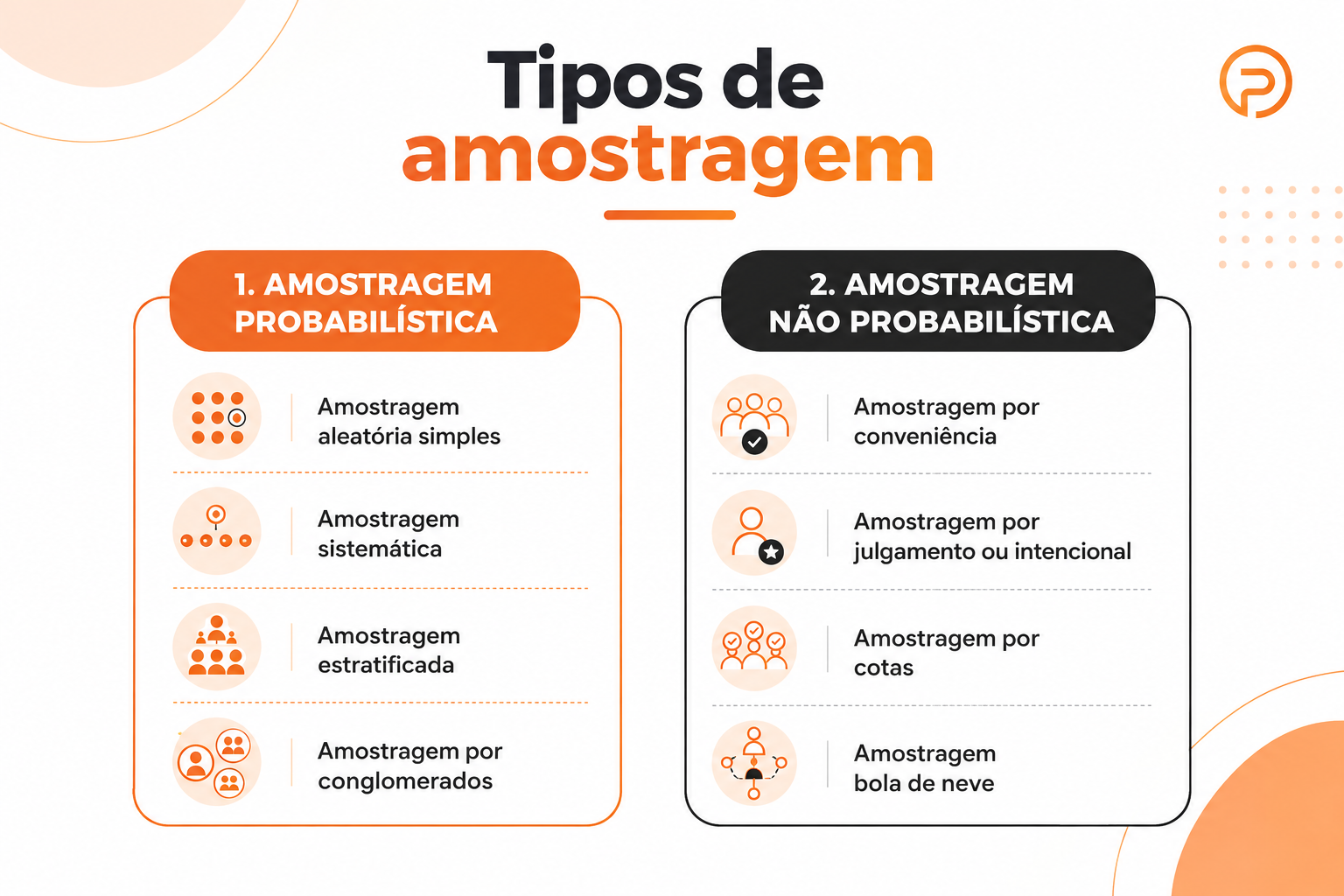
What is the difference between probabilistic sampling and non-probabilistic sampling?
The main difference between probabilistic sampling and non-probabilistic sampling lies in how participants are selected. In probabilistic sampling, selection follows a random process, and each individual in the population has a known probability of participating. In non-probabilistic sampling, participants are chosen based on criteria such as availability, convenience, researcher's judgment, or specific characteristics.
This difference directly influences the representativeness of the sample and the possibility of generalizing the results. Probabilistic sampling tends to offer greater statistical control over selection and allows estimating aspects such as margin of error, provided the research design is appropriate. Non-probabilistic sampling, on the other hand, is usually simpler, faster, and more economical, but presents a higher risk of selection bias.
| Characteristic | Probabilistic sampling | Non-probabilistic sampling |
| Participant selection | Random | Non-random |
| Probability of selection | Known | Not known |
| Representativeness | Greater potential for representativeness | May be more limited |
| Generalization of results | More suitable for inferences about the population | Should be done with caution |
| Margin of error | Can be estimated in appropriate probabilistic designs | Generally cannot be estimated in the same way |
| Time and cost | May require more planning and resources | Generally faster and more economical |
| Examples | Simple random, systematic, stratified, and cluster | Convenience, judgment, quota, and snowball |
How to choose the type of sampling for research?
There is no single method that works for all studies: the decision depends on the population being researched, the research objective, the necessary level of precision, and available resources.Here's a step-by-step guide that can help:
1. Define the research population
The first step is to determine who you want to study. This population can consist of clients, consumers, employees, students, residents of a region, or any other group related to the research objective.
The clearer the definition of the population, the easier it will be to establish criteria for selecting participants.
2. Determine the research objective
Next, define what you intend to discover with the study. Does the research aim to measure public opinion, identify behaviors, explore perceptions, or understand a specific audience?
When there is a need to obtain results that can be used to make inferences about the entire population, probability sampling tends to be more appropriate.
However, in exploratory research or research seeking to reach specific audiences, non-probability sampling may better meet the objectives.
3. Check if you have access to the population
Assess whether there is a list or database of individuals who are part of the studied population.
For example, a company with a complete customer database may be in a better position to perform a random selection. On the other hand, when there is no complete list or the audience is difficult to identify, non-probability methods may be more viable.
4. Evaluate the necessary level of representativeness
Ask: do the results need to statistically represent the entire population?
If the answer is yes, it is important to consider an appropriate probabilistic design. If the research has a more exploratory objective or is focused on understanding a certain profile of people, it may be possible to use non-probability sampling.
5. Consider time and budget
Sampling planning also needs to take into account available resources. Some methods require more planning, access to databases, and control over participant selection.
If there are time or budget limitations, a non-probability approach can be considered, provided its limitations are taken into account in the analysis of the results.
6. Choose the most suitable method
After evaluating these factors, choose the type of sampling.
If you opt for probability sampling, some possibilities are:
- Simple random: participants are chosen randomly.
- Systematic: participants are selected following a defined interval.
- Stratified: the population is divided into groups, and participants are selected within each group.
- Cluster: groups or units of the population are selected to compose the research.
If you opt for non-probability sampling, some alternatives are:
- Convenience: participants are chosen based on ease of access.
- Judgment: the researcher selects people deemed suitable for the study.
- Quota: defined quantities of participants with specific characteristics are set.
- Snowball: participants indicate other people who can participate in the research.
7. Define the sample size
After choosing the method, determine the sample size, that is, how many people need to participate in the research. This number depends on factors such as population size, confidence level, margin of error, expected variability, and sampling design.
In non-probability research, the size should also consider the study's objective, audience diversity, and available resources.
8. Establish participation criteria
Define who can or cannot participate in the research. The criteria should be clear and related to the study's objective.
For example, a survey on experience with a certain product may require the participant to have purchased or used the product in the last six months.
9. Plan data collection and monitor the sample
Finally, put the chosen method into practice and monitor the sample composition during collection. Check if certain groups are becoming underrepresented or if the selected participants truly meet the defined criteria.
How to find respondents for sampling?
After defining the population, the type of sampling, and the sample size, a practical question arises: where to find respondents to participate in the research? The answer depends on the audience profile, the defined criteria, and the chosen sampling method.
One alternative is to use proprietary databases, such as customer lists, user registrations, or company contacts. It is also possible to disseminate the research via email, social media, websites, applications, and other communication channels.
However, when the research requires a specific profile or a determined number of participants, finding the right people can become more challenging.
Use a respondent panel
An alternative is to use a respondent panel, consisting of previously registered individuals who can be invited to participate in surveys according to their profile and the study's criteria.
With a panel, the researcher can find participants with specific characteristics, such as age group, region, gender, consumption habits, and other criteria relevant to the research. This facilitates recruitment and can make data collection faster.
The PainelTAP is an option for companies and researchers who need to find respondents for market and opinion research. The platform allows directing the research to audiences according to the criteria defined in the study, facilitating access to participants.
Need to find respondents for your next research? Discover PainelTAP and find participants for your study.