Survey Respondents: A Manual for Researchers and Companies
22 min read

Whether you are a researcher, marketing professional, customer experience specialist, or someone seeking information to support strategic decisions, a challenge often arises at the very beginning of any study: finding the right survey respondents.
After all, even the best questionnaire in the world does not yield reliable results when answered by the wrong people. Data quality is directly linked to the quality of recruited participants, making the search for respondents one of the most important stages of any research project.
But how do you find people with the desired profile? How many respondents are needed? Is it worth using a research panel? And how do you ensure that the collected responses are truly relevant and representative? In this complete guide, you will understand everything you need to find the right audience for your survey.
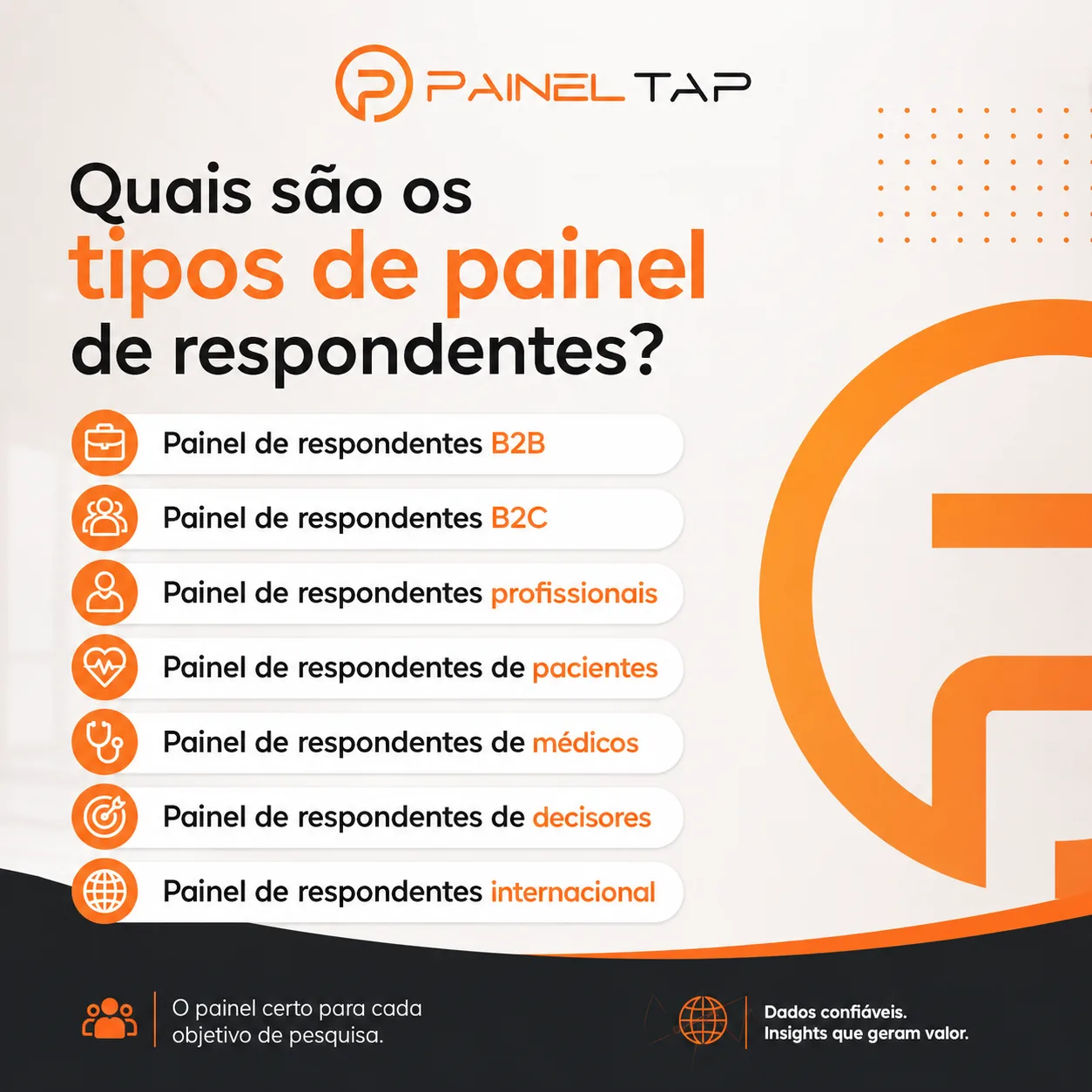
What are the types of survey respondents?
Not every survey seeks the same audience. Depending on the study's objectives, it may be necessary to speak with specific consumers. Here are some respondent segmentations you can use in your survey:
B2C Respondents
B2C respondents (Business to Consumer) are end consumers of products and services. This is one of the most common profiles in market research, customer satisfaction, consumer behavior, and product testing.
Depending on the study, criteria may include characteristics such as gender, age group, income, consumption habits, location, or purchase frequency. For example, a company that wants to evaluate the perception of a new cosmetic line might look for women between 18 and 45 years old who regularly use beauty products.
Respondents segmented by age, region, and demographic profile
In many projects, the goal is not just to find consumers, but consumers with specific characteristics. In these cases, respondents are selected based on demographic, geographic, or socioeconomic criteria.
The most common segmentations include:
- Age group
- Gender
- Region or state
- Social class and income
- Education level
- Marital status
- Presence of children in the household
This type of segmentation allows for comparing behaviors and opinions among different population groups, making the results more precise and representative.
B2B Respondents
B2B respondents (Business to Business) are professionals who represent companies and organizations. Unlike surveys aimed at end consumers, B2B studies usually address topics related to corporate processes, technology, management, purchasing, logistics, human resources, and other business environment matters.
Recruiting this audience is often more challenging, as it requires specific professional criteria and more rigorous validation of participants' profiles.
Company Decision-Makers
Within B2B research, there is a highly valued category: decision-makers. These are professionals who have direct influence or responsibility over supplier contracting, product acquisition, investments, or strategy definition.
Examples include:
- CEOs and directors
- Managers
- Coordinators with decision-making power
- Business owners
- Partners and founders
This audience is frequently recruited for research on market trends, corporate solutions, software, equipment, and specialized services.
Professionals in specific niches
Some studies require participants with very specific technical knowledge or experience. This is the case for research conducted with doctors, engineers, lawyers, architects, accountants, technology professionals, farmers, among others.
The more specific the profile, the greater the complexity of recruitment tends to be. Therefore, many companies use specialized panels or partners with experience in finding niche audiences.
Consumers of a brand
It is also common to conduct surveys with people who already use a specific brand, product, or service. In this case, the objective may be to measure satisfaction, evaluate customer experience, test new concepts, or understand brand perception.
Some examples include:
- Current customers
- Former customers
- Frequent users
- Occasional buyers
- Consumers of competing brands
These surveys help companies identify opportunities for improvement, develop new products, and strengthen relationships with their consumers.
International Respondents
Companies operating in different markets or planning to expand their operations frequently need to hear from consumers in other countries. International respondents allow for comparing behaviors, consumption habits, and perceptions across different cultures and regions.
This type of research requires special attention to factors such as language, cultural differences, local legislation, and questionnaire adaptation. Furthermore, it is important to rely on suppliers or panels that have global reach and the ability to recruit participants in various markets.
How to define the profile of respondents?
This stage directly influences the quality of the results, as a sample composed of unsuitable participants can compromise the entire analysis, regardless of the quality of the questionnaire or the methodology used. Therefore, it is essential to follow some steps. See below what they are:
Define research objectives first
The first step in defining the profile of respondents is to understand exactly what the research aims to answer. The study's objectives serve as a starting point for all recruitment-related decisions. After all, different questions require different audiences.
For example, a survey on food purchasing habits needs to hear from consumers. A study on business management software, on the other hand, requires professionals involved in this type of decision. The clearer the research objective, the easier it will be to identify who should participate.
Identify target audience characteristics
After defining the objectives, it's time to map the characteristics of the audience that possesses the necessary information for the study. This stage involves identifying aspects such as age, gender, income, location, profession, consumption habits, and interests.
Not all characteristics will be relevant for all surveys. The important thing is to select only those that truly influence the investigated topic and help compose a sample that is more aligned with the project's objectives.
Establish inclusion criteria
Inclusion criteria determine who can participate in the research. They act as filters that ensure respondents have the desired profile.
These criteria may include factors such as:
- Specific age group;
- Region of residence;
- Professional position;
- Frequency of use of a product or service;
- Purchase history;
- Belonging to a specific market segment.
The better defined the inclusion criteria, the higher the quality of recruited participants will be.
Define exclusion criteria
In addition to knowing who should participate, it is also important to determine who should not be part of the research. Exclusion criteria prevent the participation of people who may generate biases or compromise the quality of the results.
For example, a company that wants to evaluate consumers' perception of a brand may exclude employees of the organization itself or professionals who work for competitors. Similarly, frequent surveys usually limit the participation of people who regularly respond to studies.
Use quotas to balance the sample
Quotas are used to ensure that the sample adequately represents the different groups that make up the target audience. They help prevent the excessive concentration of participants with similar characteristics.
A national survey, for example, may define quotas by region, gender, or age group so that the results better reflect the reality of the studied population. This practice increases the representativeness of the sample and makes the analyses more reliable.
Consider demographic and behavioral factors
Many surveys require a combination of demographic and behavioral criteria. While demographic data helps identify who the participants are, behavioral data shows how they act in their daily lives.
Among the most used demographic factors are age, income, education, and location. Behavioral factors can include purchase frequency, app usage, consumption habits, brand preference, or experience with certain products and services.
Combining these criteria allows for building more precise and relevant profiles for the study.
Evaluate the need for specific segmentations
Depending on the project, it may be necessary to recruit highly segmented audiences. This is the case for surveys with doctors, technology managers, investors, app drivers, consumers of a specific brand, or users of certain software.
In these scenarios, profile definition needs to be even more detailed to ensure that only people with the desired experience participate in the research. The more specific the audience, the more important a structured recruitment and validation process becomes.
Validate participant profiles before the survey
Defining criteria is important, but verifying that they are actually met is indispensable. Therefore, many surveys use screening questions, also known as screening questions.
These questions are applied before the start of the main survey and aim to confirm whether the participant has the necessary characteristics to be part of the sample. This process helps increase data quality and reduces the participation of unsuitable profiles.
Review the profile before starting recruitment
Before launching the survey, it is worth reviewing all defined criteria. In some cases, excessively restrictive filters can hinder recruitment and increase costs. In others, very broad criteria can compromise the quality of the results.
A final review allows for finding the balance between recruitment feasibility and sample accuracy, ensuring that the research reaches the right participants and produces truly useful information for decision-making.
What are the main challenges in recruitment?
Finding respondents for a survey seems simple at first glance, but in practice, recruitment is one of the most challenging stages of any study.
In addition to locating people with the appropriate profile, it is necessary to ensure that they are willing to participate, respond carefully, and correctly represent the audience to be analyzed.
Here are some challenges you may face, but with knowledge, you can avoid them.
Finding people with the desired profile
One of the biggest challenges is locating participants who meet the defined criteria for the research. In some cases, finding consumers in general can be relatively simple.
In others, such as surveys with company decision-makers, specialized professionals, or users of a specific product, recruitment requires much more effort.
The more restricted the profile, the smaller the universe of eligible people will be, making the search more time-consuming and complex.
Recruiting niche audiences
Surveys aimed at specific niches often present additional challenges. Doctors of certain specialties, technology managers, investors, rural producers, or professionals in highly specialized sectors are examples of audiences that are not always easily accessible.
In these cases, recruitment usually requires qualified databases, specialized panels, or more targeted strategies to reach the right participants.
Getting a Representative Sample
It's not enough to just get responses. It's important to ensure that participants adequately represent the research's target audience. When the sample consists of very similar groups, the results may show biases and not reflect the reality of the market or population being studied.
Therefore, many surveys use quotas and segmentations to balance factors such as gender, age, region, income, and other relevant characteristics.
Reaching the Required Number of Respondents
Even when the profile is well-defined, reaching the desired number of participants can be a challenge. Low response rates, ignored invitations, and dropouts during the questionnaire are common situations that impact the final sample volume.
This scenario usually requires careful planning of invitation and recruitment strategies to ensure the survey meets its participant goal.
Avoiding Questionnaire Abandonment
Many participants start a survey but do not complete it. Long questionnaires, repetitive questions, usability issues, or lack of interest in the topic can significantly increase the abandonment rate.
In addition to reducing the number of valid responses, abandonment can compromise sample quality and increase project costs.
Ensuring Response Quality
Not every participant responds carefully. Some people may fill out questionnaires quickly just to receive a reward, while others may provide random or inconsistent answers.
Therefore, it is essential to implement quality control mechanisms, such as validation questions, consistency checks, and behavioral analyses to identify suspicious responses.
Preventing Fraud and Fake Profiles
With the growth of online surveys, challenges related to fraud have also increased. Duplicate profiles, false information, and attempts at undue participation can affect the reliability of the results.
The use of verification systems, registration validation, and behavior monitoring helps minimize these risks and protect survey quality.
Finding Respondents in Specific Regions
Some studies require participants from specific cities, states, or regions of the country. Depending on the desired location, recruitment can become more difficult, especially in areas with less internet access or lower availability of participants registered in research panels.
In these cases, it is important to use providers that have broad geographic coverage and appropriate strategies for each region.
Recruiting Decision-Makers and Busy Professionals
Executives, managers, and professionals with great responsibility usually have more restricted schedules and less availability to participate in surveys. This makes recruiting this audience more time-consuming and requires specific approaches.
Furthermore, surveys with decision-makers often require additional validation processes to ensure that participants actually hold the reported positions.
Balancing Timeline, Cost, and Quality
Every research project needs to find a balance between recruitment speed, available budget, and participant quality. Seeking very fast results can compromise sample quality, while excessively rigid criteria can increase costs and prolong the data collection period.
Therefore, one of the researcher's main responsibilities is to find the ideal combination of these three factors to meet the study's objectives.
Recruiting International Respondents
Surveys conducted in different countries bring additional challenges related to language, culture, legislation, and participant availability. A questionnaire that works well in one market may need adaptations for another.
Additionally, it is necessary to ensure that recruited participants are comparable across different markets, allowing for consistent and reliable analyses on a global scale.
How many respondents are needed for a survey?
One of the most common questions among researchers and companies is to define how many respondents are needed to obtain reliable results. The answer, however, depends on several factors, such as the study's objectives, the size of the analyzed population, the desired level of precision, and the type of research conducted.
While it's tempting to believe that more responses are always better, large volumes are not always necessary. In many cases, a well-planned sample produces more relevant results than thousands of responses collected without adequate criteria.
The most important thing is to ensure that the number of participants is sufficient to represent the studied audience and generate reliable conclusions for decision-making.
There is no single number for all surveys
The ideal number of respondents varies according to each project. A national survey on consumption habits has different needs than a study with a company's customers or a survey aimed at professionals in a specific segment.
Therefore, there is no universal answer. The sample size must be calculated considering the characteristics of the audience and the objectives of the analysis.
Population size influences the sample
The population represents the universe of people who could participate in the survey. Depending on the study, it may consist of all consumers in a category, a company's customers, or professionals in a given sector.
In general, larger populations require larger samples, but not proportionally. For example, it is not necessary to interview half the population to obtain reliable results. Statistical methods allow working with a small portion of the surveyed universe, as long as it is representative.
What is the margin of error?
The margin of error indicates the expected variation between the sample results and the actual population results.
Imagine a survey where 60% of participants state they prefer a certain brand and the margin of error is 5 percentage points. In this case, the actual result in the population will likely be between 55% and 65%.
The smaller the desired margin of error, the larger the number of respondents needed tends to be.
What is the confidence level?
The confidence level shows the degree of certainty of the obtained results. In market research, the most used levels are 90%, 95%, and 99%.
A confidence level of 95%, for example, indicates that there is a high probability that the results reflect the reality of the population within the established margin of error.
The higher the confidence level, the larger the necessary sample size usually is.
How many respondents are recommended in quantitative research?
In quantitative research, the goal is to produce statistically representative results. Therefore, larger samples are typically used.
Although the exact calculation depends on each project, some commonly used references are:
- Between 100 and 200 respondents for exploratory studies;
- Between 300 and 500 respondents for segmented analyses;
- Between 800 and 1.200 respondents for national surveys;
- More than 2.000 respondents when detailed analyses by profile or region are needed.
These numbers serve only as a reference. The ideal is always to calculate the sample considering the specific objectives of the study.
How many respondents are recommended in qualitative research?
In qualitative research, the focus is not on statistical representativeness, but on the depth of the information collected.
Therefore, the number of participants is usually significantly smaller. In many cases, in-depth interviews are conducted with 10 to 30 participants, while focus groups typically gather between 6 and 10 people per session.
The goal is to explore perceptions, motivations, and behaviors until the main themes begin to repeat, a phenomenon known as data saturation.
What happens when the sample is too small?
An insufficient sample can generate unstable results and increase the risk of erroneous conclusions. Small variations in responses end up having a much greater impact on the final results, reducing the reliability of the analyses.
Furthermore, small samples make comparisons between different profiles, regions, or audience segments difficult.
What happens when the sample is larger than necessary?
While a larger sample generally increases the precision of the results, it also requires more time and budget for recruitment and data collection.
In many cases, excessively increasing the number of respondents yields minimal statistical gains, without bringing proportional benefits to the analysis. Therefore, the goal is not to obtain the largest possible number of responses, but rather the appropriate number for the research objectives.
How to define the ideal number of respondents?
The best way to define the sample size is to jointly evaluate:
- The research objective;
- The population size;
- The desired confidence level;
- The acceptable margin of error;
- The available budget;
- The deadline for data collection;
- The need for segmentations and cross-tabulations.
When these factors are considered from the planning stage, it becomes easier to find a balance between cost, speed, and quality of results.
What channels can be used to recruit respondents?
In many cases, researchers combine different channels to broaden reach and increase the chances of finding qualified participants. Below are the main methods used to recruit respondents for surveys.
Company's own customer base
One of the most common recruitment methods is to use the company's own customer, lead, or user base. This method is especially useful for satisfaction surveys, customer experience, product evaluation, and loyalty studies.
Since participants already have a relationship with the brand, they generally show greater interest in contributing to the research. However, it is important to remember that this audience represents only current customers and may not reflect the market's perception as a whole.
Email marketing
Email remains one of the most used channels to invite participants to surveys. It allows segmenting contact lists, personalizing invitations, and tracking metrics such as open rate and response rate.
Additionally, email offers a relatively economical way to reach large volumes of people, especially when the organization already has a structured contact base.
Social media
Platforms like Facebook, Instagram, X (Twitter), TikTok, and other social networks can be used to disseminate surveys and attract participants.
This channel is particularly useful when the goal is to reach general consumers or specific audiences who already interact with certain communities and interests. However, it is important to consider that participants recruited through social media may not accurately represent the entire target population.
When the goal is to recruit professionals or B2B participants, LinkedIn is usually one of the best options.
The platform allows finding people with specific job titles, industries, hierarchical levels, and experiences. Therefore, it is widely used in surveys with executives, managers, decision-makers, and market specialists.
Specialized communities and groups
Forums, discussion groups, online communities, and professional associations can be excellent sources of recruitment for surveys that require specific audiences.
These environments bring together people with common interests, facilitating access to niches that would be more difficult to find through traditional channels. However, it is important to ensure that recruited participants align with the criteria defined for the study.
WhatsApp and messaging apps
Messaging apps have become popular tools for inviting participants and sharing survey links.
WhatsApp, for example, allows for quick and direct communication, increasing the chances of invitations being viewed. This channel usually works well for surveys with customers, specific communities, and audiences already known to the organization.
Paid ads
Paid media campaigns on platforms like Google, Facebook, Instagram, and LinkedIn can be used to expand the survey's reach and attract respondents with specific characteristics.
The main advantage is the possibility of segmentation by location, age, interests, profession, and various other criteria. This approach is especially useful when there is no proprietary contact base or when the desired audience is difficult to reach.
Events and in-person surveys
Depending on the study's objectives, recruitment can also occur at events, trade shows, points of sale, commercial establishments, or high-traffic locations.
This method is frequently used in in-person surveys, product tests, consumer experience studies, and evaluations conducted in specific environments.
Referrals and recruitment by reference
Another strategy used is to ask participants to refer other people who meet the research criteria. This method, known as referral recruitment, can be particularly useful for finding niche audiences or hard-to-reach groups.
Although efficient in some scenarios, it is important to monitor for possible biases, as referred participants often have similar characteristics to those who made the referral.
Respondent panel
Respondent panels are one of the most widely used solutions by companies, research institutes, and researchers who need to recruit participants quickly and accurately.
The main advantage of this model is the ability to quickly find respondents who meet specific profiles, without the need to start recruitment from scratch for each new study.
In addition, many panels have validation and quality control processes that help reduce fraud and ensure more reliable responses.

What is a respondent panel?
A respondent panel is an organized database of people who voluntarily register to participate in surveys and share their opinions on products, services, brands, and various topics. These people provide information about their profile, such as age, location, income, profession, consumption habits, and interests, allowing researchers to find participants aligned with the objectives of each study.
In practice, panels act as a bridge between researchers and respondents. Instead of starting a new recruitment process every time a survey is conducted, researchers can access an already structured database of pre-registered and segmented participants. This makes the collection process faster, more efficient, and more predictable.
What are the advantages of recruiting respondents with a panel?
By bringing together thousands of pre-registered and segmented participants, panels make recruitment faster, more efficient, and more reliable. In addition, there are other advantages, such as:
Faster recruitment
One of the biggest advantages of respondent panels is speed. Since participants are already part of a structured database, there is no need to start a new search process for each survey.
While traditional methods can take days or weeks to find suitable participants, a panel allows respondents to be located and invited in a matter of hours, significantly accelerating data collection.
Greater precision in segmentation
Panels store detailed information about their participants, allowing profiles to be filtered based on specific criteria.
It is possible to recruit respondents considering characteristics such as:
- Age;
- Gender;
- Region;
- Income;
- Education;
- Profession;
- Consumption habits;
- Use of products or services;
- Position and industry.
This segmentation capability helps ensure that only people aligned with the research objectives are part of the sample.
Ease of finding niche audiences
The more specific the target audience, the greater the recruitment challenge usually is. Finding doctors, technology professionals, financial managers, consumers of a certain category, or users of a specific brand can take a long time when traditional channels are used.
Panels facilitate this process by bringing together a wide variety of registered profiles, increasing the chances of quickly locating participants who meet more complex requirements.
Greater geographical reach
Surveys frequently need to hear from people in different cities, states, or countries. Recruiting geographically distributed participants can be a difficult task when relying solely on proprietary databases or dissemination through specific channels.
With a respondent panel, it is possible to reach audiences in various regions in a centralized way, expanding research coverage and facilitating national or international studies.
Better sample control
Panels allow real-time monitoring of sample composition and control of the filling of quotas defined for the study.
This helps ensure balance between different participant groups, avoiding an excess of responses from certain profiles and increasing the representativeness of the results.
Reduced operational effort
Without a panel, much of the researcher's time can be consumed by recruitment activities, screening, profile validation, and collection monitoring.
By using a structured respondent database, these tasks are simplified, allowing the team to dedicate more attention to data analysis and insight generation.
Higher quality of collected data
The best panels continuously invest in validation and monitoring mechanisms to ensure the quality of responses.
Among the most common practices are:
- Verification of registration data;
- Identification of duplicate profiles;
- Control of excessive participation;
- Detection of inconsistent responses;
- Behavior monitoring during the survey.
These processes help reduce fraud and increase the reliability of the results obtained.
Scalability for different types of research
Panels can serve everything from small qualitative studies to large quantitative surveys with thousands of participants.
This flexibility allows companies and researchers to use the same structure for different objectives, audiences, and methodologies, making recruitment more efficient regardless of project size.
Better cost-efficiency ratio
Although there is an investment involved in using a panel, the model usually generates savings when compared to the time and resources needed to recruit participants manually.
In addition to reducing operational costs, faster recruitment and higher sample quality help avoid rework and project delays.
More predictability in collection results
One of the biggest difficulties of traditional recruitment is uncertainty. It is not always possible to know how many people will respond to invitations or how long it will take to reach the desired sample.
Panels offer greater predictability regarding the volume of available participants, collection deadlines, and the feasibility of recruiting certain profiles, allowing for safer and more efficient planning.
What is the best panel for recruiting research participants?
There are several respondent panels available on the market, and the best choice depends on the needs of each project.
However, PainelTAP stands out as a solution developed to connect researchers and qualified participants.
We connect your research with a diverse base of respondents. This allows for recruiting different audience profiles, from general consumers to segmented audiences, specialized professionals, and business decision-makers.
In addition to the variety of profiles, we offer resources that help make recruitment faster and more efficient, reducing the time needed to find participants aligned with the research criteria.
This allows companies, institutes, and researchers to focus their efforts on data analysis and insight generation, without having to face the challenges of recruiting respondents from scratch for each new project.
Need to find participants for your next research?
PainelTAP connects your research to the ideal respondents, helping you recruit with greater speed, quality, and security. Schedule a demonstration and discover how we can support your next project.