Snowball Sampling: what it is, how it works, and when to use it
5 min read
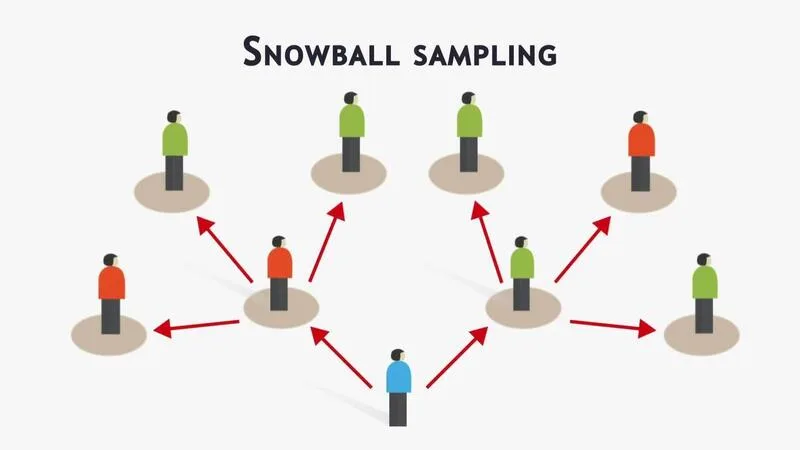
Snowball sampling is an essential methodological technique for research that seeks to understand specific audiences, sensitive contexts, or hard-to-reach groups. Unlike traditional probabilistic methods, this approach prioritizes social relationships and successive referrals, which makes the data collection process more flexible and strategic.
Next, understand in depth how snowball sampling works, when to use it, what its advantages, limitations, and best practices are for application in academic and market research.
What is snowball sampling?
Snowball sampling, also called snowball sampling, is a type of non-probabilistic sampling. In this method, the researcher begins the study with a small number of participants who meet the research criteria. Then, these participants refer other people with similar characteristics, gradually expanding the sample.
Thus, the selection of respondents occurs through relationship networks, and not by random drawing. As a result, the method proves especially effective when there is no formal or accessible list of the target audience.
Read also: Sampling Calculator for surveys
How does snowball sampling work step by step?
To ensure the effectiveness of the method, it is important to follow a structured sequence. See the main steps:
1. Clear definition of participant profile
First of all, the researcher defines objective criteria, such as demographic, behavioral, or professional characteristics. This step is fundamental to avoid deviations during data collection.
2. Identification of initial participants
Next, the researcher selects the so-called key participants. Normally, these people have a strong connection with the studied group and a high capacity for referral.
3. Data collection and request for referrals
After initial participation, the researcher asks each respondent to refer other people who fit the defined profile. Thus, the sample begins to grow organically.
4. Progressive sample expansion
As new referrals emerge, the process repeats. Consequently, the network of participants expands, increasing the diversity of experiences within the same group.
5. Reaching theoretical saturation
Finally, the researcher ends data collection when responses begin to repeat. At this point, it is understood that the research has reached sufficient depth for analysis.
Read also: How does quota sampling work in practice?
When to use snowball sampling?
Snowball sampling is mainly indicated in specific situations. Among the main scenarios, the following stand out:
-
Research with hard-to-reach audiences
-
Exploratory and qualitative studies
-
Investigations into sensitive behaviors
-
Analyses with highly specialized professionals
-
Research with closed or niche communities
Therefore, whenever traditional methods are not feasible, snowball sampling emerges as a strategic alternative.
Read also: Judgment Sampling: How it works and when to apply it
Main advantages of snowball sampling
Undoubtedly, this method presents relevant benefits. First, it facilitates access to restricted groups, eliminating initial contact barriers.
Furthermore, trust between researcher and participants tends to be greater, as referrals come from pre-existing relationships. As a result, respondents usually provide richer and more detailed information.
Another important point is the reduction of costs and time. Instead of investing in large recruitment campaigns, the researcher uses the participants' own network to expand the sample.
Read also: Why choose convenience sampling?
Limitations and precautions when using snowball sampling
Despite the advantages, snowball sampling requires careful attention and planning. First, because it is a non-probabilistic sampling, the results obtained cannot be generalized to the entire population. This means that the findings must be interpreted within the specific context studied, and not as broad statistical representations.
Furthermore, there is a risk of homogeneity bias. As participants tend to refer people similar to themselves, whether in behavior, professional profile, or worldview, the diversity of the sample may become limited during data collection. Consequently, certain perspectives may be underrepresented.
For this reason, whenever possible, it is recommended to start the study with participants of varied profiles within the same target group. In this way, the researcher expands the reach of referrals and reduces excessive concentration in a single social or professional segment.
Read also: What is systematic sampling and how to apply it in market research
Best practices for applying snowball sampling
To ensure consistent results in snowball sampling, it is essential to follow some recommendations throughout the entire research process:
-
Define clear criteria from the beginning: this step guides the selection of participants and ensures that referrals are aligned with the study objectives, avoiding methodological deviations.
-
Diversify initial participants: starting data collection with distinct profiles within the target audience expands the variety of perspectives and reduces the risk of an excessively homogeneous sample.
-
Monitor for possible biases: as referrals occur through relationship networks, it is essential to monitor the concentration of profiles and adjust recruitment whenever necessary.
-
Record the referral path: documenting who referred whom increases process transparency and facilitates the identification of patterns that may influence the results.
-
End data collection upon reaching saturation: when information begins to repeat, continued collection no longer adds analytical value and can be safely concluded.
In this way, by applying these best practices in an integrated manner, the researcher ensures greater quality, reliability, and consistency of the data obtained.
Read also: What is cluster sampling and how to apply it in practice
Snowball sampling as a decision-making tool
In summary, snowball sampling is a powerful technique for research that requires access to specific audiences and in-depth information. Although it does not offer statistical representativeness, it provides data richness, agility, and greater proximity to the studied audience, especially in contexts where traditional recruitment is limited.
In this scenario, Painel TAP acts as a strategic ally by supporting research that demands precise segmentation and qualified access to different respondent profiles. By combining methodology, technology, and experience in data collection, the company contributes to techniques such as snowball sampling being applied in a structured, ethical, and information quality-oriented manner.
Therefore, by correctly aligning research objectives with the data collection method and relying on specialized partners like Painel TAP, snowball sampling consolidates itself as a strategic tool for more assertive, consistent, and data-driven decisions.
Read also: Stratified Sampling: fundamentals, applications, and advantages