Questionnaire Questions: Types and Examples for Your Research
32 min read

Questionnaire questions are the foundation of any successful survey. Whether it's to understand customer satisfaction, validate a product idea, learn about consumption habits, or collect employee feedback, the quality of the questions directly influences the quality of the data obtained.
When they are clear, objective, and aligned with the research objective, they help generate more precise answers and truly relevant insights for decision-making.
But creating good questions goes far beyond simply drafting a form. It's necessary to choose the right type of question, avoid biases, strategically organize the sequence, and consider the experience of the respondent. Small adjustments in wording can make a big difference in the final results.
In this complete guide, you will understand the main types of questionnaire questions, learn best practices for drafting them, and check practical examples for different research objectives. All to help you build more efficient questionnaires and obtain more reliable information.
What is the importance of questionnaire questions?
Even with a good sample and an efficient platform, poorly formulated questions can compromise results and lead to mistaken conclusions.
Therefore, investing time in constructing clear, relevant, and well-structured questions is essential to obtain reliable insights and support more assertive decisions. Understand the main reasons why they are so important.
Ensure the quality of collected data
The quality of responses is directly linked to the quality of the questions. When a question is clear and objective, the participant can understand exactly what is being asked and respond with greater precision.
This reduces misinterpretations and increases the reliability of the data generated by the research.
Influence decision-making
Companies, organizations, and researchers use questionnaires to support strategies, identify opportunities, and solve problems. When questions are well-formulated, the results better reflect reality and help in making more secure decisions.
Conversely, poorly structured questions can generate incomplete or distorted information, compromising analyses and planning.
Increase response rate
Questionnaires with simple, objective, and relevant questions tend to be more pleasant to answer. This contributes to a better participant experience and reduces the chances of survey abandonment.
When respondents perceive that the questions make sense and do not require excessive effort to be understood, the probability of completing the questionnaire is higher.
Reduce research biases
Biased questions or questions that suggest a specific answer can influence participants' opinions and compromise the impartiality of the results.
Good question construction helps minimize biases, allowing responses to reflect respondents' real perceptions.
Facilitate results analysis
Well-structured questions make data more organized and easier to interpret. This simplifies the analysis stage and allows for faster identification of patterns, trends, and opportunities.
Furthermore, consistent responses contribute to the creation of more reliable and useful reports for the business.
Allow for better understanding of the audience
The right questions help reveal participants' behaviors, needs, expectations, and opinions. This information is valuable for better understanding customers, employees, consumers, or any other surveyed audience.
The more aligned the questions are with the research objectives, the richer the insights obtained will be.
Contribute to more efficient research
An efficient questionnaire is not necessarily the longest, but rather the one that asks the right questions. When each question has a clear purpose, the research becomes more objective, reduces response time, and increases the quality of the information collected.
This balance benefits both those who respond and those who analyze the results.
Generate insights that drive improvements
The responses obtained through well-designed questions can reveal innovation opportunities, areas for improvement in products and services, market trends, and important perceptions about customer experience.
How do questions influence the quality of results?
The quality of a survey directly depends on the quality of the questions that compose it. After all, they guide the collection of information and determine how participants will interpret and respond to the questionnaire.
Even with an adequate sample and a good participation rate, poorly formulated questions can generate inconsistent data, hindering analyses and compromising decisions.
Therefore, understanding how questions influence results is fundamental for creating more reliable research and obtaining truly relevant insights.
Determine the accuracy of responses
Clear and objective questions help participants understand exactly what is being asked. This reduces misinterpretations and increases the accuracy of collected responses.
When a question is confusing or ambiguous, different people may understand it in different ways, generating less consistent and more difficult-to-analyze data.
Impact data reliability
Reliable results depend on responses that faithfully represent participants' opinions, behavior, or experience. Well-formulated questions contribute to the collected information being more consistent and closer to reality.
Conversely, poorly structured questions can introduce errors that compromise the quality of the research as a whole.
Influence respondent behavior
The way a question is written can influence how people respond. Biased questions, which suggest an opinion or direct a specific answer, can generate biased results.
Therefore, neutrality is essential to ensure that the data reflects participants' real perceptions.
Affect survey completion rate
Questionnaires with long, repetitive, or difficult-to-understand questions tend to generate more dropouts during completion.
When questions are simple, relevant, and well-organized, the experience becomes more fluid, increasing the chances that participants will complete the survey to the end.
Facilitate or hinder results analysis
The structure of the questions also impacts the analysis stage. Objective questions aligned with the research objectives generate more organized data, facilitating the identification of patterns and trends.
When questions are vague or ill-defined, the results can become difficult to interpret and transform into actionable insights.
Reduce the risk of biases
Biases can arise when a question favors a certain answer, uses opinion-laden terms, or presents unbalanced alternatives.
Careful formulation helps minimize these problems, making the results more impartial and representative.
Ensure alignment with research objectives
Each question should have a clear purpose within the questionnaire. When questions are aligned with the research objectives, the collected data tends to be more relevant and useful for decision-making.
Questions that do not contribute to answering the defined hypotheses or objectives can increase the questionnaire's length without adding value to the results.
Improve insight generation
The better the questions, the more valuable the information obtained. Accurate and reliable data allows for identifying opportunities, understanding behaviors, evaluating experiences, and supporting strategic decisions with greater confidence.
In other words, the insights generated by a survey are only as good as the questions that gave rise to the responses. Therefore, paying attention to questionnaire design is one of the most important factors for the success of any research.
What are the main errors in questionnaire questions?
Many surveys do not fail due to a lack of participants or problems in data analysis. In fact, results are often compromised much earlier: in the formulation of the questions.
A questionnaire may seem well-structured at first glance, but small errors in question wording are enough to generate imprecise, biased, or difficult-to-interpret responses.
The good news is that most of these problems can be avoided with planning and attention to detail. Here are some errors you should avoid:
Asking questions with confusing language
When respondents have to reread a question multiple times to understand it, there's a problem. Complex terms, long sentences, or unclear constructions increase the chances of different interpretations.
The simpler and more direct the question, the more reliable the answers tend to be.
Mixing two topics in the same question
A very common mistake is trying to collect two pieces of information at the same time in a single question.
For example: “Are you satisfied with the quality and price of the product?” In this case, the participant might be satisfied with the quality but dissatisfied with the price. How can they choose only one option?
The ideal is to divide different topics into separate questions.
Leading a response
Biased questions influence the participant's opinion and compromise the impartiality of the results.
Expressions like “Do you agree that our excellent service deserves a high rating?” direct the respondent to a specific answer. A good question should be neutral and allow opinions to be expressed freely.
Using vague or subjective terms
Words like “frequently,” “sometimes,” “regularly,” or “very” can mean different things to different people.
Whenever possible, replace subjective terms with more specific criteria, such as time periods, quantities, or rating scales.
Creating incomplete response alternatives
The error is not always in the question. In many cases, the problem lies in the response options.
Limited alternatives or those that do not cover all possibilities can force the participant to choose an answer that does not represent their reality. This reduces the accuracy of the collected data.
Asking unnecessary questions
Each question should have a clear purpose within the survey. Questions that do not contribute to the study's objectives increase response time and can lead to participant fatigue.
Furthermore, excessively long questionnaires often have higher abandonment rates.
Not considering the audience profile
A question suitable for specialists might be incomprehensible to general consumers. Similarly, technical terms can deter participants who are not familiar with a particular subject.
Adapting the language to the audience profile is essential to ensure a good experience and more precise answers.
Not testing the questionnaire before application
Many flaws only become visible when someone responds to the survey. Confusing questions, logic problems, and inappropriate alternatives can go unnoticed during creation.
Conducting a pre-test with a small group helps identify these points and correct problems before official data collection.
Ignoring the order of questions
The sequence of questions influences how participants respond. Sensitive questions at the beginning or abrupt changes in subject can cause discomfort and harm engagement.
A logical and fluid structure makes the experience more natural and contributes to the quality of responses.
Not reviewing the questionnaire
Typographical errors, inconsistencies in scales, repeated questions, and drafting flaws can affect the credibility of the research and cause confusion among participants.
A final review is a simple but fundamental step to ensure the questionnaire is ready to produce reliable results.
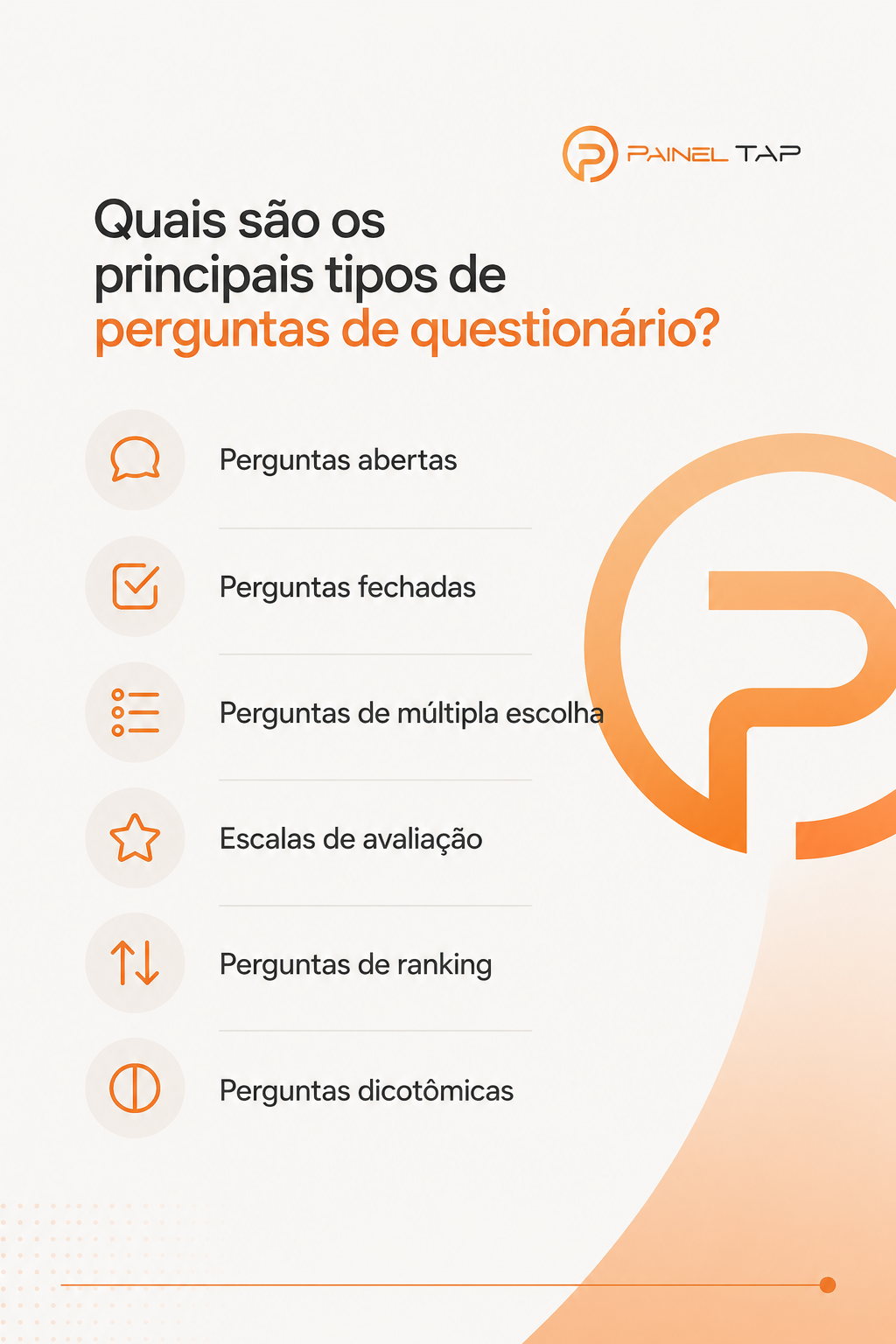
What are the main types of questionnaire questions?
Each type of question has specific characteristics and works best in certain situations. Below, learn about the main formats used in questionnaires and when each of them can be applied.
Open-ended questions
Open-ended questions allow participants to answer freely, using their own words. In this format, there are no predefined alternatives, which makes it possible to collect opinions, perceptions, feelings, and suggestions in greater depth.
This type of question is especially useful when the objective is to understand the context behind an answer or to explore topics that cannot be limited to fixed options.
Example:
- What do you consider most important in quality customer service?
- How was your experience with our product?
Although they generate rich insights, open-ended questions usually require more time from participants and make data analysis more complex.
Closed-ended questions
Closed-ended questions present predefined answer options, allowing the participant to choose one of the available alternatives.
This format facilitates the comparison of results, makes analysis faster, and reduces the subjectivity of answers. For this reason, it is one of the most used models in quantitative research.
Example:
- How often do you use our app?
- Daily
- Weekly
- Monthly
- Rarely
Closed-ended questions are ideal when the possible answers that the participant may provide are already known.
Multiple-choice questions
Multiple-choice questions are a variation of closed-ended questions. In this format, the participant can select one or more alternatives from the options presented.
They are widely used to identify preferences, behaviors, consumption habits, or characteristics of a specific audience.
Example:
- Which channels do you use to contact companies?
- Phone
- Online chat
- Social media
Depending on the research objective, it is possible to allow only one choice or multiple selections.
Rating scales
Rating scales are used to measure intensity, satisfaction, agreement, effort, or perception about a given topic.
In this format, the participant assigns a score or chooses a level within a predefined scale. It is one of the most efficient ways to transform opinions into quantitative data.
Example:
- On a scale of 1 to 5, what is your level of satisfaction with the service received?
- How much do you agree with the statement: “The process was easy to complete”?
This type of question is widely used in metrics such as NPS, CSAT, and CES.
Ranking questions
Ranking questions ask participants to organize options in order of preference, importance, or priority.
This format helps identify which factors are most relevant to the surveyed audience and allows comparing priorities among different groups of respondents.
Example:
- Rank the factors below from most important to least important:
- Price
- Quality
- Service
- Delivery time
Ranking questions are widely used in market research and consumer behavior studies.
Dichotomous questions
Dichotomous questions offer only two answer options, usually opposite to each other.
The most common example is the “Yes” or “No” format, but alternatives such as “Agree” or “Disagree,” “True” or “False,” among other binary combinations, can also be used.
Example:
- Have you used our service before?
- Yes
- No
Because they are simple and quick to answer, dichotomous questions are very useful for audience segmentation, survey filters, and initial qualification questions.
How to write clear and objective questions?
Writing clear and objective questions is one of the most important steps in creating a questionnaire. After all, the easier it is to understand a question, the higher the quality of the information collected. Check out the best practices.
Use simple language
The first step is to write as simply as possible. Complex words, technical terms, and little-known expressions can make it difficult to understand the question.
Whenever possible, prefer accessible language appropriate to the profile of the audience that will answer the survey.
Example:
Less clear:
- What is your degree of satisfaction regarding the usability of the platform?
More clear:
- How satisfied are you with the ease of use of the platform?
Ask only one question at a time
One of the most common mistakes is to combine two different topics into a single question. This can confuse the participant and make the answer imprecise.
Each question should address only one specific topic.
Example:
Less clear:
- Are you satisfied with the service and price of our services?
More clear:
- Are you satisfied with the service?
- Are you satisfied with the price of our services?
Be specific
Generic questions can generate vague and difficult-to-interpret answers. Whenever possible, make the context of the question clear.
The more specific the question, the more precise the answers tend to be.
Example:
Less clear:
- Do you use our services frequently?
More clear:
- How many times have you used our services in the last 30 days?
Avoid ambiguous terms
Some words can have different meanings for each person. Terms like “regularly,” “sometimes,” “frequently,” or “very” are subjective and can lead to varied interpretations.
Whenever possible, replace these expressions with objective criteria.
Example:
Less clear:
- Do you often shop online frequently?
More clear:
- How many online purchases have you made in the last three months?
Eliminate unnecessary information
Long questions require more reading effort and increase the chances of confusion. The ideal is to convey the message with the fewest possible words, without losing context.
Before finalizing a question, check if all words are truly necessary.
Avoid biased questions
An objective question should not suggest a specific answer. When the wording conveys an opinion or expectation, the results can be biased.
The ideal is to maintain neutral and impartial language.
Example:
Less clear:
- Do you agree that our excellent technical support deserves a positive evaluation?
More clear:
- How do you rate the technical support received?
Adapt the language to the audience
The same question can work in different ways depending on who is answering. A specialized audience can easily understand technical terms, while general consumers may struggle.
Knowing the participants' profile helps choose more appropriate words and improve the understanding of the questions.
Choose clear scales and alternatives
When using closed-ended questions, it is important that the response options are easy to understand and leave no room for doubt.
The alternatives should be consistent, balanced, and represent all relevant possibilities.
Example:
- Very satisfied
- Satisfied
- Neither satisfied nor dissatisfied
- Dissatisfied
- Very dissatisfied
Read the question as a respondent
After writing a question, try to analyze it from the perspective of someone who will answer it. Ask yourself:
- Is there more than one way to interpret this question?
- Is the answer I want to obtain clear?
- Would the participant understand this question quickly?
This simple exercise often reveals problems that go unnoticed during questionnaire creation.
Conduct tests before application
Even questions that seem clear can generate doubts when put into practice. Therefore, conducting a pilot test with a small group of participants is an important step.
In addition to identifying confusing questions, the test helps evaluate response time and the overall questionnaire experience.
Clarity generates better results
Clear and objective questions make the experience simpler for those who answer and more valuable for those who analyze the data. When participants understand exactly what is being asked, responses tend to be more accurate, consistent, and useful for decision-making.
How to avoid biased questions?
When a question suggests an answer, conveys an opinion, or influences the participant's perception, the results may cease to reflect reality and instead represent the direction created by the research itself.
This type of problem is known as question bias. Although it often happens involuntarily, it can compromise data quality and lead to mistaken conclusions. Therefore, knowing how to identify and avoid biased questions is fundamental to obtaining more accurate and reliable results.
Use neutral language
One of the most effective ways to avoid bias is to use neutral language. The question should present the topic without conveying judgments, opinions, or expectations about which answer is considered correct.
When the wording seems to favor a specific alternative, the participant may feel influenced to answer in a certain way.
Example:
Biased question:
- Do you agree that our exceptional service deserves a positive evaluation?
Neutral question:
- How do you rate the service received?
Avoid emotionally charged words
Some terms carry positive or negative emotions and can influence respondents' perception.
Words like “excellent,” “incredible,” “problematic,” “bad,” or “disappointing” often induce judgments even before the person answers the question.
Whenever possible, replace these terms with objective and impartial descriptions.
Do not suggest the desired answer
The participant should not feel that there is an expected answer from the company, researcher, or organization.
When the question suggests a specific position, the results may be artificially skewed towards a certain side.
Example:
Biased question:
- Don't you think our new app made the process much simpler?
Neutral question:
- How do you rate the ease of use of the new app?
Avoid presuppositions
A question should not assume that all participants had the same experience or share a certain opinion.
When this happens, people who do not identify with the premise may be left without an adequate answer.
Example:
Biased question:
- What was your favorite part of our event?
Neutral question:
- How would you rate your experience at the event?
The second option allows for positive, negative, or neutral responses.
Be careful with negative questions
Questions formulated with negations can cause confusion and increase the chance of incorrect answers.
In addition to making comprehension difficult, they can influence how the participant interprets the question.
Example:
Less clear:
- Don't you consider that the process was not complicated?
More clear:
- How do you rate the ease of the process?
The simpler the sentence structure, the lower the risk of misinterpretations.
Offer balanced alternatives
In closed-ended questions, response options can also introduce bias.
If the alternatives are unbalanced or present more positive than negative options, the results may be distorted.
Inadequate example:
- Excellent
- Very good
- Good
- Fair
In this case, practically all options have a positive connotation.
Adequate example:
- Very satisfied
- Satisfied
- Neither satisfied nor dissatisfied
- Dissatisfied
- Very dissatisfied
This structure offers balance and allows for different positions.
Avoid combining facts and opinions
Mixing factual information with an opinion can influence the participant and affect the neutrality of the question.
Example:
Biased question:
- Considering that our product has received several awards, how do you rate its quality?
Neutral question:
- How do you rate the quality of the product?
Additional information can create an expectation that influences the answer.
Review questions with a critical eye
After preparing the questionnaire, it is worth analyzing each question for possible signs of bias.
Ask yourself:
- Does the question suggest an answer?
- Is there any opinion-laden term?
- Can the participant answer freely?
- Are the alternatives balanced?
This review helps identify problems before the survey is administered.
Conduct a pilot test
Even questions that seem neutral can be interpreted differently by participants. A pilot test allows identifying possible biases and adjusting the wording before official data collection.
In addition, participant feedback helps verify if the questions are truly being understood as intended.
How many questions should a questionnaire have?
There is no ideal number of questions that works for all types of research. The appropriate quantity depends on the study's objectives, the audience's profile, and the complexity of the information that needs to be collected.
However, one rule usually applies in almost all scenarios: a questionnaire should only have the necessary questions to answer the research objectives.
Many people believe that a longer questionnaire generates more information and, consequently, better results. In practice, this is not always the case.
Extensive surveys can cause participant fatigue, increase abandonment rates, and reduce the quality of responses. As the respondent loses interest or feels tired, the tendency to answer quickly, without the necessary attention, increases.
On the other hand, excessively short questionnaires can also be a problem. When there are too few questions, there is a risk of not collecting enough information to understand the context of the responses or achieve the research objectives. The challenge is to find the balance between depth and practicality.
Generally, satisfaction surveys, customer experience or feedback tend to work better when they can be answered in a few minutes. Market studies, product evaluations, or academic surveys may require a larger number of questions, provided that each one has a clear and relevant purpose.
A good practice is to evaluate each question individually and ask yourself: “Will this information actually be used in the analysis or decision-making?” If the answer is no, the question can probably be removed. This exercise helps eliminate redundant questions and keep the questionnaire more objective.
It is also important to consider the format of the questions. Open-ended questions require more time and effort from the participant than closed-ended questions or rating scales. Therefore, even a questionnaire with a few open-ended questions may require more response time than a larger survey composed only of objective alternatives.
In addition to the number of questions, the completion time is an important indicator. In many cases, thinking about the duration of the survey is more efficient than focusing only on the number of questions. A questionnaire that can be completed quickly and without excessive effort tends to generate greater engagement and more consistent responses.
Examples of questionnaire questions
Creating an efficient questionnaire goes beyond choosing the appropriate question type. It is also important to formulate questions aligned with the research objective and the audience that will answer it. Depending on the context, some questions can generate valuable insights into satisfaction, experience, behavior, market, or product perception.
Below, check out examples of questions for different types of research that can serve as inspiration for building your questionnaires.
Questions for satisfaction surveys
Satisfaction surveys help understand how customers, consumers, or users evaluate an experience, service, or product.
- On a scale of 0 to 10, what is your level of satisfaction with our product?
- Did the service you received meet your expectations?
- How satisfied are you with the quality of our service?
- How do you rate our team's response time?
- Did the product solve your need?
- What contributed most to your satisfaction?
- What could we improve in your experience?
- Would you use our services again?
- How do you rate the cost-benefit of the product?
- What score would you give for your overall experience with us?
Questions for customer experience (CX)
Customer experience surveys seek to understand the entire consumer journey and identify areas for improvement at different interaction points.
- Was the purchase process easy to complete?
- Did you quickly find the information you were looking for?
- How do you rate the navigation on our website or app?
- Was the service provided helpful in resolving your need?
- Was there any moment in your journey that caused difficulty?
- How much effort did you have to make to resolve your request?
- Did you feel valued during your interaction with the company?
- How do you rate the communication received throughout the journey?
- Which stage of the experience could be improved?
- How likely are you to recommend our company to friends or colleagues?
Questions for market research
Market research helps companies understand consumer behaviors, habits, needs, and preferences.
- How often do you use products in this category?
- What factors most influence your purchase decision?
- Which brands do you consider when purchasing this type of product?
- What is most important to you: price, quality, or service?
- Where do you usually research before making a purchase?
- What price range do you consider appropriate for this product?
- What problems do you seek to solve with this type of solution?
- What attracts you most to a brand?
- Is there any need you feel is not met by the market?
- What trends do you believe will be most important in the coming years?
Questions for organizational climate surveys
Organizational climate surveys help assess employees' perception of the work environment, leadership, and company culture.
- How do you rate the company's work environment?
- Do you feel valued for your work?
- Does your manager offer support when needed?
- Do you believe there is good communication between teams?
- How do you rate professional growth opportunities?
- Do you feel that your opinion is considered in company decisions?
- Is the work-life balance satisfactory?
- Would you recommend the company as a good place to work?
- What contributes most to your motivation at work?
- What improvements could make the work environment more positive?
Questions for product testing
Product testing surveys allow collecting feedback before or after the launch of a solution, helping to identify improvement opportunities.
- What was your first impression when using the product?
- Was the product easy to use?
- Did you encounter any difficulties during use?
- Did the product meet your expectations?
- Which feature did you find most useful?
- Was there any feature you missed?
- How do you rate the product's design?
- Did the product solve the problem you expected to solve?
- What could be improved in the user experience?
- Would you buy or continue using this product after the test?
How to avoid questionnaire abandonment?
The abandonment rate can directly impact the quality of the research, reducing the number of responses and creating possible distortions in the results. Therefore, in addition to developing good questions, it is essential to think about the respondent's experience throughout the completion.
Check out the main strategies to reduce abandonment and increase questionnaire completion.
Keep the questionnaire objective
One of the main reasons for abandonment is the excessive number of questions. Very long questionnaires require more time and effort from the participant, increasing the chances of abandonment.
Before including a new question, evaluate whether that information will actually be used in the analysis of the results. Questions without a clear objective make the survey more tiring and can harm the quality of the responses.
The ideal is to find a balance between collecting sufficient information and respecting the respondent's time.
Inform the necessary time to respond
People tend to be more engaged when they know what to expect. Informing approximately how long the questionnaire will take to complete helps create a realistic expectation and reduces the feeling of effort.
A simple message like “This survey takes about 3 minutes to complete” can increase confidence and encourage participation until the end.
Start with simple questions
The first questions play an important role in participant engagement. Very complex, personal, or questions that require a lot of reasoning right at the beginning can lead to abandonment.
A good practice is to start with easy and quick-to-answer questions, creating a more fluid experience before moving on to more specific topics.
Use clear and accessible language
Questions that are difficult to interpret make the participant waste time trying to understand what is being asked.
Avoid technical terms, very long sentences, and confusing constructions. The simpler and more direct the communication, the more comfortable the completion experience will be.
Avoid repetitive questions
Repeating questions with small variations can cause frustration and give the impression that the survey is longer than it should be.
Each question should add new relevant information. When two questions seek to understand the same point, evaluate whether it is possible to combine or eliminate one of them.
Organize the questionnaire in a logical sequence
The order of questions influences the participant's experience. Abrupt changes of subject or a disorganized structure can cause confusion and reduce interest in continuing.
A well-planned sequence should follow a natural logic, leading the respondent from more general questions to more specific ones.
Use different question formats
A questionnaire consisting of only one type of question can become tiring. Varying between multiple-choice questions, rating scales, and some open-ended questions helps maintain participant interest.
However, it is important to use each format with a clear objective and avoid unnecessary complexity.
Ensure a good experience on mobile devices
Most surveys are currently answered on mobile phones. A questionnaire that does not work well on smaller screens can cause difficulties and increase abandonment.
Make sure that the questions are easy to view, that the fields are simple to fill in, and that navigation is intuitive on different devices.
Avoid requesting too much personal information
Questions about personal data or sensitive information can cause discomfort and lead participants to abandon the survey.
Always assess whether this information is truly necessary and explain the reason for collection when relevant. Transparency increases respondent trust.

Show survey progress
When possible, presenting a progress bar or indicating how many steps are left helps participants understand how much more time will be needed.
Having a sense of progress reduces the feeling that the questionnaire is endless and increases motivation to complete it.
Offer a positive closing experience
The end of the survey also influences the participant's perception. A thank-you message shows appreciation for the time dedicated and improves the overall experience.
When applicable, it is also possible to inform how the responses will be used, reinforcing the importance of the contribution.
Test the questionnaire before sending
Before releasing the survey, conduct tests to identify possible navigation problems, confusing questions, or steps that might lead to abandonment.
Feedback from a few people before the official application can reveal obstacles that were not perceived during creation.
How to increase survey response rates?
The greater the number of participants, the higher the chances of obtaining a more representative view of the surveyed audience. To achieve this, it is necessary to combine a good approach strategy with a simple, relevant, and pleasant questionnaire to answer.
Check out the main practices to increase participation in a survey.
Define a well-segmented target audience
Sending a survey to people unrelated to the topic reduces interest and increases the chance of non-response.
Good segmentation ensures that the questionnaire reaches participants who truly have experiences, opinions, or characteristics relevant to the study.
The more aligned the audience, the greater their engagement with the survey tends to be.
Explain the survey's objective
People are more likely to respond when they understand why their opinion is important. A brief introduction explaining the purpose of the survey helps create connection and increase engagement.
Clearly state how the responses will be used and what impact participation can generate.
Create an attractive invitation
First impressions directly influence the decision to participate. A generic invitation may go unnoticed, while a clear and personalized message increases public interest.
Highlight the reason for the survey, the time needed to respond, and the value of the participant's contribution.
Keep the questionnaire short and relevant
A very long questionnaire is one of the main barriers to participation. Before sending the survey, review each question and keep only those that truly contribute to the study's objectives.
The less effort required to respond, the higher the probability of completion.
Choose the best time to send
The timing of sending can influence the response rate. A survey sent at inappropriate times or during periods of low availability may be ignored.
Analyze audience behavior and choose times when participants are most likely to view and respond to the invitation.
Use personalized communication
Personalized messages usually generate more closeness than generic invitations. Using the participant's name or adapting the communication to the audience's profile can increase the sense of relevance.
People tend to get more involved when they perceive that the survey was designed for them.
Facilitate access to the questionnaire
The fewer steps required to respond, the better the experience. Broken links, difficult-to-access forms, or slow-loading pages can cause participants to give up before even starting.
Ensure that the questionnaire is simple to open and works correctly on different devices.
Ensure a good mobile experience
Many participants answer surveys on their smartphones. A questionnaire that does not adapt well to smaller screens can harm the experience and reduce the completion rate.
Make sure texts are easy to read, fields are simple to fill out, and navigation is intuitive.
Offer incentives when it makes sense
Depending on the type of survey and the audience involved, offering incentives can increase interest in participation.
Benefits such as sweepstakes, rewards, or recognition for contribution can serve as additional stimuli, provided they are aligned with the survey's objective and audience.
Send strategic reminders
Many people leave a survey to answer later and end up forgetting. A well-planned reminder can retrieve participants who are still interested in contributing.
The ideal is to avoid excessive messages and maintain respectful communication, reinforcing the importance of participation.
Build trust with transparency
Participants tend to respond more when they trust the survey and know how their data will be used.
Informing who is conducting the study, explaining the purpose of the information, and ensuring transparency about the use of responses helps increase security and willingness to participate.
Test different approaches
Small changes in communication can generate big differences in response rates. Testing different titles, invitation messages, formats, and distribution channels allows identifying which strategies work best for each audience.
How to create questionnaire questions?
To build an efficient questionnaire, it is important to follow some steps, from defining the research objectives to the final review of the questions. Check out the step-by-step guide.
Define the research objective
Before writing the first question, it is essential to understand what you want to discover. A well-defined objective serves as a guide for the entire questionnaire and avoids unnecessary questions that can make the survey longer and less efficient.
Ask yourself: what information do I need to obtain? What decisions will be made based on this data? With these answers in mind, it becomes easier to create questions aligned with the research purpose.
Know the audience that will respond
The language and format of the questions must be appropriate for the participants' profile. A questionnaire intended for specialists can use technical terms, while surveys aimed at the general public require simpler and more accessible communication.
Furthermore, understanding the audience helps define the level of detail of the questions and choose examples that make sense to those responding.
Choose the most appropriate question types
Each research objective may require a different question format. Closed-ended questions facilitate data analysis, while open-ended questions allow for deeper exploration of opinions and perceptions.
The combination of different formats usually generates more complete results, balancing quantitative and qualitative data.
Write clear and objective questions
Clarity is one of the most important factors in questionnaire design. Long, complex, or ambiguous questions can lead to different interpretations and compromise the quality of responses.
Try to use direct sentences, avoid jargon, and focus on only one topic per question. The simpler the understanding, the greater the chance of obtaining consistent responses.
Avoid biased questions
A good question should be neutral and not induce the respondent to choose a certain answer. When the wording suggests an opinion or directs the participant, the results can be distorted.
The ideal is to present the alternatives in a balanced way, allowing the person to express their opinion without influence from the question's wording.
Organize the sequence of questions
The order of questions influences the participant's experience and can impact the quality of responses. In general, it is recommended to start with simpler questions and gradually move to more specific or sensitive questions.
A logical structure helps maintain engagement and makes filling out more natural.
Define appropriate response options
When using closed-ended questions, it is important that the alternatives are clear, comprehensive, and mutually exclusive. This avoids doubts and reduces the chance of inaccurate responses.
It is also worth considering including options such as “Other” or “Prefer not to answer” when it makes sense for the research context.
Test before publishing
Before making the questionnaire available to the public, conduct a test with a small group of people. This step helps identify confusing questions, navigation problems, and possible flaws in the survey structure.
Adjustments made at this stage can significantly improve the quality of the data collected.
Analyze and review the questionnaire
After completing the elaboration, review all questions to ensure they are aligned with the research objective. Check for repeated questions, ambiguous terms, or questions that do not add value to the results.
How to find respondents for the questionnaire?
The simplest way to find qualified respondents is by using a research panel. On PainelTAP, for example, you can access a segmented participant base for different types of studies, allowing you to find people with specific characteristics according to your research objectives.
Want to find respondents for your research quickly, securely, and with the ideal profile? Get to know PainelTAP and connect your questionnaire to a participant base ready to generate insights.