Types of survey questions: learn how to choose
24 min read

Choosing the types of survey questions is one of the most important factors to ensure the quality of the data collected and the reliability of the results obtained.
Regardless of whether the survey aims to measure customer satisfaction, understand consumption habits, evaluate user experience, or conduct a market study, the way questions are structured directly influences the responses received.
Therefore, understanding the different types of questions available is a fundamental step to create more efficient questionnaires and achieve truly relevant insights. After all, a good survey depends not only on the right audience but also on the right questions.
In this article, you will learn about the main types of survey questions, understand when to use each model, check practical examples, and discover how to choose the best option to obtain more relevant answers and support more strategic decisions.
Why does the choice of questions influence survey results?
The quality of a survey is directly related to how the questions are formulated. Therefore, choosing the appropriate type of question is a fundamental step to ensure accurate and useful results for decision-making.
Determines the quality of collected data
Every survey aims to transform opinions, behaviors, or perceptions into data that can be analyzed. When questions are clear and appropriate to the context, participants can answer more easily and accurately.
On the other hand, confusing, ambiguous, or poorly structured questions can generate inconsistent responses, making it difficult to interpret the results and compromising the reliability of the survey.
Influences the depth of responses
Each question format generates a different type of information. Open-ended questions allow participants to explain their opinions in more detail, while closed-ended questions facilitate the measurement and comparison of data.
Therefore, the choice of format must be aligned with the survey's objective. If the intention is to understand feelings, perceptions, or motivations, open-ended questions are usually more appropriate. When the objective is to measure indicators or identify trends, closed-ended questions generally offer more consistent results.
Well-designed questions reduce bias
One of the biggest challenges in surveys is to prevent questions from influencing participants' responses. Biased questions, which suggest a specific answer, can distort results and lead to mistaken conclusions.
By using neutral and objective language, it is possible to minimize biases and ensure that responses reflect the real opinion of respondents, increasing the credibility of the survey.
Participant experience also depends on the questions
The way a questionnaire is structured directly impacts participant engagement. Long, complex, or repetitive questions can cause fatigue and increase abandonment rates.
When questions are clear, objective, and logically organized, the response experience becomes more fluid, contributing to a higher completion rate and the collection of more complete data.
Affects the analysis of results
In addition to influencing data collection, the choice of questions also impacts the analysis stage. Closed-ended questions facilitate the generation of graphs, indicators, and statistical comparisons, while open-ended questions require a more in-depth qualitative analysis.
Therefore, it is important to balance different question formats to obtain relevant information without making the analysis excessively complex.
Generate more assertive decisions
The main objective of any survey is to support decisions. When questions are chosen strategically, the results more accurately reflect the reality of the surveyed audience, allowing for the identification of opportunities, correction of problems, and development of more effective actions.
What are the main types of survey questions?
Each format has specific characteristics and is indicated for different objectives, from collecting detailed opinions to measuring indicators and behaviors. Therefore, it is so important to know each of them. We will explain some of the most important ones:
Open-ended questions
Open-ended questions allow participants to answer freely, using their own words. In this format, there are no predefined answer alternatives, which makes it possible to collect opinions, perceptions, suggestions, and experiences in more detail.
This type of question is indicated when the objective is to better understand participants' motivations, identify problems, discover new ideas, or explore information that could not have been previously foreseen by researchers.
Among its main advantages is the possibility of obtaining more complete answers and generating deeper insights. However, as responses need to be analyzed individually, data interpretation can require more time and effort.
Examples of open-ended questions:
- What most influenced your purchase decision?
- How can we improve our service?
- Tell us about your experience using our product.
Closed-ended questions
On the other hand, closed-ended questions present previously defined answer options, allowing participants to choose one or more available alternatives. This format is widely used in quantitative research, mainly because it facilitates data collection, organization, and analysis.
Furthermore, this type of question is indicated when the objective is to measure behaviors, identify trends, or generate comparable indicators among different groups. However, despite the ease of analysis, its main limitation lies in restricting responses to the alternatives offered in the questionnaire.
Examples of closed-ended questions:
- Have you used this product before?
- Yes
- No
- Would you recommend our company to a friend?
- Yes
- No
Multiple-choice questions
Among the most used formats in surveys are multiple-choice questions. They present a list of alternatives for the participant to select the option that best represents their answer.
This model is indicated for identifying preferences, consumption habits, communication channels used, or specific characteristics of respondents. Furthermore, to ensure more precise results, it is important that the alternatives are clear, comprehensive, and organized in a way that correctly represents the possible answers.
Examples of multiple-choice questions:
- Which channel do you use most frequently to contact companies?
- Phone
- Online chat
- Social media
Single-choice questions
Single-choice questions, in turn, are a variation of multiple-choice questions, but they allow the participant to select only one alternative from the available options.
This format is ideal when responses are mutually exclusive and there is only one option that best represents the participant's reality. Furthermore, this model facilitates data segmentation and the comparison of results obtained in the survey.
Examples of single-choice questions:
- What is your age group?
- Up to 18 years old
- 19 to 25 years old
- 26 to 35 years old
- 36 to 50 years old
- Over 50 years old
Multiple-response questions
Unlike single-choice questions, multiple-response questions allow the participant to select more than one alternative from the available options.
This format is indicated when the respondent may exhibit different behaviors, interests, or characteristics simultaneously. Furthermore, it provides a more complete view of the participants' profile and helps to better understand the patterns identified in the survey.
Examples of multiple-response questions:
- Which social media platforms do you use regularly?
- TikTok
- X (Twitter)
- YouTube
Scale questions
Scale questions are used to measure participants' intensity, frequency, satisfaction, agreement, or perception regarding a particular topic. Among the most well-known formats is the Likert Scale, widely used in satisfaction and customer experience surveys.
In this model, participants indicate their level of agreement with a statement, usually using options ranging from “Strongly disagree” to “Strongly agree.” Additionally, rating scales can also use scores, stars, or different levels of satisfaction.
This type of question is indicated when the objective is to transform subjective opinions and perceptions into measurable data, facilitating the analysis and comparison of results.
Examples of scale questions:
- On a scale of 1 to 5, how would you rate our service?
- How much do you agree with the statement: “The purchase process was simple and intuitive”?
Ranking questions
Ranking questions allow participants to organize a list of options according to their preference, importance, or priority.
This format is indicated when the objective is to identify which attributes, products, services, or factors are most relevant to the surveyed audience. Furthermore, it helps to better understand respondents' priorities and facilitates comparison between different evaluated options.
Examples of ranking questions:
- Rank the factors below in order of importance when choosing a supplier:
- Price
- Quality
- Service
- Delivery time
- Company reputation
Matrix questions
Matrix questions allow multiple statements or criteria to be grouped into a single table, using the same response scale for all items.
This format helps reduce the questionnaire's length and facilitates comparison between different evaluated aspects. However, it is important to use matrices in moderation, as very extensive tables can cause fatigue and increase survey abandonment.
Examples of matrix questions:
Rate the following aspects of the service using a scale of 1 to 5:
| Aspect | Rating |
| Friendliness | 1 to 5 |
| Agility | 1 to 5 |
| Technical knowledge | 1 to 5 |
| Problem resolution | 1 to 5 |
Dichotomous questions
Dichotomous questions are those that offer only two possible answers, usually “Yes” or “No”.
Because they are quick and objective, they are widely used for audience segmentation, information validation, and applying conditional logic in questionnaires.
Examples of dichotomous questions:
- Have you purchased from us before?
- Yes
- No
- Do you have an active service subscription?
- Yes
- No
Demographic questions
Demographic questions aim to identify characteristics of the participants' profiles. This information helps segment the results and understand how different groups respond to the survey.
Depending on the study's objectives, data related to age, gender, education, income, occupation, geographical location, among others, may be collected.
Demographic questions are commonly used in market research, consumer behavior, customer satisfaction, and population studies.
Examples of demographic questions:
- What is your age?
- In which state do you reside?
- What is your education level?
- What is your main occupation?
- What is your monthly income bracket?
How to define the best types of survey questions?
The choice should consider the study's objectives, the audience profile, the depth of information desired, and how the data will be analyzed later. See each step to choose the appropriate question.
Start by defining the survey objective
Before choosing any question, it is essential to understand what the survey aims to answer. The objective will serve as a guide for all decisions related to the questionnaire.
If the intention is to measure satisfaction, for example, scale questions are usually more efficient. However, when the objective is to discover opinions, suggestions, or identify opportunities for improvement, open-ended questions can bring richer information.
The clearer the survey objective, the easier it will be to select the appropriate formats for each stage of the questionnaire.
Identify what information needs to be collected
After defining the objective, the next step is to list what information will be necessary to answer the central question of the survey.
If you want to understand consumer behavior, you can use multiple-choice questions and demographic questions. If the focus is on understanding perceptions and feelings, open-ended questions and agreement scales can generate more relevant results.
This step avoids the inclusion of unnecessary questions and contributes to the creation of more objective questionnaires.
Consider the desired depth of responses
Not every survey requires detailed answers. Some demand quick and quantitative information, while others need to explore deeper opinions.
Closed-ended questions are ideal for collecting objective data and facilitating comparisons. Open-ended questions, on the other hand, allow understanding participants' motivations, expectations, and experiences.
A good practice is to combine different formats to balance depth and practicality in data collection.
Think about the participant's experience
Long or complex questionnaires can reduce the response rate and increase survey abandonment. Therefore, the choice of questions should also consider the experience of those who will answer.
Simple, objective, and easy-to-understand questions contribute to a more pleasant journey. When it is necessary to use open-ended questions or matrices, it is important to do so in moderation to avoid fatigue.
The more intuitive the questionnaire, the greater the chances of obtaining complete and quality responses.
Evaluate how the data will be analyzed
The analysis method also influences the choice of question type. Closed-ended questions, scales, and multiple-choice questions facilitate the generation of graphs, indicators, and statistical comparisons.
Open-ended questions, on the other hand, produce more detailed information but require a more in-depth qualitative analysis, which can demand more time and resources.
Therefore, it is important to consider from the outset how the data will be used after collection.
Choose the most appropriate question type for each situation
Each question format has a specific purpose. In general, some combinations tend to work better for certain objectives:
- Open-ended questions: to explore opinions, suggestions, and experiences.
- Closed-ended questions: to obtain objective and easy-to-analyze answers.
- Multiple choice: to identify preferences and behaviors.
- Single answer: when only one option can represent the participant.
- Multiple answer: when more than one alternative can be selected.
- Scales: to measure satisfaction, agreement, or intensity.
- Ranking: to identify priorities and preferences.
- Matrix: to evaluate various criteria using the same scale.
- Demographics: to segment and analyze different participant profiles.
Combine different types of questions
The best surveys rarely use only one question format. Combining different models allows for a more complete view of the surveyed audience.
For example, a satisfaction survey can start with a scale question to measure the customer's overall evaluation and then present an open-ended question to understand the reasons for that rating.
This combination brings together the best of both worlds: quantitative data for measurement and qualitative data for in-depth analysis.
Conduct tests before launching the survey
Even after choosing the types of questions, it is advisable to conduct a test with a small group of participants before the official application.
This step helps identify doubts, ambiguities, interpretation problems, and possible flaws in the questionnaire structure.
Small adjustments made before launch can significantly improve the quality of the collected data and increase the reliability of the results.
Always prioritize clarity and objectivity
Regardless of the type of question chosen, clarity should be a priority. Simple, direct, and easy-to-understand questions increase the quality of responses and reduce interpretation errors.
A well-formulated question not only makes the participant's life easier but also generates more consistent data for analysis and decision-making.
What are the types of questions for satisfaction surveys?
Satisfaction surveys primarily aim to understand how customers perceive a company, product, service, or experience. For this, there are specific methodologies that use different types of questions capable of measuring customer satisfaction, loyalty, and effort in a standardized way. Take a look:
NPS (Net Promoter Score)
The NPS is a methodology created to measure the level of customer loyalty and the likelihood of recommending a brand, product, or service. The survey uses a simple and objective question, answered on a scale of 0 to 10.
The traditional NPS question is:
“On a scale of 0 to 10, how likely are you to recommend our company to a friend or colleague?”
Based on the responses, participants are classified into three groups:
- Promoters (9 and 10): highly satisfied customers who are likely to recommend the brand.
- Neutrals (7 and 8): satisfied customers, but without a strong bond with the company.
- Detractors (0 to 6): dissatisfied customers or those at higher risk of churn.
NPS is suitable for companies that want to monitor customer loyalty over time, identify churn risks, and track the evolution of the experience offered.
In addition to the main question, many companies include a complementary open-ended question to understand the reasons for the assigned rating.
Example of a complementary question:
“What was the main reason for the rating you gave?”

CSAT (Customer Satisfaction Score)
CSAT is a metric used to measure the level of customer satisfaction in relation to a specific experience. Unlike NPS, which assesses loyalty more broadly, CSAT seeks to understand the customer's perception after an interaction, purchase, service, or use of a service.
The question usually uses a satisfaction scale, such as:
“How satisfied were you with the service received?”
The options generally range between:
- Very satisfied
- Satisfied
- Neutral
- Dissatisfied
- Very dissatisfied
It is also common to use numerical scales, such as ratings from 1 to 5 or from 1 to 10.
CSAT is especially useful for monitoring specific moments in the customer journey and identifying opportunities for improvement in processes, service channels, and products.
CSAT question example:
“How would you rate your shopping experience on our website?”
CES (Customer Effort Score)
CES measures the effort a customer had to make to perform an action, solve a problem, or complete an interaction with the company. The logic behind this metric is simple: the less effort required from the customer, the greater their satisfaction and loyalty tend to be.
The question usually follows the format:
“Did the company make it easy to resolve your request?”
Or:
“How much effort did you have to make to resolve your problem?”
Responses typically use agreement scales or effort levels, varying between options such as:
- Very easy
- Easy
- Neutral
- Difficult
- Very difficult
CES is widely used in post-service surveys, customer support, purchasing processes, and digital channels.
Its main objective is to identify barriers that create friction in the customer journey and opportunities to simplify processes.
CES question example:
“On a scale of 1 to 7, how much do you agree with the statement: ‘The company made it easy to resolve my request’?”
Which metric to choose?
Although often used together, NPS, CSAT, and CES have different purposes. NPS measures loyalty and recommendation intent, CSAT evaluates satisfaction with a specific experience, and CES identifies the level of effort required from the customer during their journey.
Therefore, choosing the ideal metric depends on the research objectives. Companies that want a more complete view of the customer experience often combine the three indicators to identify not only the level of satisfaction but also the factors that influence customer loyalty and retention.
How many questions should a survey have?
There is no ideal number of questions that works for all surveys. The appropriate number depends on the study's objectives, the participants' profile, and the depth of information that needs to be collected.
However, one rule applies to any project: the survey should be long enough to answer business questions, but short enough not to tire respondents.
One of the most common mistakes is believing that the more questions included, the better the results will be. In practice, extensive questionnaires tend to reduce the response rate, increase abandonment during completion, and compromise the quality of the information collected. When participants get tired, they often start answering hastily, without adequately reflecting on each question.
On the other hand, very short surveys may not provide enough information to generate relevant insights. The challenge is to find the balance between depth and participant experience.
Number of questions in each type of survey
In satisfaction surveys, for example, many companies obtain valuable results using only one main question, as is the case with NPS, CSAT, and CES surveys. When it is necessary to deepen the analysis, it is common to add one or two complementary questions to understand the reasons for the responses.
Market research, consumer behavior, or product testing surveys usually require a larger number of questions, as they need to collect information about habits, preferences, opinions, and participant profiles. Even in these cases, it is important to constantly review the questionnaire to eliminate questions that do not directly contribute to the research objectives.
A good practice is to question the relevance of each item before including it in the form. If the answer to a certain question does not generate a relevant action, decision, or learning, it may not need to be in the survey.
In addition to the number of questions, the time required to answer the questionnaire also deserves attention. In general, surveys that can be completed in a few minutes tend to have better participation and completion rates. The simpler and more objective the respondent's experience, the greater the chances of obtaining complete and reliable answers.
What are the most common errors in question design?
Even when the target audience is well-defined and the methodology is appropriate, errors in question formulation can compromise the reliability of the collected data.
Therefore, knowing the main errors in question design is essential to avoid biases, improve participant experience, and ensure more accurate results.
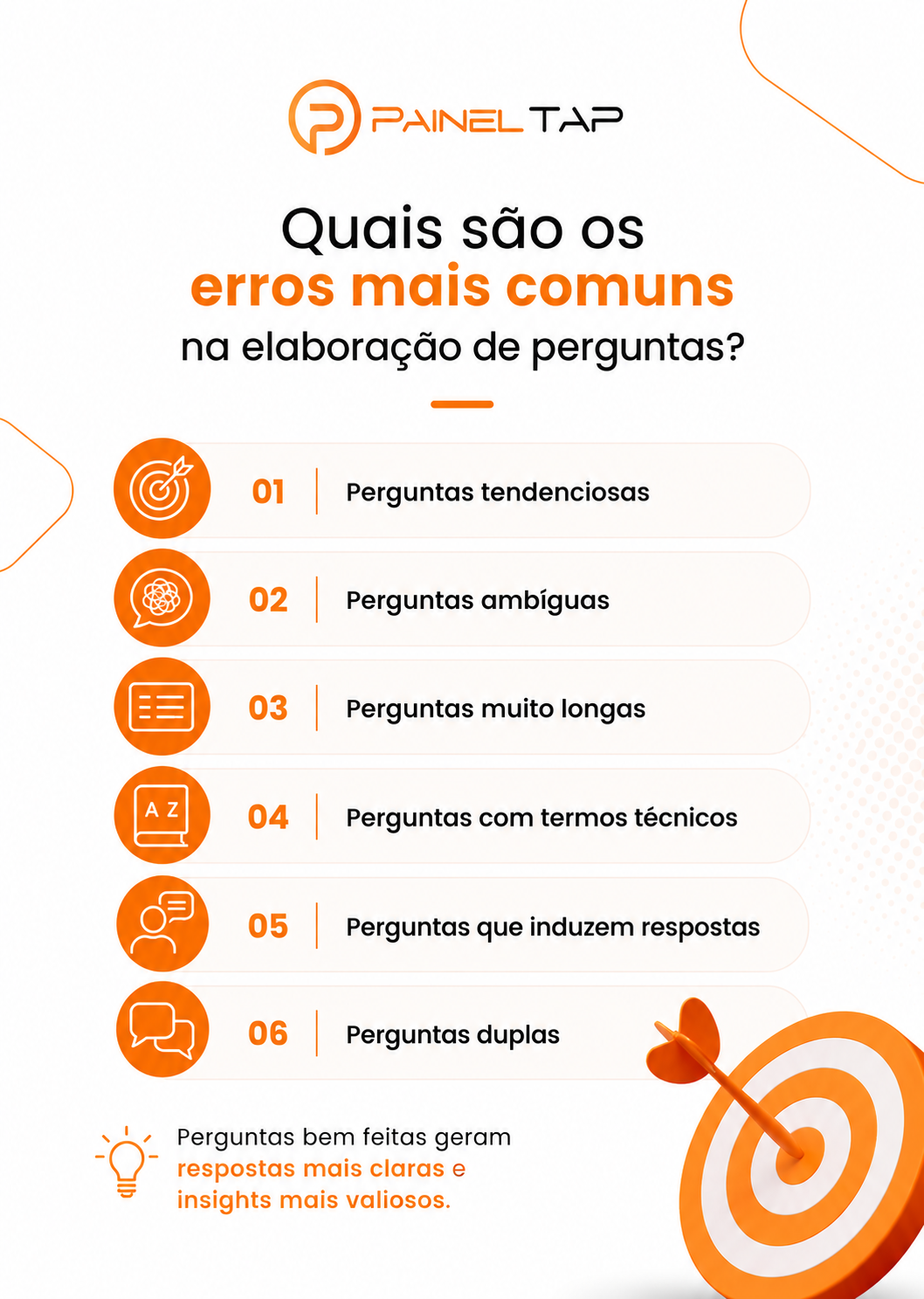
Biased questions
Biased questions are those formulated in a way that influences the participant to choose a certain answer. Instead of collecting a genuine opinion, they end up directing the respondent to a conclusion previously suggested by the question itself.
This type of error can generate distorted results and compromise the credibility of the research, as the answers no longer reflect the real perception of the participants.
Inadequate example:
“Do you agree that our excellent service deserves a positive evaluation?”
Adequate example:
“How would you rate our service?”
To avoid biased questions, use neutral language and avoid including opinions, adjectives, or value judgments in the statement.
Ambiguous questions
Ambiguous questions are those that can be interpreted in different ways by participants. When this happens, different people can answer the same question thinking of completely different situations.
The consequence is the collection of inconsistent data, which makes analysis difficult and can lead to mistaken conclusions.
Inadequate example:
“Do you frequently use our services?”
The term “frequently” can mean once a week for some people and once a month for others.
Adequate example:
“How many times have you used our services in the last 30 days?”
The more specific the question, the lower the chances of different interpretations.
Overly long questions
Excessively long questions require more attention and effort from participants, increasing the chances of confusion, survey abandonment, or inaccurate responses.
When a question contains too much information, explanations, or unnecessary details, the respondent may lose focus and not fully understand what is being asked.
Inadequate example:
“Considering all the interactions you have had with our company over the past few months, including service, support, website navigation, and use of the services offered, how would you rate your overall experience?”
Adequate example:
“How would you rate your overall experience with our company?”
Whenever possible, prioritize short, objective, and easy-to-understand sentences.
Questions with technical terms
Not all participants have the same level of knowledge about a particular subject. The use of technical terms, acronyms, or specialized language can generate doubts and impair the quality of responses.
When the respondent does not fully understand the question, they may answer randomly or abandon the survey.
Inadequate example:
“How would you rate the efficiency of our service SLA?”
Adequate example:
“How would you rate the time it took us to respond to your request?”
The rule is simple: use language compatible with the profile of the surveyed audience and prefer clear and accessible terms.
Leading questions
Although similar to biased questions, leading questions usually present information or arguments that influence the participant even before they answer.
In this case, the respondent may feel that there is a more correct or expected answer than the others.
Inadequate example:
“Knowing that our company has one of the best evaluations in the market, do you consider our service satisfactory?”
Adequate example:
“How would you rate our service?”
A good question should allow the participant to express their opinion without any external influence.
Double-barreled questions
Double-barreled questions occur when two or more questions are grouped into a single question. This error makes answering difficult, as the participant may have different opinions on each aspect addressed.
In these cases, it becomes impossible to identify which part of the question is being evaluated.
Inadequate example:
“Are you satisfied with our service and the price of our products?”
The participant may be satisfied with the service but dissatisfied with the prices.
Adequate example:
“How would you rate our service?”
“How would you rate the price of our products?”
Whenever a question addresses more than one topic, it is ideal to divide it into separate questions to ensure more accurate responses and more reliable analyses.
What tool to use to create survey questions?
When looking for a tool to create survey questions, it is important to consider features such as different question types, questionnaire customization, conditional logic, automated sending, real-time monitoring, and report generation. These features allow for the development of more complete surveys and the collection of more relevant information for decision-making.
VisionCX was developed precisely to simplify this process. With the platform, it is possible to create surveys using various question formats, such as open-ended, closed-ended, multiple-choice, satisfaction scales, NPS, CSAT, CES, and many other models. This offers flexibility to adapt each questionnaire to the specific objectives of the research.
In addition to creating forms, VisionCX allows for real-time monitoring of results through intuitive dashboards and automated reports. This way, collected responses are quickly transformed into strategic information, facilitating the identification of trends, improvement opportunities, and areas of concern.
Another differential is the integration with other solutions in the VisionCX ecosystem, allowing companies to centralize customer experience management, monitor satisfaction indicators, and track the evolution of results over time.
How to increase the response rate with well-structured questions?
Although factors such as sending channel and target audience are important, the way questions are constructed also has a great impact on participant engagement.
Clear, objective, and relevant questions make the experience more pleasant and increase the chances of the respondent completing the questionnaire.
Keep questions simple and objective
The easier it is to understand a question, the more likely it is to be answered correctly. Long, complex questions or those with excessive information can generate doubts and increase abandonment during completion.
The ideal is to use direct sentences, avoiding unnecessary explanations and terms that may hinder interpretation. When the participant quickly understands what is being asked, the experience becomes more fluid and pleasant.
Use language appropriate to the audience
Not all respondents have the same level of knowledge about a particular subject. Therefore, it is important to adapt the language to the profile of the surveyed audience.
Avoiding jargon, acronyms, and technical terms helps make the questionnaire more accessible. The more natural and closer to the participant's reality the communication is, the greater the engagement with the research tends to be.
Ask only relevant questions
One of the main reasons for survey abandonment is the presence of questions that seem unnecessary or unrelated to the main topic.
Before including a question in the questionnaire, it's worth considering whether that information will actually be used in the analysis or decision-making. More concise surveys tend to generate better completion rates because they respect the participant's time.
Start with the easiest questions
The first questions serve as a gateway to the rest of the survey. When the questionnaire begins with simple and quick-to-answer questions, the participant tends to feel more comfortable continuing.
More complex, reflective, or effort-intensive questions can be placed throughout the questionnaire, after the respondent is already engaged with the survey.
Balance open-ended and closed-ended questions
Open-ended questions are excellent for collecting detailed opinions but require more effort from the participant. When used excessively, they can reduce the completion rate.
A good strategy is to prioritize closed-ended questions throughout the survey and use open-ended questions only when deeper insights are truly necessary. This way, it's possible to balance data quality and respondent experience.
Avoid overly long surveys
Even when questions are well-designed, extensive questionnaires can lead to fatigue and abandonment.
Therefore, it's important to focus on the quality of the questions rather than the quantity. An objective survey that gets straight to the point tends to generate more responses and more reliable data than an excessively long questionnaire.
Use intuitive scales and formats
Rating scales, multiple-choice questions, and well-organized response options facilitate completion and make the process faster.
When the participant can answer without having to think excessively about the question's structure, the experience becomes more natural and increases the likelihood of survey completion.
Show the participant that their opinion is important
People tend to respond more when they understand the relevance of the research. Clearly explaining how responses will be used and demonstrating that the participant's opinion has an impact can significantly increase engagement.
When the respondent perceives value in their contribution, they feel more motivated to dedicate time to answer carefully.
Find the right respondents for your survey
In addition to creating well-structured questions, it is essential to ensure that the survey reaches the right people. Often, a low response rate is not related to the questionnaire itself, but to the difficulty of finding a qualified audience interested in participating.
In this scenario, having a respondent panel can make all the difference. With PainelTAP, it is possible to access segmented participants according to criteria such as demographic profile, consumption behavior, region, interests, and various other filters. This helps to increase the response rate, reduce collection time, and obtain more reliable results for your surveys.
If you are looking for quality answers and want to reach the ideal audience for your project, it is worth getting to know PainelTAP and discovering how a respondent panel can make your surveys faster, more efficient, and more strategic.