How to define a research sample? Step by step
6 min read

Developing a study involves understanding how to define a research sample. If you don't know how to do this yet, here we will show you the step-by-step process.
First, do you know what a research sample is?
A research sample is the group of people who will be selected to participate in the study and represent the public you want to understand. Instead of interviewing the entire population, which would often be unfeasible, the research works with a portion of that universe.
For the results to be relevant, it is important to define the sample considering criteria such as the public's profile, the number of respondents, and the characteristics of the studied population. A well-defined sample helps to obtain answers that are more aligned with the research objectives and increases the quality of the conclusions.
What is the difference between sample and sampling?
The difference is simple: a sample is the group of people who participate in the research; sampling is the process used to select that group.
Sample
The sample is the group of people who participate in the research. It represents a part of the population to be studied and is defined according to the public's profile and the study's objectives.
For example, if a survey seeks to understand the opinion of consumers of a certain product and has 500 participants, these 500 people form the research sample.
Sampling
Sampling is the process used to recruit and select the people who will be part of the research. It is at this stage that the criteria for finding participants are defined, such as age, gender, region, consumption habits, or other characteristics relevant to the study.
For example, if the research needs 500 consumers between 25 and 40 years old who have purchased a certain product in the last six months, sampling involves the process of finding, selecting, and recruiting people who meet these criteria.
Does every research need a sample?
Not every research necessarily needs a sample. This depends on the study's objective and the number of people who are part of the public you want to analyze.
When it is possible to hear the entire population, we have a census. This is the case for research conducted with a small and easily accessible group, where everyone can participate.
However, when it is not feasible to interview everyone, whether due to the size of the population, time, or costs involved, a sample is used, meaning a portion of the public that will be studied.
Therefore, before defining how to collect data, it is important to understand who the research population is and whether it will be necessary to work with a sample.
What are the types of profiles in a sample?
When defining a sample, it is important to establish who should participate in the research. This profile can be defined according to the characteristics and objectives of each study.
Demographic profile
Considers basic characteristics of participants, such as age, gender, region of residence, education level, and income bracket. These criteria help to identify and select the public that corresponds to the research objective.
Behavioral profile
Considers the participants' habits, behaviors, and attitudes. This may include purchase frequency, use of a specific product or service, consumption habits, and preferences.
Consumption profile
It is defined based on the participant's relationship with specific products, brands, or categories. For example, a car survey might only consider people who own or intend to buy a vehicle.
Usage profile
Takes into account the experience or frequency of use of a product, service, or platform. A survey might, for example, seek frequent users, occasional users, or people who have stopped using a certain service.
Professional profile
Considers characteristics related to the participants' occupation or professional activity. It can be used in B2B research or studies that need to hear from professionals in specific areas, positions, or segments.
Specific profile
In some studies, the sample needs to meet very specific criteria. In this case, different characteristics can be combined to reach exactly the desired audience, such as women aged 25 to 34, living in the Southeast, who own a car and bought a vehicle in the last two years.
Understand how to define a research sample
To arrive at an adequate sample, it is necessary to understand who the research audience is, how many people should participate, and how these respondents will be recruited. Below, see the main steps to define the sample for your study.
1. Define the research objective
Before thinking about the number of respondents, make it clear what the research aims to discover. The study's objective helps determine which audience should participate and which characteristics need to be considered in the sample.
2. Define the research audience
Determine who you need to hear from. Consider characteristics such as age, gender, region, income, profession, consumption habits, relationship with a brand, or use of a specific product or service.
The clearer the audience, the easier it will be to find the appropriate respondents.
3. Establish the sample criteria
After defining the audience, establish the criteria that participants need to meet. These criteria may include demographic, behavioral, or consumption characteristics.
For example: men and women, between 25 and 45 years old, residents of the Southeast, and who have bought a car in the last two years.
4. Define the number of respondents
Determine how many people will participate in the research. The necessary quantity depends on factors such as population size, study objective, desired level of precision, and available budget.
5. Define the sampling method
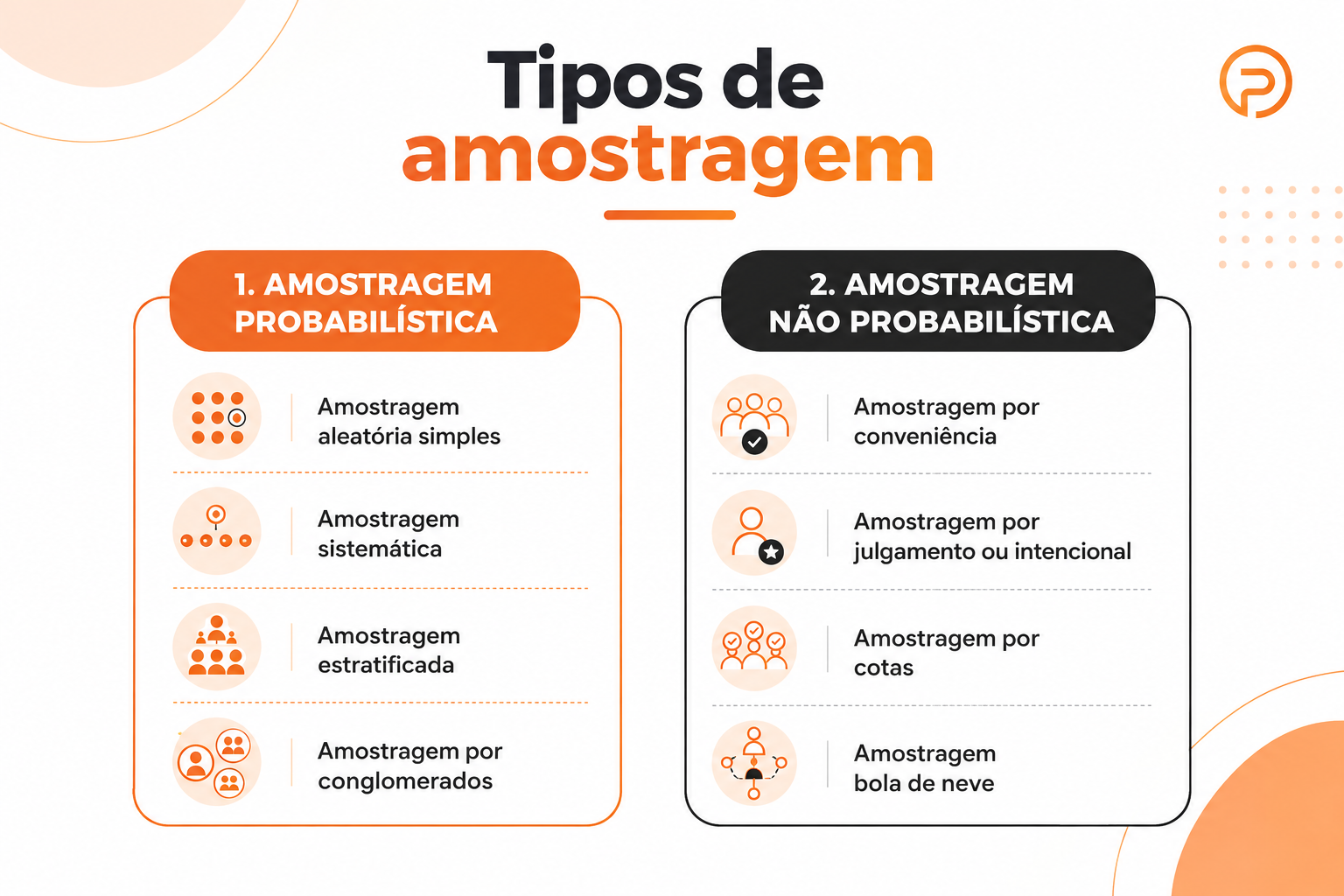
With the audience and the number of respondents defined, it's time to choose how participants will be selected to be part of the research. At this point, sampling can be probabilistic or non-probabilistic.
Probabilistic sampling: uses a random process to select participants. In this model, population members have a known probability of being selected for the research. It is widely used when the study seeks greater statistical representativeness of the population.
Non-probabilistic sampling: does not necessarily use a random process. Participants are selected according to criteria defined by the researcher, such as profile, availability, or specific characteristics. It is common in market research that needs to find an audience with certain characteristics.
6. Screen participants
Before including a person in the sample, it is important to verify if they truly match the profile defined for the research. For this, screening questions can be used, which help identify if the participant meets the necessary criteria.
7. Monitor the sample composition
During data collection, monitor whether the sample is following the planned profile. If the research requires specific quantities by age, region, or other criteria, this control helps prevent an excessive concentration of participants in a single profile.
8. Validate the sample before starting the research
Finally, check if the profile, the number of respondents, and the selection criteria are in accordance with the study's objectives. A well-defined sample increases the chances of obtaining relevant data and answers truly aligned with the audience you want to understand.
How to find a sample for research?
After understanding how to define a research sample, the number of respondents, and the research criteria, it is necessary to find people who truly match the desired profile.
One of the most practical ways to do this is to use a respondent panel. In it, you can define specific characteristics of the audience and recruit participants who meet the necessary criteria for your study.
With PainelTAP, you find respondents for different profiles and research objectives, facilitating recruitment and allowing your research to reach the right audience.
Need a sample for your research? Get to know PainelTAP and find the respondents your study needs.