Quality control in the respondent panel: how does it work?
10 min read

If you are looking for people to answer your survey, you must have come across the online sample. And at that moment, the question arose: how does quality control work in the respondent panel? Here, we will explain.
First, do you know what a respondent panel is?
A respondent panel is a database formed by registered individuals available to participate in market, opinion, and behavior research.
These participants provide information about their profile, such as age, region, gender, consumption habits, interests, and socioeconomic characteristics. From this data, it is possible to find people who match the audience a survey needs to reach.
In practice, it works like this: a company needs, for example, to hear from consumers who bought a car in the last 12 months. Instead of searching for these people one by one, it can use a respondent panel to identify participants who fit this profile and invite them to answer the survey.
How does a panel gather people?
To form a respondent base, panels use different recruitment strategies. The goal is to attract people interested in participating in surveys and, at the same time, build a diverse base with different demographic and behavioral profiles.
This process can happen through apps, websites, or proprietary platforms, where people register and provide information about their profile. It is also common for panels to use dissemination campaigns, digital media, social networks, referrals, and other strategies to attract new participants.
But registration is just the first step. To encourage participation in surveys, panels usually offer some type of incentive, such as points, money, vouchers, or other benefits. Thus, the person is invited to answer surveys that match their profile and receives a reward for participation.
As the base grows, the panel gains information that helps identify who has the appropriate profile for each survey. This way, when a company needs to hear from a specific audience, the panel can select and invite respondents who meet the criteria defined in the study.
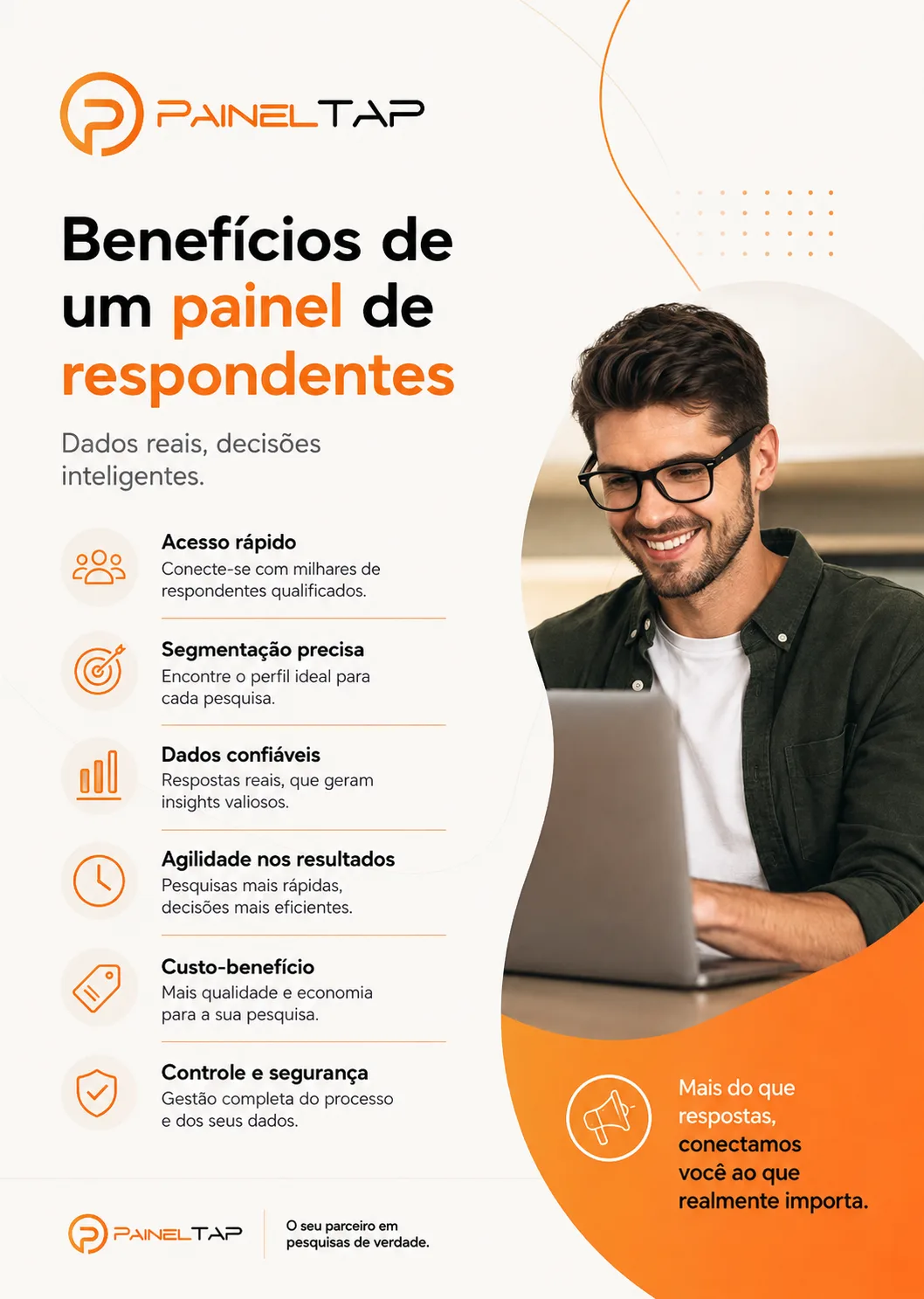
What are the advantages of using a respondent panel?
In addition to facilitating access to the desired audience, they help make the collection process more agile, organized, and efficient. Furthermore, they offer other benefits, such as:
Access to different respondent profiles
A panel brings together people with different demographic, behavioral, and consumption characteristics. This allows finding more specific audiences according to the objectives of each survey.
More agility in collecting responses
Instead of starting recruitment from scratch for each study, the company can rely on a base of already registered participants available to answer surveys, speeding up the collection stage.
Audience segmentation
The data provided by participants during registration allows applying filters and finding people who meet the criteria defined for the survey, such as age, region, income, consumption habits, or experience with a particular product.
Greater reach for specific surveys
When the study needs to hear from a more difficult-to-find audience, a panel can facilitate access to these profiles, increasing the possibilities of reaching the necessary sample.
Incentive to participate
Panels usually offer rewards to participants, such as money, points, or vouchers. This incentive helps stimulate participation and keep people engaged with new surveys.
Respondent quality control
A structured panel has mechanisms to monitor participant behavior, identify inconsistent or suspicious responses, and prevent people who do not meet the criteria from compromising sample quality.
Reduced operational effort
By using a panel, the company does not need to individually manage the entire recruitment and selection process of participants. The panel can take on a large part of this operation, making collection simpler and more organized.
How is quality control performed in the respondent panel?
The panel needs to have mechanisms to verify participant identity, keep data updated, and identify behaviors that could compromise response quality.
Data validation during registration
At the time of registration, the panel may request information such as name, date of birth, address, phone number, and CPF (Brazilian individual taxpayer ID). This data helps verify if the participant is a real person and reduces the risk of duplicate or fraudulent registrations.
Identity verification
Depending on the platform and the required security level, identity validation mechanisms may be used to confirm that the registered person matches the provided data. The goal is to prevent the same person from creating multiple profiles or using false data.
Duplicate registration control
The panel can also use different information and identifiers to detect when a person tries to create more than one account. This control is important because multiple registrations can allow the same individual to participate in a survey multiple times.
Participant profiling
In addition to verifying identity, the panel collects information about respondents' profiles. This data helps understand who that person is and which surveys are suitable for them, avoiding invitations to studies that do not match their profile.
Response verification
Control continues during the survey. The panel can analyze the time taken to respond, identify response patterns, check attention questions, and observe behaviors considered suspicious, such as always answering in the same way.
Behavior monitoring
Participation history can also be monitored. If a respondent repeatedly provides inconsistent answers, abandons surveys unusually, or demonstrates other behaviors indicating low quality, the panel may restrict or block their participation.
Data update
Participant data needs to be updated over time. After all, age, profession, income, consumption habits, and other characteristics can change. Keeping the profile updated helps ensure that the person continues to receive surveys compatible with their reality.
Use of security technologies
Depending on the platform, technical resources may also be used to identify suspicious activities, such as IP address analysis, device, approximate location, and other behavioral signals. These mechanisms help detect fraud attempts or manipulation of participation.
What type of research can be done with an online sample panel?
With an online sample panel, it is possible to conduct different types of research, from quick opinion studies to more in-depth projects on behavior and consumption. The main advantage is being able to segment participants according to the profile needed for each study.
Habits and behavior research
Allows understanding how people act daily, what products they use, how often they buy a certain item, and what factors influence their decisions.
Satisfaction research
Can be used to find out how consumers evaluate a brand, product, service, or experience and identify areas that need improvement.
Market research
Helps understand the market, identify trends, know the audience, and analyze opportunities for new products or services.
Opinion research
Allows knowing people's perception of different themes, concepts, brands, campaigns, and everyday situations.
Brand knowledge and awareness research
It is possible to find out if the public knows a certain brand, which brands they associate with a category, and what the recognition level of each one is.
Product research
Can be used to evaluate existing products or test new ideas before launch. It is possible to investigate interest, preference, perceived value, attributes, and purchase intention.
Concept testing
Before investing in the development of a product, service, or campaign, the company can present a concept to the public and understand how it is received, what points stand out, and what can be improved.
Communication and advertising testing
Allows evaluating ads, advertising pieces, slogans, videos, and other communications before or after a campaign. This way, the company can understand if the message was understood and what impact it had on the audience.
Purchase intention research
Helps identify the likelihood of consumers buying a certain product or service and what factors can increase or decrease that intention.
Segmentation research
Can be used to identify different groups of consumers based on characteristics, needs, behaviors, and consumption habits.
B2B research
A panel can also be used to reach professionals and decision-makers within companies, provided the base has these profiles available and the necessary segmentation can be performed.
In other words, the online sample panel is not suitable for just one type of study. It can be used whenever the research needs to hear from people with certain profiles and transform their opinions, perceptions, and behaviors into data for decision-making.
Is the online sample panel reliable?
Yes, an online sample panel can be reliable, but this depends directly on the quality of the panel and the controls used to select and monitor respondents.
A panel with a large number of participants is not necessarily a quality panel. For the collected data to be reliable, it is important to have processes for recruitment, validation, profiling, and monitoring of respondents.
What makes a panel reliable?
Participant identification: The panel must have mechanisms to verify participant identity and reduce false or duplicate registrations.
Updated respondent profile: Information about participants needs to be kept updated so that surveys are directed to people who truly match the desired audience.
Response control: It is important to identify behaviors that may indicate low-quality responses, such as very fast completion, lack of attention, or inconsistent patterns.
Fraud prevention: Technological resources and participation rules help detect fraud attempts, multiple registrations, and other behaviors that could harm the sample.
Sample adequate for the study: Even with good controls, reliability also depends on selecting a sample that aligns with the research objective. A panel alone does not guarantee that every sample will be representative of the population.
How is a respondent panel contracted?
Contracting a respondent panel is usually a simple process. See below:
Find the most suitable panel
The first step is to research providers and evaluate which panel best meets the needs of your study. It is important to consider factors such as profile and quantity of available respondents, segmentation capability, quality control, collection deadline, and results delivery format.
Submit the research project
After choosing the panel, you present the project and explain what you need to discover. At this point, it is important to inform the research objective, target audience, number of respondents, regions, segmentation criteria, and desired deadline.
The more detailed the briefing, the easier it will be for the panel to assess the feasibility of the study.
Receive the quote
With the project information, the panel evaluates the requested audience and calculates the research cost. The price may vary according to factors such as number of interviews, quantity and duration of questions, participant profile, level of segmentation, and difficulty in finding the desired audience.
Send the questionnaire
With the approved quote, it's time to send the questionnaire that will be applied to participants. In addition to the questions, quotas, filters, and screening criteria can be defined to ensure the research reaches the right people.
Test the questionnaire
Before officially starting data collection, it is important to test the questionnaire. This step allows verifying if the questions are working correctly, if the filters and logic are directing participants to the right paths, and if there are no errors that could compromise data collection.
Run the survey
After questionnaire approval, the panel begins recruiting participants who match the defined profile. The survey is made available to respondents, and data collection proceeds until the established number of interviews and quotas are met. In some services, it is also possible to monitor the progress of data collection.
Receive the results
When the required number of responses is reached, data collection is closed, and the data is made available in the format agreed upon with the provider. From there, you can analyze the responses, cross-reference them, and transform the data into insights for decision-making.
Which respondent panel to use?
When choosing a respondent panel, it's worth considering more than just the size of the base. It's important to evaluate the quality of participants, the segmentation possibilities, respondent control, and the agility of data collection.
PainelTAP brings together these features to help companies find the right audience for their surveys and collect responses more practically and efficiently. With a diverse participant base and quality control processes, the platform allows for research with different audience profiles, according to the objectives of each project.
If you need to find respondents for your next survey, get to know PainelTAP and submit your project to receive a personalized proposal.