100 market research question examples
16 min read

When developing a study to understand the current landscape your company operates in, many questions often arise about what to ask. The good news is that, in this content, you will find plenty of inspiration: we have gathered 100 market research question examples that can help in building your questionnaire.
Shall we begin?
First, do you really know what market research is?
Market research is a tool used to collect information about consumers, competitors, products, services, and trends in a specific industry. It helps companies better understand public behavior, identify opportunities, reduce risks, and make decisions with more confidence.
Through questionnaires, interviews, focus groups, and other methodologies, it is possible to discover what people think, want, and expect from a brand, product, or service. These insights are valuable for guiding marketing strategies, product development, customer experience, and business planning.
In other words, market research transforms opinions and behaviors into data that supports more assertive decisions. The better the quality of the information collected, the greater the company's ability to understand its market and adapt to consumer needs.
Why do large companies conduct market research?
Launching a product, creating a campaign, defining prices, choosing sales channels, or understanding customer satisfaction are just a few examples. But making decisions based on assumptions can lead to high costs and results below expectations.
That's why large companies continuously invest in market research. They use real consumer data and opinions to better understand the scenario they operate in, identify opportunities, and reduce risks. Below, learn some of the main reasons that make market research such an important tool.
Understand consumer behavior
People's habits, preferences, and needs change all the time. Market research helps companies keep up with these changes and understand what truly influences consumers' purchasing decisions. With this information, it becomes easier to create products, services, and campaigns aligned with public expectations.
Identify market opportunities
Often, there are demands that are not yet being met or niches that are little explored by competitors. Research allows identifying these opportunities before they become evident to the market.
This can open space for new products, services, or growth strategies.
Reduce decision risks
Every business decision involves some level of risk. However, when it is based on concrete data, the chances of error tend to be lower. Research can help validate ideas, test concepts, and assess public receptivity before making more significant investments.
Better understand the competition
Understanding how consumers perceive competing brands is fundamental for building competitive advantages.
Market research helps identify strengths, weaknesses, opportunities, and threats, allowing the company to position itself more strategically.
Measure customer satisfaction
Satisfied customers are more likely to remain loyal to the brand and recommend it to others. Through satisfaction surveys, it is possible to identify areas for improvement, correct problems, and enhance the experience offered to the consumer.
Develop products more aligned with market needs
What a company believes to be important is not always what consumers truly value. Research helps understand which features, functionalities, and benefits make the most sense to the target audience.
This increases the chances of success in launching new products and services.
Strategically define prices
Price is one of the factors that most influence purchasing decisions. Market research helps understand how much consumers are willing to pay and how they perceive the value offered by the brand.
With this, the company can create more efficient and competitive pricing strategies.
Evaluate campaigns and marketing actions
Before, during, or after a campaign, research can be used to measure perception, brand recall, purchase intent, and various other indicators. This data helps understand what is working and what can be adjusted to improve results.
Monitor market trends
Markets evolve rapidly. New technologies, cultural changes, and economic transformations can directly impact consumer behavior. Companies that monitor these trends through research can adapt more quickly and maintain their competitiveness.
Make data-driven decisions
Perhaps this is the main reason. Market research allows replacing guesswork with concrete information, making the decision-making process safer and more efficient.
When a company deeply understands its audience and its market, it is better prepared to grow sustainably and achieve better results.
What insights can be obtained from market research?
Depending on the study's objectives, the results can provide answers to several important questions about the market and the target audience. See some of the main ones that market research can provide:
Target audience profile
Research allows for a better understanding of who the brand's consumers are. Information such as age, gender, income, location, profession, and lifestyle helps create a more accurate portrait of the audience. With this understanding, it becomes easier to develop more relevant strategies and communications.
Consumption habits
Understanding how, when, and why people buy is one of the main objectives of many surveys.
Data can show purchase frequency, preferred channels, factors influencing decisions, and behaviors related to the consumption of products and services.
Consumer needs and expectations
Consumers do not always express their needs directly. Research helps identify desires, expectations, and problems that have not yet been fully resolved by the market.
These insights can guide improvements and innovations.
Customer satisfaction level
Research allows measuring the degree of consumer satisfaction regarding products, services, customer service, and overall brand experience. In addition to identifying strengths, it also helps find opportunities for improvement.
Reasons for purchase
Understanding what leads someone to choose a brand or product is essential for developing more effective strategies. Research can reveal which attributes are most valued, such as quality, price, trust, convenience, innovation, or service.
Purchase barriers and objections
Not all consumers who show interest end up buying. Often there are obstacles that prevent conversion.
Research can identify factors such as high price, lack of information, insecurity, low brand trust, or difficulties in accessing the product.
Brand perception
Understanding how the brand is seen by the market is fundamental for strengthening its positioning. Research can show which attributes consumers associate with the company, what feelings it evokes, and how it differentiates itself from competitors.
Brand recognition and recall
Also known as awareness, this insight shows the level of knowledge consumers have about a particular brand. This information helps evaluate the strength of the company's market presence and the effectiveness of communication actions.
Comparison with competitors
Research can reveal how consumers evaluate your brand in relation to available alternatives in the market. This allows identifying competitive advantages, differentiation opportunities, and points that need to be strengthened.
Potential for new products or services
Before investing in a new solution, it is possible to assess public interest, test concepts, and validate ideas. This way, the company reduces risks and increases the chances of launching something that truly has demand.
Price sensitivity
Research also helps understand how consumers react to different price ranges. This insight is valuable for defining pricing strategies that are more aligned with market expectations.
Trends and behavioral changes
Consumer habits are constantly changing. Research allows monitoring these changes and identifying emerging trends before they consolidate. This helps the company anticipate market movements.
Purchase intention
Another very relevant piece of information is the likelihood of a consumer purchasing a particular product or service in the future. This indicator can be used to estimate demand, evaluate launches, and support strategic decisions.
Consumer journey
Research helps map the steps taken by the consumer from the moment they identify a need until the purchase decision. With this, it is possible to identify friction points and opportunities to improve the experience.
Loyalty and recommendation
Many companies use research to understand the level of customer loyalty and the likelihood of brand recommendation.
Indicators such as NPS (Net Promoter Score) help measure the relationship between company and consumer and identify opportunities to strengthen this connection.
What are the types of market research?
Market research can be applied in various ways, depending on the study's objectives and the information the company wants to obtain.
In some cases, the focus is on understanding behaviors and opinions. In others, the goal is to measure results, test concepts, or monitor indicators over time. In other words, there are several types, such as:
Satisfaction survey
The satisfaction survey aims to understand how customers evaluate products, services, customer service, or the experience offered by the company. It helps identify strengths, opportunities for improvement, and factors that influence consumer loyalty.
Consumer profile research
This type of research seeks to understand who the company's audience is. The data collected may include demographic, socioeconomic, behavioral information, and even aspects related to consumers' lifestyles.
Consumption habits research
The objective is to understand how people buy, use, and relate to certain products or services. These studies help identify purchasing behaviors, frequency of use, preferred channels, and factors that influence consumer decisions.

Purchase intention research
Widely used before launches or campaigns, this research evaluates the public's interest in acquiring a particular product or service. It helps companies estimate demand and reduce risks before making investments.
Brand image and positioning research
This type of study measures how a brand is perceived by the market. Research can reveal attributes associated with the company, reputation, competitive differentiators, and the brand's position relative to competitors.
Brand awareness research
The objective is to measure how well a brand is known by the public. These studies analyze indicators such as spontaneous recall, aided recall, and consumer familiarity with the company.
Concept testing research
Before launching a new product, service, or campaign, many companies conduct concept tests. The idea is to present a proposal to the public and evaluate its attractiveness, relevance, and potential for acceptance.
Product testing research
In this type of study, participants try a product and share their opinions on different aspects, such as quality, functionality, design, taste, packaging, or performance. It is a methodology widely used to improve products before launch.
Pricing research
Pricing research seeks to understand how much consumers are willing to pay for a product or service. This data helps define more competitive pricing strategies aligned with the market's perception of value.
Customer experience (CX) research
The focus is on understanding the entire consumer journey and evaluating their experience at different touchpoints with the brand. This type of research helps companies identify bottlenecks and opportunities to improve customer satisfaction.
NPS (Net Promoter Score) research
NPS is a widely used methodology to measure customer loyalty. From a simple question about recommendation, it is possible to identify promoters, neutrals, and detractors of the brand, as well as monitor the evolution of this indicator over time.
B2B Market Research
Aimed at companies that sell to other businesses, this research seeks to understand the needs, challenges, purchasing criteria, and behavior of corporate decision-makers. Methodologies are usually adapted to the reality of the business market.
Competitor Research
This study helps to understand how consumers perceive competing brands and what factors influence their choices. The results allow for identifying opportunities for differentiation and competitive advantages.
Market Trend Research
The objective is to identify behavioral changes, new demands, and emerging movements that may impact a given sector. Companies use these insights to anticipate market transformations.
Quantitative Research
Quantitative research works with numbers, metrics, and statistical data. It is usually applied to a larger sample of participants and allows for objectively measuring behaviors, opinions, and trends.
Qualitative Research
Unlike quantitative research, qualitative research seeks to understand motivations, perceptions, feelings, and opinions in a deeper way. It generally uses in-depth interviews, focus groups, and other exploratory methodologies.
Exploratory Research
It is used when the company is still learning about a problem or opportunity. Its objective is to generate hypotheses, gather initial information, and broaden understanding of a given topic.
Descriptive Research
Descriptive research seeks to portray a specific situation, behavior, or profile. It helps answer questions such as who, when, where, and how a certain phenomenon occurs.
Longitudinal Research
In this model, data is collected at different times over a period. This allows for monitoring behavioral changes, indicator evolution, and market trends.
Ad Hoc Research
These are surveys developed to meet a specific need of a company. The questionnaire, sample, and methodology are customized according to the study's objectives.
Continuous Research
Unlike ad hoc research, continuous research is conducted regularly to monitor indicators and trends over time. It allows for tracking market changes and evaluating the evolution of important business metrics.
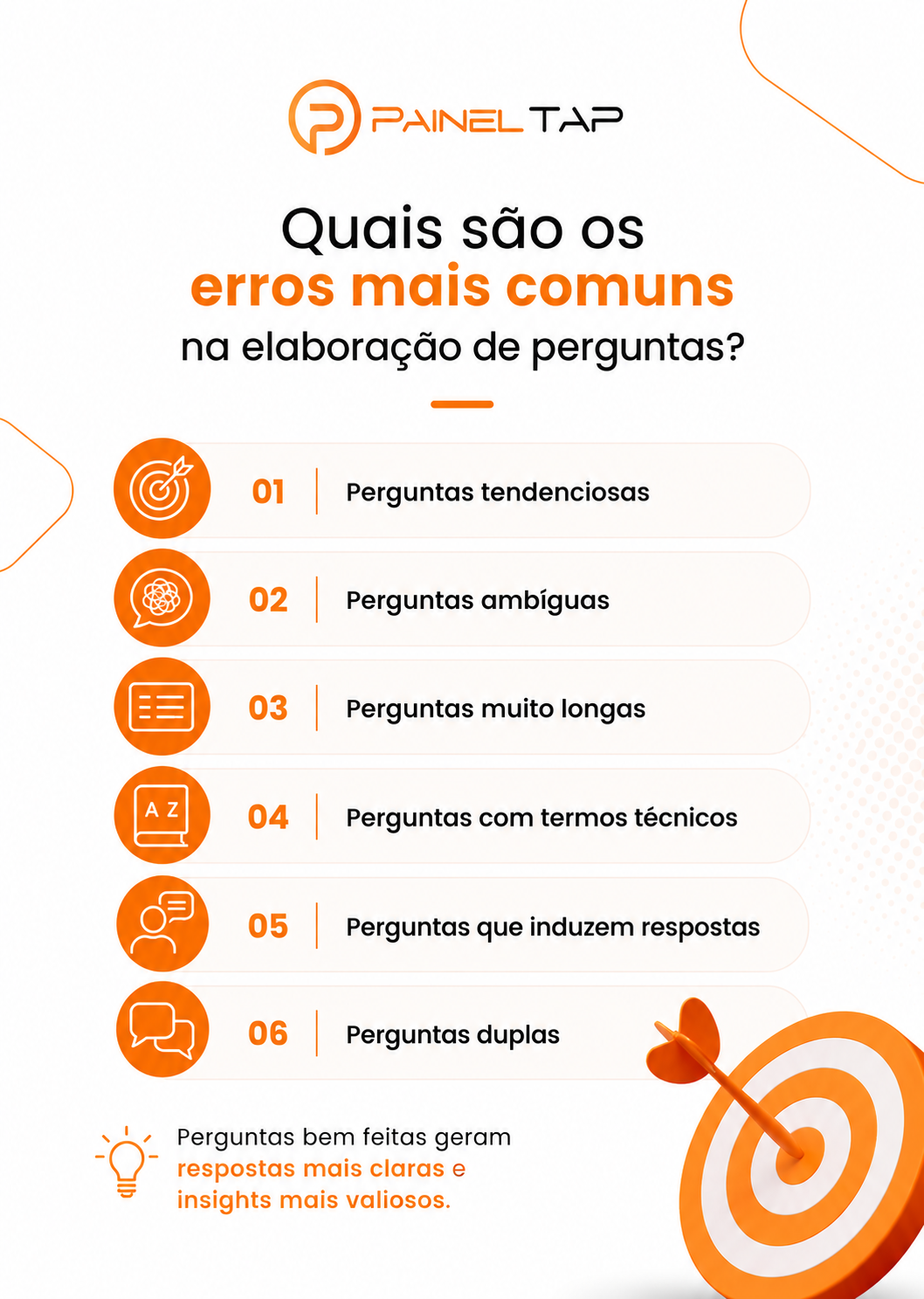
And what to ask? Check out 100 examples of market research questions
There is no universal questionnaire that works for all situations. The ideal questions for a satisfaction survey can be completely different from those used in a study on consumer behavior, purchase intent, or brand perception.
Therefore, before developing any questionnaire, it is important to clearly define what information you want to obtain. The more aligned the questions are with the research objectives, the more useful and strategic the results will be.
The good news is that there are several question models that can serve as inspiration for different types of studies. They can be adapted according to the audience, the company's industry, and the research objectives.
Below, we have gathered 100 examples of market research questions organized by categories. Use them as a starting point to build more complete questionnaires and obtain valuable insights about your consumers, products, services, and market.
Audience Profile (1 to 10)
- What is your age?
- What gender do you identify with?
- Which state do you live in?
- What is your level of education?
- What is your monthly income bracket?
- What is your main occupation?
- How many people live in your household?
- Do you have children?
- What is your marital status?
- What type of city do you live in (capital, metropolitan area, or countryside)?
Consumption Habits (11 to 20)
- How often do you buy products in this category?
- Where do you usually make your purchases?
- Which channel do you use most frequently to buy?
- What times do you usually shop online?
- Do you usually research before buying?
- What sources do you use to find information about products?
- When was the last time you bought a product in this category?
- Do you usually buy on impulse?
- What most influences your purchasing decisions?
- What device do you use to make online purchases?
Purchase Decision Process (21 to 30)
- What factors are most important in your purchase decision?
- Does price influence your choice?
- Does brand reputation influence your decision?
- Do reviews from other consumers impact your choice?
- Do you usually compare different brands before buying?
- How long does it take you to decide on a purchase?
- Does customer service influence your decision?
- Do promotions and discounts impact your choice?
- Does the recommendation of friends or family influence your purchase?
- What could make you switch brands?
Brand Awareness and Perception (31 to 40)
- What brands come to mind when you think of this category?
- Are you familiar with our brand?
- How did you learn about our brand?
- What is your perception of our brand?
- What characteristics do you associate with our brand?
- How do you rate the credibility of our brand?
- What differentiates our brand from competitors?
- Do you consider our brand innovative?
- Is our communication clear to you?
- How would you describe our brand to someone else?
Customer Satisfaction (41 to 50)
- What is your level of satisfaction with our product?
- How do you rate your overall experience with our company?
- Did the product meet your expectations?
- How do you rate the quality of the product?
- How do you rate our customer service?
- How do you rate the ease of purchase?
- How do you rate the delivery time?
- What did you like most about our company?
- What could be improved?
- Would you buy from us again?
NPS and Loyalty (51 to 60)
- On a scale of 0 to 10, how likely are you to recommend our company?
- What is the main reason for your score?
- Do you intend to continue using our products?
- Have you ever recommended our brand to anyone?
- What makes you remain a customer?
- What could lead you to stop being a customer?
- How long have you been using our products?
- Do you consider yourself loyal to our brand?
- What is the likelihood of buying again?
- What would strengthen your relationship with our company?
Products and Services (61 to 70)
- Which product do you use most frequently?
- Which functionality do you consider most important?
- Is there any feature you miss?
- Is the product easy to use?
- Does the product solve your main need?
- What improvements would you like to see?
- Which features do you use most frequently?
- Are there any difficulties in using the product?
- How do you compare our product to competitors?
- What would make our product even better?
Price and value perception (71 to 80)
- How do you rate the product's price?
- Do you consider the price fair for what is offered?
- Is price a decisive factor for your purchase?
- What price range do you consider appropriate?
- Would you pay more for additional features?
- What adds the most value to the product?
- How do our prices compare to those of the competition?
- Do promotions influence your purchase decision?
- What discount do you find attractive?
- Does the cost-benefit meet your expectations?
Competition (81 to 90)
- Which competing brands are you familiar with?
- Which brands do you currently use?
- What do you like most about competitors?
- What do you like least about competitors?
- Why did you choose our brand instead of the competition?
- In what aspects are competitors better?
- In what aspects is our brand superior?
- What would make you switch providers?
- Which brand is your first choice currently?
- What could our company learn from competitors?
Trends and opportunities (91 to 100)
- What trends do you perceive in this market?
- What kind of innovation would you like to find?
- Is there any unmet need?
- What problems do you currently face?
- What products or services would you like to see exist?
- How do you believe this market will evolve in the coming years?
- What behavioral changes do you notice in your consumption?
- What new technologies could improve your experience?
- What would be most important in a new product in this category?
- If you could change one thing in this market, what would you change?
How to find market research respondents?
You already know what to ask. Now, it's important to understand how to find the ideal audience to answer your survey.
One of the simplest and fastest ways to do this is by using a respondent panel. PainelTAP, for example, connects your survey to over 19 million people, with over 2 million in Brazil alone. In addition, you can segment participants based on more than 300 attributes, ensuring your study reaches exactly the desired profile.
Want to understand how it works better? Schedule a demo and discover how to find the right respondents for your research.