Why the type of sample can change the result of a survey
4 min read
Market research plays a fundamental role in understanding people's behavior, consumption preferences, and perceptions of products, services, or brands. Companies, institutions, and researchers use this information to guide strategic decisions and reduce uncertainties. However, for a survey to produce reliable results, it's not enough to just formulate good questions or collect many responses. First and foremost, it is essential to correctly define the type of sample.
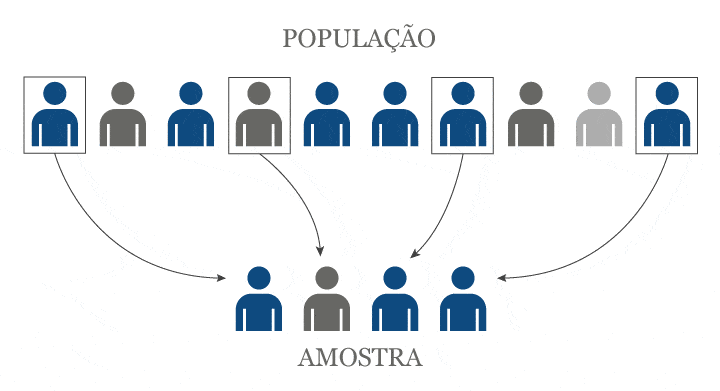
The sample corresponds to the group of people selected to participate in a survey with the objective of representing a larger population. Instead of interviewing all individuals in a given public, researchers choose only a part of it. This way, they can analyze trends and behaviors more quickly and viably. However, the way this selection occurs directly influences the quality and credibility of the results.
What is sampling in a survey
Sampling is the process of selecting a portion of the population to participate in a study. Since it is often impossible or unfeasible to interview all people in a public, researchers use this method to collect data more efficiently.
Furthermore, when the sample is well-planned, the results obtained allow for understanding trends, identifying behaviors, and making projections about the larger group. Therefore, the quality of the sample directly influences the quality of the survey's conclusions.
Read also: Unveiling Sampling: The Key to Understanding Large Datasets
Main types of samples
There are different sampling methods, and each of them serves specific objectives within a study. Among the main ones, the following stand out:
Probabilistic sample
In this type of sample, all individuals in the population have a known chance of being selected. As a result, the data tends to be more representative and reliable.
Simple random sample
Participants are chosen completely randomly. This way, all individuals have the same probability of participating in the survey.
Stratified sample
In this method, researchers divide the population into groups with similar characteristics, such as age, gender, or region. Then, they select participants from each group to ensure greater representativeness.
Convenience sample
Researchers choose participants who are most easily accessible. Although this method is quick and practical, it can reduce the representativeness of the survey.
Quota sample
In this case, researchers pre-define the proportion of certain participant profiles, such as age group or gender. Thus, they seek to balance the composition of the sample.
Read also: Brand research sample: types and best practices
How the type of sample influences the results
The type of sample directly influences the conclusions of a survey because it determines which profiles of people will participate in the study. When the sample accurately represents the population, the results more precisely reflect the opinions and behaviors of the analyzed public.
On the other hand, when certain groups participate more than others, the survey may present sampling bias. In this scenario, the results no longer reflect the reality of the population and instead represent only the perspective of a specific group.
Read also: Types of samples: what they are and how to choose the best option
Practical example of the impact of the sample
Imagine a company that wants to understand the behavior of delivery app consumers. If researchers conduct the survey only with young university students, the results will likely show high app usage and a preference for fast meals.
However, this scenario may be different among families, older professionals, or people who cook more frequently. In this case, the company may interpret the market incompletely and make decisions based on limited data.
Read also: How to combine different types of samples in the same study
The importance of a representative sample
A representative sample allows researchers to generalize the results to the studied population. In other words, the conclusions obtained in the study reflect real trends of the analyzed public.
Furthermore, a well-defined sample increases the credibility of the research and strengthens strategic decision-making. For this reason, companies and institutions dedicate great attention to sampling planning.
Read also: Most used sample types in market research
Common errors in defining the type of sample
During the planning of a survey, some errors can compromise the quality of the results. Among the most common are:
-
selecting participants only for ease of access
-
not considering the diversity of the population
-
using a sample that is too small to represent the public
-
ignoring important criteria, such as age, income, or location.
When these problems occur, the results may show distortions and reduce the reliability of the research.
Read also: Types of samples: common errors that can compromise your research
How to define the type of sample in market research
The type of sample can completely change the result of a survey because it defines who participates in the study and which perspectives will be considered in the collected data. Therefore, choosing the appropriate sampling method is a fundamental step to ensure more reliable results.
Furthermore, when researchers correctly plan the sample, they can represent different profiles of the population and generate more accurate information about public behavior. In this context, data collection platforms, such as PainelTap, contribute to making this process more efficient, as they allow access to participants with different characteristics and profiles, facilitating the construction of samples that are more aligned with the research objectives.
Read also: Maximizing Accuracy: Exploring Sample Types for Research