Technological Innovations in Panels and Surveys
3 min read

Technological advancement is profoundly transforming how companies conduct market research. Previously heavily based on extensive forms and time-consuming interviews, these investigations are now evolving, driven by technological innovations, towards smarter, more agile approaches connected to digital reality. Among the main drivers of this change are artificial intelligence (AI), passive data collection, and the integration of multiple information sources.
Beyond merely monitoring consumer behavior, modern research seeks to anticipate it — based on patterns, contexts, and decisions that users themselves often cannot consciously describe. In this sense, technological innovations not only optimize collection methods but also expand the possibilities for data analysis and interpretation.
Consequently, panels gain new functions and are transformed. From simple collection tools, they now operate as dynamic strategic intelligence systems, capable of delivering real-time, deeper, and more actionable insights. Thus, technological innovations not only keep pace with the evolution of research but also drive it to a new level of efficiency and relevance.
Continue reading at: Examples of target audience for research with online respondent panels
Passive data: the observation that reveals the unspoken
Passive data collection is gaining ground because it captures real behaviors, not just declared intentions. Meanwhile, traditional research still depends on what the participant is willing to report.
On the other hand, passive data shows what they do in their daily lives. This includes, for example, browsing history, app usage, geolocation, purchases, interactions with virtual assistants, screen time, and wearable data.
As a result, it is possible to build more complete and authentic profiles, with less cognitive bias. Furthermore, passive collection is less invasive and requires less effort from participants. Thus, engagement increases and dropout rates decrease, a common challenge in online research.
Hybrid panels: the new generation of insights
The future of research lies in hybrid panels, which integrate active data (conscious responses), passive data (observed behaviors), and artificial intelligence to process and interpret all this information in an integrated manner.
This combination allows for a 360-degree view of the consumer, encompassing both what they think and what they actually do. For example, while active research may indicate the intention to purchase a product, passive data may show that the consumer visited a competitor's website multiple times or interacted more with another type of offer.
Furthermore, hybrid panels offer more speed. With the automation of steps such as sampling, analysis, and data visualization, research cycles become shorter, which is essential in contexts where timing can define the success of a campaign or the launch of a product.
Ethical challenges and responsible data use
With the increase in passive data collection and the intensive use of technology, companies' responsibility regarding user privacy also grows. It is essential to ensure informed consent, transparency in data use, and the security of stored information.
Good practices include clear data protection policies, anonymization of sensitive information, and compliance with legislation such as LGPD (General Data Protection Law) and the European GDPR. Participant trust remains an essential pillar for the success of any panel.
Learn more here: What is data collection for? Understand its importance
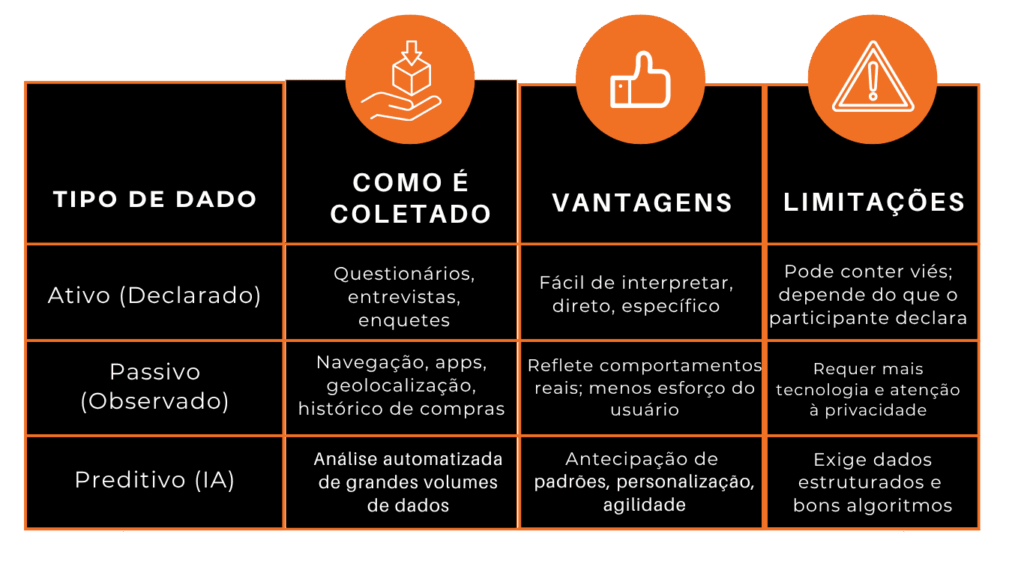
Table: Comparison between Data Collection Models in Research
Need research with a sample from an online panel? Count on Painel TAP.
Behind Painel TAP is a team passionate about data and insight generation, who finds in each project a challenge to seek the best and fastest solution for the most diverse types of needs and demands in online research and market investigation.