How does a respondent panel work? We explain it here!
10 min read

If there's one thing that can make the job of a researcher difficult, it's finding the right people to answer the questionnaire. Therefore, understanding how a respondent panel works can make all the difference for those who need to reach a specific audience and obtain relevant answers for their research. Here we will explain everything about this service.
What is a respondent panel?
A respondent panel is a database of people previously registered and available to participate in market, opinion, and behavior research.
These participants provide information about their profile, such as age, location, profession, consumption habits, and other relevant criteria, allowing them to be selected according to the audience the research needs to reach.
In practice, the panel acts as a bridge between the researcher and the people who can answer it. Instead of starting the search for participants from scratch, the researcher can use an already structured database and find respondents with specific characteristics.
What types of respondent panels exist?
There are different types of respondent panels, and the choice depends on the research objective, the profile to be reached, and the frequency with which participants will be consulted. The main ones are:
General panel
Gathers participants with different demographic and behavioral profiles. It is suitable for research that needs to represent a broader audience, such as opinion studies, consumption habits, and brand perception.
Segmented panel
It is formed by people who meet specific characteristics. It can be segmented by age, region, profession, income, interests, consumption habits, or other criteria relevant to the study.
Specialized panel
Concentrates participants who have specific knowledge, experiences, or characteristics related to the research topic. It is common in studies that need to hear from professionals in certain areas or more restricted audiences.
Continuous panel
In this format, the same participants can be invited to answer different surveys over time. It is especially useful for monitoring changes in opinion, behavior, or perception of a given audience.
What respondent segmentations does a panel offer?
The available criteria vary according to the platform, but generally include:
Demographic data
Allow selecting participants based on characteristics such as age, gender, location, marital status, and education level. These are basic criteria for defining the sample profile.
Location
It is possible to segment respondents by country, state, city, or region, depending on the level of detail offered by the panel. This option is useful for research with a specific geographic scope.
Income and socioeconomic profile
Segmentation by income bracket, socioeconomic class, or purchasing power helps direct studies to consumers with different financial conditions.
Profession and area of activity
For B2B research or studies that require specific knowledge, the panel may allow filters by profession, position, sector, area of activity, or type of company.
Consumption habits
It is also possible to find participants according to their purchasing and consumption habits, such as purchase frequency, categories consumed, brands used, or preferred channels.
Behavior and interests
Some panels allow segmenting people by interests, preferences, lifestyle, and behaviors. This type of filter helps reach more specific audiences.
Product or service usage
When the research needs to hear from customers or users of a certain category, criteria related to the use of products, services, applications, platforms, or brands can be used.
Specific research criteria
Depending on the panel's structure, there may also be customized filters to meet the needs of a study. Thus, the researcher can combine different criteria to build a sample more aligned with the audience they wish to investigate.
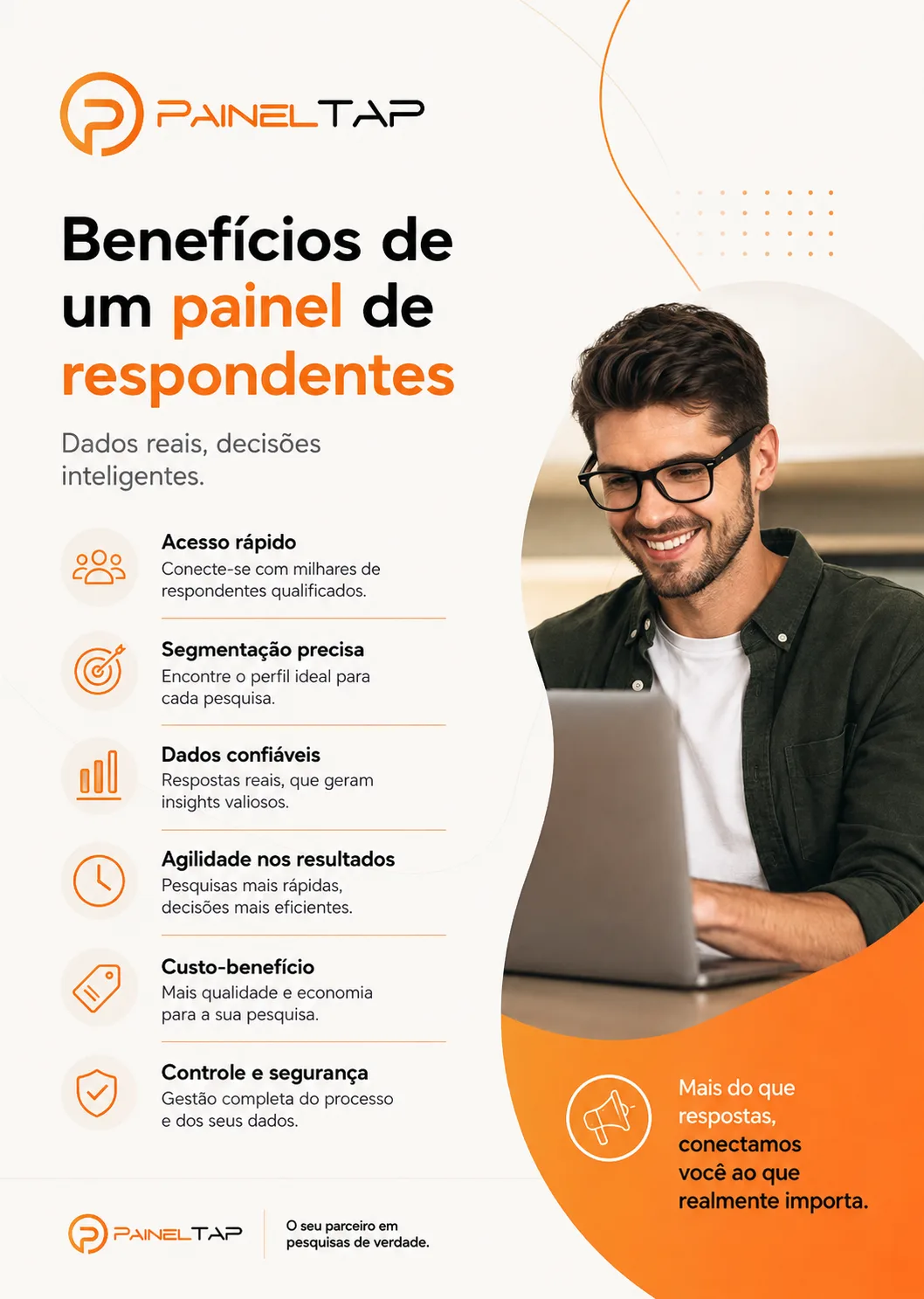
What are the advantages of using a respondent panel?
In addition to facilitating access to the research audience, this resource brings important gains for those who need to conduct studies with more agility and consistency. See some advantages:
Access to specific audiences
One of the main advantages is being able to reach people who meet the criteria defined for the research. This allows directing the questionnaire to specific profiles, such as age group, region, profession, consumption habits, or behavioral characteristics.
More agility in collecting responses
With participants already registered and available for research, the recruitment stage tends to be faster. This is especially useful when there is a short deadline to complete the survey and analyze the results.
Greater control over the sample profile
The researcher can establish criteria before starting data collection, monitoring whether the participating audience is in line with the planned profile. This control helps keep the sample composition closer to the study's objectives.
Reduced recruitment effort
Finding participants on your own can require dissemination, contacts, and different attraction strategies. The panel reduces part of this work by providing a structured database of potential respondents.
Possibility of conducting recurring research
For companies that conduct research frequently, the panel can facilitate new surveys over time. This allows conducting different studies without having to start the audience recruitment process for each new survey.
Better research planning
By knowing which profiles can be reached, the researcher can better structure the collection from the beginning. This facilitates the definition of the sample, participation criteria, and study timeline.
What types of research can be done using a panel?
From quick opinion polls to more structured market projects, a panel can be an ally. Some examples of research you can do are:
Market research
It can be used to conduct market research and understand consumer behavior, identify trends, evaluate categories, and discover new market opportunities.
Satisfaction research
Companies can use panels to measure customer perception regarding products, services, customer service, or specific experiences.
Habits and behavior research
Allows investigating how people make decisions, what products they use, how often they buy certain categories, and what factors influence their choices.
Opinion research
It is an alternative to understand people's perception about different subjects, ideas, situations, or events, always considering the defined audience for the study.
Concept testing
Before launching a product, service, or campaign, the company can present an idea to the public and evaluate its acceptance, interest, and purchase intention.
Product testing
Allows hearing from consumers about new or existing products, analyzing aspects such as user experience, packaging, perception, preference, and intention to continue using or buying.
Brand research
A panel can also support branding studies, helping to understand recognition, recall, preference, and perception of a brand among a given audience.
Customer Experience research
Companies can hear from customers about different stages of the journey, evaluating the experience at touchpoints and identifying opportunities for improvement.
B2B research
When the panel includes professionals and decision-makers from companies, it can also be used for research on corporate markets, suppliers, tools, services, and purchasing processes.
Is a respondent panel secure?
The service can be secure, provided it is managed by a company that adopts good data protection practices and participant management. This involves measures such as access control to information, proper data storage, transparency about its use, and compliance with applicable privacy rules, such as the LGPD in Brazil.
It is also important to observe how participants are recruited, what information is collected, and how the data is used in the research. A reliable panel should clearly state its privacy policies and offer mechanisms for participants to control their data.
For the researcher, security is also related to the quality of the database: validation and control processes help reduce duplicate profiles, inconsistent responses, and other problems that can compromise research results.
What security requirements must a panel have?
When choosing a respondent panel, it is not enough to evaluate the number of registered people. It is also important to understand how the platform protects data, controls access, and ensures the quality of responses. Some requirements deserve attention:
LGPD compliance
The panel must follow the rules of the General Data Protection Law (LGPD), clearly stating what data is collected, why it is used, and how it is stored. It must also offer mechanisms for data subjects to exercise their rights.
Transparent privacy policy
Information about data collection, processing, storage, and sharing must be presented clearly. Participants need to know how their information will be used before participating in surveys.
Protection of personal data
It is important that the platform adopts technical and organizational measures to protect personal information against unauthorized access, leaks, alterations, or losses.
Access control
Access to participant information must be restricted to authorized persons. Different levels of permission help prevent users from accessing data that is not necessary for their functions.
Participant validation
A reliable panel needs to have mechanisms to verify the identity or authenticity of participants and reduce the presence of duplicate, fake, or inappropriate profiles.
Response quality control
In addition to protecting data, the platform must have mechanisms to identify suspicious behavior, inconsistent responses, very fast completions, or other situations that may compromise research quality.
Security in storage and transmission
Data must be protected both during transmission and storage. Features such as encryption and secure infrastructure help reduce the risks of improper access to information.
Consent management
When applicable, the panel must properly record and manage participant consent, allowing monitoring of permissions related to the use of their data.

So, how does a respondent panel work?
The operation of a respondent panel involves several stages, from participant registration to participant selection and response collection. Although the process may vary between platforms, it generally follows a similar logic.
Participant registration
The first step is to gather people interested in participating in surveys. During registration, information is collected to help identify each participant's profile, such as age, location, profession, habits, and interests.
Profile building and organization
After registration, participants' information is organized into a database. This data allows identifying which people meet the necessary criteria for each type of research.
Defining the research audience
Before starting the collection, the researcher defines who needs to answer the questionnaire. They can establish criteria such as age group, region, profession, income, consumption habits, or use of a specific product or service.
Selecting respondents
With the audience defined, the panel identifies participants who match the research criteria. Depending on the platform, the selection can consider different filters and combinations of characteristics.
Invitation to participate
Selected participants receive an invitation to answer the survey. Communication can occur through different channels, such as email, SMS, app, or other means provided by the panel.
Questionnaire application
Upon accepting the invitation, the respondent accesses the questionnaire and provides their answers. In some studies, initial screening questions may exist to confirm if the person truly meets the required profile.
Validation of responses
After collection, quality control mechanisms may be applied to identify incomplete, inconsistent, duplicate, or out-of-criteria responses. This step helps preserve data quality.
Delivery of results
With data collection completed and responses validated, the data becomes available for analysis. The delivery method can vary, including reports, tables, dashboards, or files for later analysis.
What is the price of a respondent panel?
The price of a respondent panel varies according to several factors, so there is no single value for this type of service.
The cost can mainly depend on the number of responses needed, the profile of the participants, the level of segmentation required, and the complexity of the research.
Studies that need to reach very specific or hard-to-find audiences, for example, may cost more than surveys aimed at a broad audience.
It is also important to consider the contracting model: some platforms charge per response, while others work with packages, projects, or plans.
Therefore, before comparing prices, it is worth evaluating not only the cost but also the quality and suitability of the respondents for the research objectives.
Which respondent panel to use?
If you are looking for a respondent panel to conduct research more quickly and reach audiences according to different segmentation criteria, PainelTAP can be an alternative.
The service allows finding participants for different types of research, helping companies and researchers direct their questionnaires to profiles more aligned with the study's objectives.
Thus, instead of investing time recruiting respondents from scratch, you can count on a prepared base to support data collection and transform responses into useful information for decision-making.
Want to know more? Schedule a demonstration!