Analyzing research with AI: what is changing in researchers' routines
12 min read

If finding insights used to take hours or even days, today analyzing research with AI is already part of many researchers' routines. Technology is completely changing the way relevant insights are obtained. But, in practice, how are researchers using this in their daily lives? That's what we're going to show here.
How does artificial intelligence help in research analysis?
AI has been helping researchers automate operational tasks, find patterns more quickly, and transform large volumes of data into relevant insights. And this applies to both quantitative and qualitative research.
Below, we show how this technology is being applied in research analysis and what impacts it already brings to the sector.
How does AI help in quantitative research?
Quantitative research deals with large volumes of structured data, such as spreadsheets, graphs, and statistical information databases. In this scenario, AI has been accelerating processes that previously took hours or even days. See how:
Processing large volumes of data
Artificial intelligence algorithms can clean, organize, and cross-reference thousands of pieces of information in a few seconds. This reduces the time spent on operational tasks and allows researchers to focus more on interpreting the results.
Furthermore, AI helps identify inconsistencies, hidden patterns, and correlations that might go unnoticed in manual analyses.
Predictive modeling and trend identification
Another important use is the ability to predict future behaviors based on historical data.
With the support of Machine Learning, researchers can identify consumption trends, predict market fluctuations, analyze customer behavior, and even anticipate strategic scenarios for companies.
This makes the analysis more dynamic and decision-oriented.
Automation of statistical analyses
Tools with AI can also automatically perform statistical tests, assisting in more complex analyses quickly and accurately.
Today, many systems can generate correlations, cross-tabulations, and comparative analyses similar to those performed in traditional research and statistical software.
How does AI help in qualitative research?
In qualitative research, artificial intelligence primarily helps in the analysis of textual content, interviews, and open-ended responses.
Automatic transcription of interviews
One of the most used applications is the automatic transcription of audio and video. What once required hours of manual work can now be done in minutes, allowing researchers to accelerate important stages of the project.
Organization and categorization of responses
In addition to transcribing, AI can also identify recurring themes, group similar opinions, and categorize large volumes of open-ended responses automatically.
This greatly facilitates the reading of qualitative data in surveys with hundreds, or thousands, of participants.
Sentiment analysis and interpretation of opinions
With Natural Language Processing (NLP) technologies, artificial intelligence can interpret emotions and patterns present in comments, reviews, and open-ended responses.
This allows identifying whether a certain topic generates positive, negative, or neutral perceptions, in addition to revealing important emotional trends for brands and companies.
How does AI help in literature review and information synthesis?
Another great advantage of artificial intelligence is its speed in organizing academic information and extensive documents.
Screening of articles and content
AI can analyze hundreds of articles, reports, and documents in a short time, helping researchers find relevant materials more quickly.
This optimizes initial stages of academic research, dissertations, and market studies.
Summarization and synthesis of complex content
Smart tools also help summarize long documents and highlight methodologies, main concepts, and important conclusions.
This support accelerates the understanding of the material and makes the review process much more efficient.
Does AI replace the researcher?
No. Despite advances, it is a strategic support tool. It accelerates processes, automates repetitive tasks, and expands analytical capacity, but critical interpretation still depends on human experience.
The researcher remains essential for validating contexts, understanding behaviors, and transforming data into truly relevant insights.
What are the benefits of analyzing research with AI?
Among the main benefits of analyzing research with AI are:
Greater speed in data analysis
One of the biggest gains is agility. Processes that previously took hours can be completed in a few minutes.
AI can organize information, cross-reference data, identify patterns, and generate analyses quickly, reducing the operational time of research teams.
Ability to analyze large volumes of information
With the growing volume of available data, analyzing everything manually becomes increasingly difficult. Artificial intelligence can process thousands of responses, comments, interviews, and statistical data simultaneously, making projects more scalable and efficient.
Easier identification of patterns and insights
AI helps find trends, behaviors, and relationships between data that would often go unnoticed in traditional analyses. This allows for faster insight generation and supports strategic decisions with greater depth.
Automation of repetitive tasks
Activities such as data cleaning, categorization of open-ended responses, transcription of interviews, and report generation can be automated with AI support.
This allows researchers to dedicate more time to interpretation and strategy building.
More efficiency in qualitative research
In qualitative research, artificial intelligence helps organize open-ended responses, analyze sentiments, and identify recurring themes automatically. In practice, this reduces manual effort and accelerates important stages of analysis.
Support for decision-making
With faster and more organized analyses, companies can transform data into decisions more quickly. AI helps teams access relevant information in less time, increasing the business's responsiveness.
Reduction of operational errors
By automating processes, artificial intelligence also reduces human errors in repetitive tasks, such as data organization and statistical cross-tabulations. The result is more consistent and reliable analyses.
More time for strategic analyses
Perhaps this is one of the biggest benefits: while AI handles the operational, the researcher can focus on what truly matters: interpreting data, generating insights, and building smarter strategies.
What research stages can be automated with AI?
It can already automate various stages of the research process, from initial data organization to the generation of analyses and reports. This helps teams reduce operational tasks, accelerate deliveries, and focus more on the strategic interpretation of results. Take a look:
Data collection and organization
One of the first stages that can be automated is the organization of collected information.
AI can:
- Automatically structure databases
- Identify duplicate responses
- Detect inconsistencies
- Standardize information
- Clean incomplete or incorrect data
This accelerates data preparation for analysis and reduces operational errors.
Transcription of interviews and audios
In qualitative research, artificial intelligence is already widely used to automatically convert audios and videos into text.
What once required hours of manual transcription can now be done in a few minutes, speeding up important stages of qualitative analysis.
Categorization of open-ended responses
Tools with AI can identify patterns in open-ended responses and group similar comments by themes, topics, or sentiments.
This facilitates the reading of large volumes of qualitative information and helps researchers find trends more quickly.
Statistical analyses and data cross-tabulation
In quantitative research, AI can also automate statistical analyses and information cross-tabulations.
Today, many platforms can:
- Identify correlations
- Detect behavioral patterns
- Create automatic segmentations
- Generate comparisons
- Find trends in data
All of this in a few seconds.
Sentiment analysis and textual interpretation
With the support of Natural Language Processing (NLP), AI can interpret emotions and intentions present in texts.
It can classify responses as positive, negative, or neutral, as well as identify recurring perceptions in comments, reviews, and social media.
Report and summary generation
Another stage that is being automated is report creation.
Artificial intelligence can summarize information, highlight key results, and structure initial data presentations, accelerating the research delivery process.
Literature review and reference search
In academic research and more in-depth studies, AI also helps in screening articles, identifying relevant content, and summarizing extensive materials.
Is analyzing research with AI safe for sensitive data?
The security of using artificial intelligence for research analysis depends directly on the platform used, the privacy policies adopted, and how data is handled during the process.
Not all platforms use data in the same way
Some tools may use information sent by users for training artificial intelligence models, while others offer private and more secure environments for companies and researchers.
Therefore, it is important to check points such as:
- Platform's privacy policy
- Data storage and sharing
- Access control to information
- Compliance with data protection laws, such as LGPD
- Possibility of anonymizing responses
These factors make all the difference, especially in research involving personal, strategic, or sensitive data.
Human care remains essential
Even with advanced technologies, the responsibility for the secure use of information remains with companies and researchers.
Good practices such as anonymizing data, limiting access, reviewing permissions, and avoiding unnecessary information sharing help reduce risks during analysis.
How to combine human analysis and artificial intelligence in research?
The best approach is not to replace researchers with technology, but to use AI as a support tool for analytical work.
AI accelerates operational processes
Artificial intelligence is extremely efficient in repetitive and operational tasks.
It can:
- Organize large volumes of data
- Automatically identify patterns
- Transcribe interviews
- Categorize open-ended responses
- Generate statistical analyses
- Summarize information quickly
This reduces the time spent on manual activities and increases the productivity of research teams.
The researcher interprets data with context
Despite AI's speed, strategic interpretation still depends on human experience. The researcher can understand cultural nuances, social contexts, behaviors, and business objectives that often do not appear in the data alone.
It is this critical eye that transforms numbers and responses into truly relevant insights.
The combination improves analysis quality
When AI and human analysis work together, the process becomes more balanced. Technology helps gain scale and speed, while researchers ensure depth, critical thinking, and validation of information.
This makes it possible to reduce errors, improve the reading of results, and increase confidence in decisions made based on the research.
AI supports, but does not replace strategy
Even with increasing advancements, artificial intelligence still depends on human direction.
Defining hypotheses, interpreting results, understanding behaviors, and connecting insights to the market context remain the responsibilities of researchers.
Therefore, the future of research tends to be increasingly collaborative: technology handling automation and professionals focused on strategy and data interpretation.
The balance between technology and human insight is the differentiator
Companies and teams that can combine technological efficiency with critical human analysis tend to generate faster, smarter, and more strategic research.
More than automating processes, the goal of AI in research is to expand researchers' ability to find better answers and make decisions with greater confidence.
What precautions are necessary when analyzing research with AI?
Despite all the benefits, it is important to know how to use it strategically and safely.
Validate the quality of the data used
Artificial intelligence relies entirely on the information it receives. If the data is incomplete, disorganized, or incorrect, the analysis may also generate mistaken interpretations. Before starting any AI processing, it is essential to review and correctly structure the databases.
Clean and well-organized data increase the accuracy of results.
Do not rely solely on automatic interpretation
Although AI can quickly identify patterns and trends, it can still interpret information out of context.
Cultural expressions, irony, complex emotions, and human behaviors are not always correctly understood by automated tools.
Therefore, human analysis remains essential to validate results and ensure deeper interpretations.
Choose reliable platforms
Not all artificial intelligence tools offer the same level of security and analytical quality. Before using any platform, it is important to evaluate:
- Privacy policy
- Data protection and storage
- Use of information for AI training
- Compliance with LGPD
- Access control and permissions
This care is even more important in research involving sensitive or strategic data.
Avoid biases in analysis
AI learns from existing data patterns and models. This means that automated analyses can also reproduce biases present in the information used.
Therefore, researchers need to critically monitor the results, checking for possible distortions, generalizations, or biased interpretations.
Ensure anonymization and information security
Research often deals with personal data, opinions, and confidential information.
Whenever possible, it is ideal to anonymize responses and limit access to the data used in analyses. This helps protect participants and reduces privacy-related risks.
Which platforms are used to analyze research with AI?
Today we have several platforms that have started offering features for quantitative and qualitative research analysis. This allows researchers to automate tasks, interpret data more quickly, and generate insights with the support of intelligent tools.
The choice of the ideal platform depends on the type of research, the volume of data, and the objectives of the analysis.
ChatGPT and generative AI assistants
Generative AI tools are being used to support the analysis of open-ended responses, interview summaries, information categorization, and the creation of data syntheses.
These platforms help researchers accelerate operational steps and organize information more efficiently.
They are also used to support brainstorms, generate hypotheses, and structure initial reports.
Power BI with AI features
Power BI already incorporates artificial intelligence functionalities for data analysis, pattern identification, and automatic insight generation.
The platform is widely used in quantitative research because it facilitates strategic visualizations, dashboards, and cross-referencing of information in large volumes of data.
It is widely used in customer experience, market, and behavior research.
Specialized statistical analysis tools
Traditional software like SPSS, JAMOVI, and R are also incorporating automation and artificial intelligence features to accelerate quantitative analyses and predictive modeling.
These platforms continue to be widely used in academic and corporate research.
Already know AnáliseTAP?
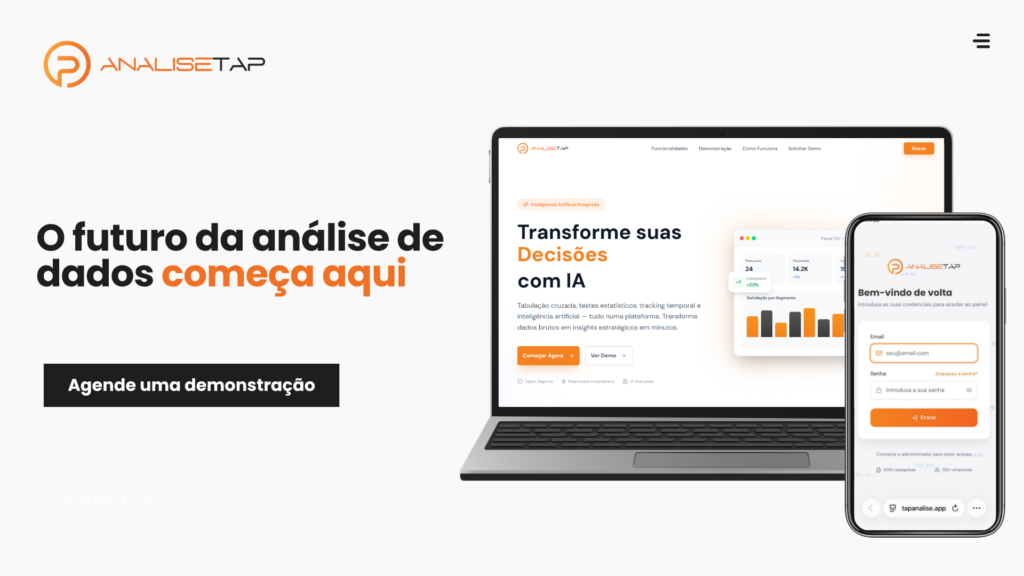
AnáliseTAP combines technology, artificial intelligence, and strategic analysis to make research faster, more organized, and more efficient.
The goal is not to replace human insight, but to enhance researchers' analytical capabilities through intelligent automation and advanced data interpretation tools.
With AI support, AnáliseTAP helps companies and researchers transform large volumes of information into relevant insights for decision-making. See how it works:
Automation of operational processes
One of the main applications of artificial intelligence in AnáliseTAP is the automation of repetitive and operational tasks. Technology helps to:
- Organize databases
- Categorize open-ended responses
- Structure information automatically
- Identify patterns and trends
- Expedite quantitative and qualitative analyses
More agility in research analysis
With AI support, AnáliseTAP can accelerate important steps in the analytical process. The use of intelligent technologies allows processing large volumes of data more quickly, facilitating the generation of insights and making deliveries more efficient.
Support in qualitative analysis
The platform also uses artificial intelligence to support qualitative analyses, especially in projects with open-ended responses, interviews, and large volumes of text.
The tools help identify recurring themes, organize opinions, and find behavioral patterns more quickly and structured.
Data security and care
Responsible use of technology is also part of the process. AnáliseTAP follows good practices related to the organization, protection, and treatment of information used in analyses, always considering the importance of data security in research projects.
The future of research analysis has already begun
Artificial intelligence is already part of the transformation of the research market, and AnáliseTAP follows this evolution to offer increasingly fast, intelligent, and data-driven analyses.
The proposal is to help researchers and companies make decisions with more agility, depth, and efficiency. Want to know more? Contact our team to schedule a demonstration!